

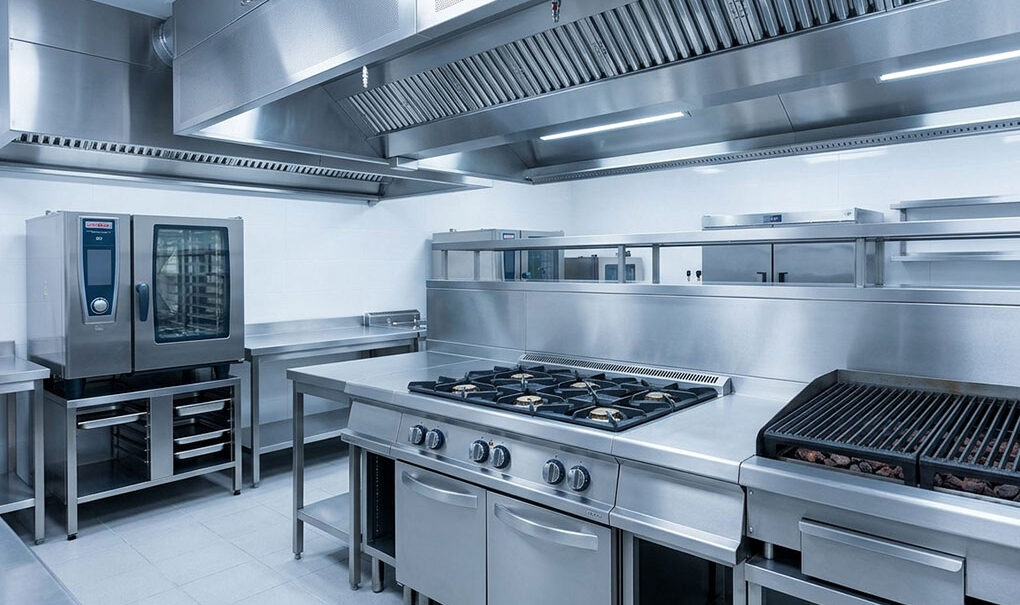
19 Essential Commercial Cooking Products for Australian Kitchens
-
- 19 essential products: Every commercial kitchen needs a core cooking line — stove, oven, grill or fryer — and a set of specialist products determined by the menu. This guide covers all 19, with a product recommendation and specification guidance for each.
- Start with your menu: The right cooking equipment is determined by what you cook. Specify to your menu and peak cover count first — every product on the cooking line generates heat, consumes gas or power, and requires extraction capacity.
- The combi oven is the highest-value single purchase: For most full-service restaurant kitchens, a combi oven from Rational, Unox or Blue Seal replaces multiple single-purpose appliances and delivers consistent results across roasting, steaming, baking and holding.
- Gas dominates Australian commercial kitchens: For cooking line equipment, gas offers faster heat recovery, lower operating cost and preferred chef control. Induction is the right choice for specific precision applications.
- Ventilation is a fixed constraint: Every cooking product must sit under a compliant extraction canopy meeting AS 1668.2. Size your canopy to the full heat load of your line before purchasing individual products.
Choosing the right commercial cooking equipment for an Australian kitchen is one of the most significant investment decisions a hospitality operator makes. The right commercial cooking equipment determines your production capacity from the first night of service. Specify to your menu, your cover count and your kitchen layout. The wrong products create bottlenecks, wasted capital and daily frustration for your kitchen team.
This guide covers all 19 essential commercial cooking equipment products available through Snowmaster. Each section leads with a clear recommendation and explains who needs it. Use the jump menu below to navigate directly to the product you need.
All 19 Commercial Cooking Equipment Products
Combi Ovens · Commercial Stoves · Commercial Cooktops · Convection Ovens · Char Grills · Hot Plates · Deep Fryers · Pizza Ovens · High Speed Ovens · Bratt Pans · Salamander Grills · Wok Burners · Teppanyaki Plates · Dim Sum Steamers · Pasta & Noodle Cookers · Stock Pot Burners · Target Top Ovens · Chicken Rotisseries · Sous Vide
1. Combi Ovens
Who needs it: Every full-service restaurant, hotel kitchen, aged care facility and institutional kitchen. The combi oven is the single most important cooking product in a professional kitchen.
A combi oven combines convection heat and steam in a single unit — roasting, steaming, baking, poaching, reheating and holding at precise, programmable settings. It replaces a conventional oven, a steamer and often a hot holding cabinet, and produces consistent results regardless of who is operating it.
Leading brands in Australian commercial kitchens include Rational (the global benchmark), Unox (strong mid-tier performer) and Blue Seal (well-established in Australia). Specify a 6-tray model for smaller operations; 10-tray or 20-tray for high-volume kitchens. Most serious operators specify two units — a single combi oven is a single point of failure during service. Look for an automatic cleaning program, which saves labour and extends equipment life.
2. Commercial Stoves
Who needs it: Any kitchen producing sauces, soups, braised dishes, sautéed items or à la minute cooking. The commercial stove is the foundation of most cooking lines.
A commercial stove provides multiple open burners for direct heat cooking, with an oven cavity below for roasting and finishing. Gas models dominate Australian commercial kitchens — faster heat response, lower operating cost and preferred by most chefs. Burner output is measured in MJ/hr. A standard commercial burner delivers 5–7 MJ/hr; a heavy-duty burner 8–12 MJ/hr. Higher output burners recover temperature faster between batches during a busy service.
Strong brands at Snowmaster include Blue Seal, Waldorf and Goldstein at the premium end, and Luus and Cobra at mid-range. Specify a minimum 6-burner model for any kitchen serving 80+ covers. Read our commercial cooktop buying guide for full specification guidance.
3. Commercial Cooktops
Who needs it: Kitchens where a combi oven handles all oven work and the cooking line needs maximum burner capacity without the stove footprint. Also the right choice where induction is preferred for safety or precision reasons.
Commercial cooktops are bench-mounted burner units without an oven cavity below — the same cooking power as a stove in a smaller, more flexible footprint. Available in gas, electric and induction configurations. Gas suits most Australian applications; induction from brands like Waldorf and Luus suits pastry kitchens, chocolate work and any application requiring precise, stable temperature control without an open flame. Read our commercial cooktop buying guide for a full gas vs electric vs induction comparison.
4. Commercial Convection Ovens
Who needs it: Bakeries, pastry kitchens and high-volume operations needing dedicated baking throughput separate from the main combi oven.
Commercial convection ovens use fan-forced heat to produce even baking across all tray positions simultaneously — faster and more consistent than static ovens for pastries, cakes, biscuits and bread rolls. For a full-service restaurant, the combi oven’s convection mode usually suffices. A dedicated convection oven becomes the right call when baking volume is high enough to compete with the combi oven’s use for other cooking methods during service. Brands like Unox, Blue Seal and Waldorf offer well-supported convection oven ranges in Australia.
5. Commercial Char Grills and Overhead Grills
Who needs it: Any kitchen with grilled proteins on the menu — steakhouses, pub bistros, modern Australian restaurants and any venue where char marks and smoky flavour are part of the product.
A commercial char grill uses gas-heated radiants (ceramic or lava rock) to generate intense radiant heat from below, producing char marks and the smoky, caramelised flavour that cannot be replicated on a flat top or in an oven. Specify at least 600mm of cooking surface for a full-service restaurant; 900mm or wider for a steakhouse or high-volume grill operation. Blue Seal, Waldorf and Goldstein are the benchmark brands in Australian kitchens. Char grills generate significant grease and smoke — canopy extraction and a grease management schedule are essential. Read our commercial char grill buying guide for full specification guidance.
6. Commercial Hot Plates and Griddles
Who needs it: Breakfast kitchens, burger operations, pub bistros and any kitchen cooking eggs, bacon, burgers or pancakes at volume on a flat surface.
A commercial hot plate provides a large, flat cooking surface for direct contact heat — essential for items that need even surface contact rather than grill marks. Gas hot plates from Blue Seal, Waldorf and Goldstein heat faster and recover temperature more quickly between items; electric models from Roband offer more consistent surface temperature across the full cooking area. Specify size to your peak throughput — a 600mm hot plate suits a small café; a 900mm or 1200mm model suits a hotel breakfast operation.
7. Commercial Deep Fryers
Who needs it: Any kitchen serving chips, crumbed or battered items, fried seafood or any other deep-fried menu item.
A commercial deep fryer from Blue Seal, Waldorf or Goldstein at the premium end, or Luus and Cookrite at mid-range, handles the sustained oil temperature demands of a commercial fry operation. Specify a twin-tank model for kitchens cooking different items simultaneously at different temperatures. Gas fryers recover temperature faster between batches than electric. The most commonly overlooked feature is oil filtration. A built-in filtration system extends oil life significantly, reducing one of the largest ongoing operating costs in any fry-dependent kitchen. Read our commercial deep fryer buying guide for full specification guidance.
8. Commercial Pizza Ovens
Who needs it: Pizzerias, Italian restaurants, casual dining venues with pizza on the menu, and any operation cooking flatbreads or pide at volume.
Commercial pizza ovens deliver the high direct heat required for proper pizza cooking — temperatures a standard convection oven cannot reach. Gas deck pizza ovens from Moretti Forni and Roband use stone or refractory brick decks for the base heat that produces a crisp, evenly cooked base. Conveyor pizza ovens from Lincoln and TurboChef automate the cooking process for high-volume, consistent-output takeaway operations. For Neapolitan-style pizza requiring 400°C+, a high-temperature gas deck oven is the correct specification.
9. Commercial High Speed Ovens
Who needs it: Cafés, QSR operations, kiosks, convenience stores and any venue needing fast, consistent heating of grab-and-go items without a full cooking line.
Commercial high speed ovens combine microwave energy, convection heat and infrared to cook or reheat food 10–15 times faster than a conventional oven. Merrychef and Menumaster are the benchmark brands — widely used in café grab-and-go counters, petrol stations and QSR operations across Australia. Most high speed ovens are ventless, requiring no extraction canopy — they can be positioned on a counter in front-of-house or kiosk locations where a conventional cooking line is not possible. This makes them the go-to product for expanding a food offering without a full kitchen fit-out.
10. Bratt Pans and Tilting Skillets — Commercial Cooking Equipment for High-Volume Kitchens
Who needs it: Hotel kitchens, hospital and aged care kitchens, school canteens, catering operations and any high-volume institutional kitchen producing food in large batches.
A bratt pan (also called a tilting skillet or braising pan) is a large, rectangular flat-bottomed pan with a tilting mechanism for safe pouring and draining of large batches. A single bratt pan from Waldorf or Blue Seal can fry, braise, stew, boil, steam and hold — replacing multiple single-purpose appliances in an institutional kitchen. The tilting mechanism makes batch production safe and efficient: a full pan of soup or stew decants directly into transport containers without manual ladling. Gas models suit most applications; electric models offer more consistent temperature control for delicate sauces and custards.
11. Salamander Grills and Overhead Grills
Who needs it: Full-service restaurants needing a finishing station for browning, glazing, melting and gratin work — almost every serious à la carte kitchen.
A salamander grill provides intense overhead radiant heat for finishing dishes — browning the top of a fish gratin, melting cheese on a steak, caramelising a crème brûlée or glazing a sauce. Unlike a char grill (which heats from below), a salamander heats from above, allowing precise finishing without disturbing the base of the dish. Blue Seal, Waldorf and Goldstein gas salamanders are the standard specification in Australian restaurant kitchens. Most kitchens position the salamander above or adjacent to the main cooking line as a dedicated finishing station.
12. Commercial Wok Burners
Who needs it: Chinese restaurants, Asian fusion kitchens, Southeast Asian restaurants and any operation where wok cooking is central to the menu.
Commercial wok burners deliver extremely high output — typically 150,000–250,000 BTU — specifically engineered for the rapid, high-heat technique that produces wok hei (the smoky, charred flavour of properly executed wok cooking). Standard commercial burners cannot reach the temperatures required. Luus and Cookrite wok burners are widely used in Australian Asian restaurant kitchens. Critical specification note: a wok burner generates more heat load than an entire standard cooking line — your extraction canopy must be rated and sized specifically for wok cooking before purchase.
13. Commercial Teppanyaki Plates
Who needs it: Japanese teppanyaki restaurants, modern Asian venues with theatre cooking, high-volume breakfast operations and burger kitchens needing a very large flat cooking surface.
Commercial teppanyaki plates are large, flat steel cooking surfaces for direct-contact cooking — often in front of guests as part of the dining experience. Counter-mounted models built into the dining room bench are the standard for front-of-house theatre cooking. Waldorf and Blue Seal produce teppanyaki plates well-suited to the Australian market. For back-of-house high-volume applications, a freestanding model provides the same large flat cooking surface without the theatre configuration.
14. Dim Sum Steamers
Who needs it: Yum cha restaurants, Chinese restaurants, Asian bakeries and any kitchen steaming dumplings, buns or rice dishes at high volume.
A dedicated dim sum steamer is specialist commercial cooking equipment that provides continuous, high-capacity steaming specifically configured for bamboo steamer baskets and the rapid turnover of a busy yum cha service — it outperforms a combi oven in steam mode for this specific application in both throughput and operational simplicity. Luus dim sum steamers are the standard specification in Australian Chinese restaurants. Hard water causes mineral scale buildup in steamers — in hard water areas (Brisbane, Adelaide, parts of Sydney), a water filtration system is essential to extend equipment life and reduce maintenance frequency.
15. Pasta and Noodle Cookers
Who needs it: Italian restaurants, ramen bars, Asian noodle restaurants and any kitchen where pasta or noodles are ordered frequently throughout service.
Pasta and noodle cookers are dedicated boiling units with basket inserts that maintain a constant water temperature for rapid, consistent cooking to order. Using a stockpot on a standard burner for pasta at volume is slow and produces inconsistent results — the water temperature drops with each batch and recovery takes time during a busy service. A dedicated pasta cooker from Roband or Luus maintains temperature continuously and speeds up service significantly. Specify multiple basket inserts for kitchens cooking different pasta types simultaneously.
16. Stock Pot Burners
Who needs it: Hotel kitchens, restaurants with a serious stock production program, institutions and catering operations producing soups and broths in large batch quantities. Stock pot burners are essential commercial cooking equipment for any batch-production kitchen.
Stock pot burners are high-output floor-level burners designed for large-format stockpots — typically 40–100 litres — that are too large and heavy to use safely on a standard cooking line. Positioned at floor level, they allow safe loading and unloading of full pots without lifting above cooking line height. Goldstein and Luus stock pot burners are the standard Australian specification. Essential for any kitchen where stocks, broths or large-batch soups are produced regularly.
17. Target Top Ovens and Solid Top Stoves — Specialist Commercial Cooking Equipment
Who needs it: Classical French-style kitchens, fine dining operations and any kitchen requiring sustained, controllable heat for slow-cooked dishes, stocks and sauces without open flame management.
Target top ovens (also called solid tops or French tops) feature a cast iron or steel solid cooking surface with a central high-heat zone and progressively cooler zones toward the edges. Pots and pans slide from the centre heat zone to the cooler periphery for temperature management without removing them from the heat. Blue Seal and Waldorf produce target top models well-suited to fine dining applications. Less common in modern Australian kitchens than open-burner stoves, but the preferred cooking surface in classical European-style kitchens where precise heat management is a priority.
18. Commercial Chicken Rotisseries
Who needs it: Butcher shops, delis, takeaway chicken operations, supermarket hot food counters and any venue cooking whole roast chickens at volume.
A commercial chicken rotisserie is commercial cooking equipment built for self-basting rotating spit cooking — producing consistently moist, evenly browned roast chickens without manual intervention. The rotating mechanism ensures even cooking and natural basting from the bird’s own juices — a quality and consistency level that a standard oven cannot match at volume. Specify capacity by bird count per load — entry-level models hold 6–8 birds; larger commercial models hold 16–24 birds or more. Roband and Goldstein rotisseries are well-established in the Australian market. Gas models are standard; electric models suit locations without gas supply.
19. Sous Vide — Precision Commercial Cooking Equipment
Who needs it: Fine dining restaurants, modern Australian kitchens, hotel restaurants and any operation where protein consistency and batch cooking efficiency are priorities.
Sous vide equipment circulates water at a precise low temperature to cook vacuum-sealed food to an exact internal temperature — producing consistently perfect proteins (steak, duck breast, fish, pork belly) that are impossible to achieve through conventional cooking. Polyscience and Clifton are the benchmark brands in professional kitchens. Sous vide works in conjunction with a commercial vacuum sealer — food is sealed before cooking and can be held in the water bath or rapidly chilled in a blast chiller for later service. The combination of precise temperature control and batch cooking makes sous vide a significant kitchen efficiency and consistency tool.
Common Commercial Cooking Equipment Buying Mistakes
Avoid These
- Buying before finalising the menu — your menu determines your equipment needs; equipment purchased before the menu is set is often wrong for the final product
- Underspecifying the combi oven — a single small combi oven becomes a bottleneck fast; specify to your tray count requirement at peak service, not average load
- Not checking extraction canopy capacity — adding a high-output char grill, wok burner or bratt pan without checking your canopy’s heat load rating risks compliance failure and fire safety issues
- Not confirming gas supply before purchase — confirm your gas meter capacity against the total MJ/hr demand of your full cooking line; an undersized gas meter causes all burners to underperform simultaneously
- Skipping oil filtration on the fryer — oil is one of the largest ongoing consumable costs in a fry-dependent kitchen; built-in filtration pays for the price difference within months through extended oil life
- Single-sourcing without comparing brands — Blue Seal, Waldorf and Goldstein are benchmark brands but Luus, Cobra and Cookrite offer strong value at mid-range; the right brand depends on your budget, volume and service network in your location
Frequently Asked Questions
What are the 19 essential commercial cooking products for a restaurant?
The 19 essential commercial cooking products are: combi oven, commercial stove, commercial cooktop, convection oven, char grill, hot plate, deep fryer, pizza oven, high speed oven, bratt pan, salamander grill, wok burner, teppanyaki plate, dim sum steamer, pasta and noodle cooker, stock pot burner, target top oven, chicken rotisserie and sous vide equipment. Not every kitchen needs all 19 — your menu determines which products are essential for your operation.
What is the most important piece of commercial cooking equipment?
For most full-service restaurant kitchens, the combi oven is the highest-value single cooking product — it replaces multiple appliances, produces consistent results across the widest range of cooking methods, and delivers the best return on investment of any single piece of cooking equipment. Brands like Rational, Unox and Blue Seal are the benchmark in Australian professional kitchens.
Is gas or electric better for commercial cooking equipment in Australia?
Gas dominates Australian commercial kitchens for cooking line equipment — faster heat recovery, lower operating cost and preferred by most chefs for cooking control. Induction is the right choice for specific applications: pastry kitchens requiring precise temperature control, operations near staff with open flame safety concerns, or venues without gas supply. For most new restaurant fit-outs in Australia, specify gas for the primary cooking line.
What brands of commercial cooking equipment does Snowmaster stock?
Snowmaster stocks commercial cooking equipment from Blue Seal, Waldorf, Goldstein, Luus, Cobra, Cookrite, Roband, Rational, Unox, Merrychef, Menumaster, Moretti Forni, Polyscience and more. Browse the full brands page or contact our team for a recommendation matched to your specific menu and kitchen layout.
Can I finance commercial cooking equipment through Snowmaster?
Yes. All Snowmaster cooking equipment is available through SilverChef Rent-Try-Buy, Geared Finance and Shift Payments. SilverChef approvals up to $65,000 take as little as 10 minutes. Read our commercial kitchen equipment finance guide for a full explanation of each option, or apply for SilverChef finance directly.
Snowmaster stocks all 19 essential commercial cooking equipment products from Australia’s leading brands — Blue Seal, Waldorf, Goldstein, Luus, Rational, Unox, Merrychef and more. All commercial cooking equipment is available for delivery Australia-wide with SilverChef finance on every product.
Browse All Cooking Equipment →
Browse by product: Combi Ovens · Stoves · Char Grills · Deep Fryers · Pizza Ovens · High Speed Ovens · Contact Us