

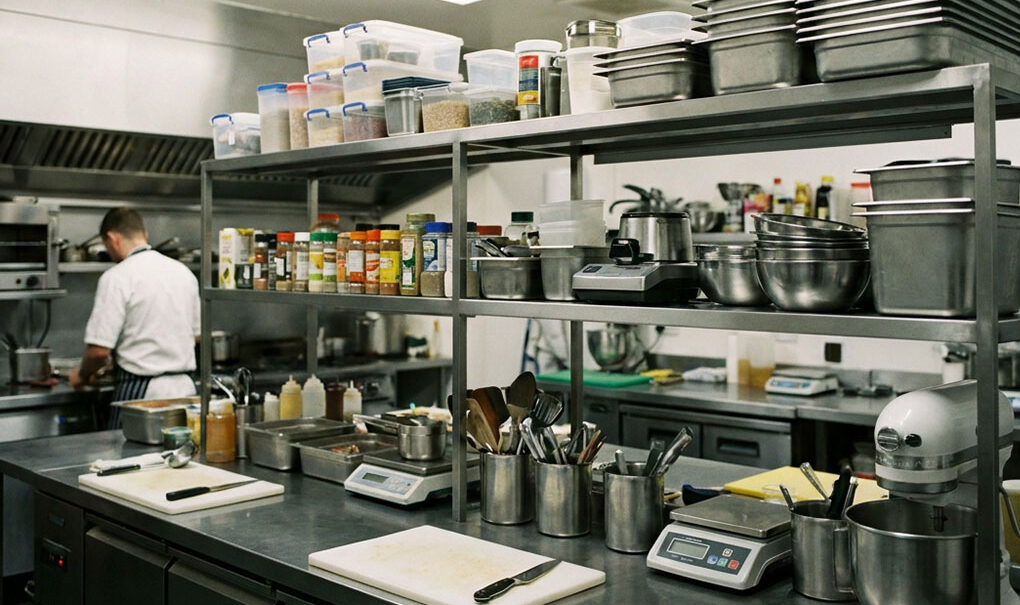
7 Key Factors to Consider Before Buying Stainless Steel Shelves
Quick Summary
- Grade first: 304 stainless for wet, humid or high-wash environments; 430 for dry storage only. Getting this wrong means rust within 12 months and a full replacement.
- Load rating: Calculate your maximum shelf load before purchasing — a shelf collapse in a commercial kitchen is a safety incident, not just an inconvenience.
- Solid vs ventilated: Ventilated shelves for coolrooms and drying areas; solid shelves for small items, dry goods and easy-clean surfaces.
- Wall-mounted vs freestanding: Wall-mounted for fixed prep stations with defined workflows; freestanding for flexibility to reconfigure as the operation changes.
- Ergonomics: Shelves positioned too high or too low create repetitive strain — the most commonly ignored specification in commercial kitchen shelving.
- Clearance: Account for equipment height below the shelf and door swing clearance before fixing anything to a wall.
- Compliance: FSANZ Standard 3.2.3 requires food contact surfaces to be smooth, non-absorbent and easy to clean — 304 stainless steel meets this; many alternatives don’t.
Stainless steel shelves are one of the most fundamental and most frequently underspecified pieces of equipment in a commercial kitchen. The wrong grade corrodes. The wrong load rating collapses. The wrong configuration creates a workflow obstruction that costs staff time every service. Getting shelving right is a one-time decision that affects every day of operation.
This guide covers the seven key factors to work through before buying stainless steel shelving for a commercial kitchen, coolroom, food service or retail environment.
1. Steel Grade — The Most Important Decision
The grade of stainless steel is the most important specification — and the one most commonly chosen incorrectly to save money upfront.
Grade 304 — Wet and Humid Environments
- Contains 18% chromium and 8% nickel — the nickel content provides superior corrosion resistance that 430 grade cannot match
- Withstands repeated exposure to water, cleaning chemicals, steam and food acids without corroding
- The correct choice for shelves above or near a commercial dishwasher, within a coolroom or freezer, near a sink or in any position exposed to steam or frequent washing
- Meets FSANZ Standard 3.2.3 food contact surface requirements
- Higher upfront cost than 430 — recovered quickly in avoided replacement costs
- Use for: Coolrooms, dishwasher areas, sinks, wet prep stations, any wall or freestanding shelf in a humid environment
Grade 430 — Dry Storage Only
- Contains 17% chromium with no nickel — adequate corrosion resistance in dry conditions, inadequate in wet or humid environments
- Will rust within months in a humid environment — particularly near a dishwasher, above a sink or inside a coolroom
- Lower purchase price makes it appropriate for dry storage areas where moisture exposure is genuinely minimal
- Not suitable for any food contact surface in a wet environment
- Use for: Dry goods storage rooms, dry back-of-house storage areas, any position with no moisture exposure
2. Weight Capacity — Calculate, Don’t Estimate
Every commercial stainless steel shelf has a manufacturer-specified maximum load rating — and exceeding it is a safety risk, not just a warranty issue. A shelf loaded beyond its rated capacity can fail suddenly, causing injury to staff and damage to equipment and stock.
How to calculate your shelf load
Formula: Add up the maximum weight of everything that will be on the shelf simultaneously at peak load — including containers, ingredients, equipment and any additional items added during service.
Example: A shelf above a prep station holding four 5L containers of sauce (20kg), a commercial blender (8kg) and assorted dry goods (5kg) = 33kg minimum load rating required. Specify a shelf rated to at least 40kg to allow headroom.
Key rule: Always specify to your peak load plus 20% — never to your average load.
| Shelf Application | Typical Load | Recommended Minimum Rating |
|---|---|---|
| Spice and condiment shelf | 5–10kg | 15kg |
| Light dry goods and smallwares | 10–20kg | 30kg |
| Bulk dry goods and containers | 20–40kg | 50kg |
| Heavy equipment — mixers, processors | 40–80kg | 100kg+ |
| Coolroom racking — full stock load | 80–200kg per shelf | Specify per pallet/bay configuration |
3. Solid vs Ventilated Shelves
The shelf surface type affects hygiene, airflow and what the shelf can practically store — choosing the wrong type creates operational problems that aren’t immediately obvious at purchase.
Best for Dry Goods
Solid Shelves
Flat, unperforated surface — easy to wipe clean, no gaps for small items to fall through. The right choice for storing jars, small containers, packaged dry goods and any item that would fall through or balance awkwardly on a wire surface. Also easier to clean than ventilated shelves — one wipe covers the entire surface.
Best for Coolrooms
Ventilated / Wire Shelves
Perforated or wire construction allows cold air to circulate freely around stored product — essential in coolrooms and freezers where blocking airflow creates warm pockets and uneven temperature distribution. Also ideal for drying areas after washing. The correct choice for any coolroom, freezer or food storage application where air circulation matters.
Above Cooking Equipment
Overshelves
Wall-mounted shelves positioned directly above stainless steel benches, cooktops and prep stations — keep frequently accessed items within arm’s reach without consuming bench space. Available in single and double tier configurations. See Snowmaster’s full range of stainless steel overshelves.
Heavy Equipment
Pot Shelves
Heavy-duty construction for storing large pots, pans and cookware — rated for the significant weight of commercial cookware in a working kitchen. Typically mounted above the dishwashing area or along a kitchen wall. See Snowmaster’s full range of stainless steel pot shelves.
4. Wall-Mounted vs Freestanding
Mounting configuration determines flexibility, floor space and installation complexity — and the right answer depends entirely on whether your kitchen layout is fixed or subject to change.
Wall-Mounted Shelves
- Fixed to the wall — no floor footprint, maximises usable floor space beneath
- Ideal for shelves above defined workstations where the workflow is fixed — above a prep bench, above the dishwasher outlet, above the pass
- Requires proper wall fixings appropriate for the wall type and shelf load — lightweight fixings in a heavy-load application are a safety risk
- Professional installation recommended for any shelf carrying more than 20kg in a commercial environment
- Cannot be relocated without patching and repainting the wall
- Best for: Fixed workstations, above benches, above sinks, space-constrained kitchens
Freestanding Shelving Units
- Self-supporting on adjustable feet — can be positioned anywhere and relocated as the operation evolves
- Higher capacity for bulk storage than most wall-mounted configurations — multi-tier units can hold significantly more than a wall shelf
- Does consume floor space — factor this into kitchen layout planning
- No wall fixings required — simpler installation and no wall damage if relocated
- Adjustable shelf heights allow configuration for different stock sizes
- Best for: Dry goods stores, coolrooms, back-of-house storage areas, any position where layout flexibility is needed
5. Ergonomics and Shelf Height
Shelves positioned at the wrong height are one of the most common and most avoidable causes of repetitive strain injury in commercial kitchens — and one of the least considered specifications at purchase time.
The principle is straightforward: items used frequently during service should be stored at a height that requires no bending, no reaching above shoulder height and no use of a step. Items used infrequently can be stored at less convenient heights.
Ergonomic Shelf Height Guidelines
- Primary working zone (shoulder to waist height — approximately 900mm–1500mm): Frequently accessed items — spices, sauces, smallwares used during service. This is the most valuable shelf position in a working kitchen.
- Secondary zone (waist to knee height — approximately 500mm–900mm): Items accessed less frequently — bulk containers, less-used equipment. Avoid placing heavy items here that require lifting from a bent position.
- Tertiary zone (above shoulder height — above 1500mm): Infrequently used items, lighter items only. Never store heavy items at or above shoulder height — the combination of height and weight is a manual handling risk.
- Below bench (under 500mm): Bulk dry goods in sealed containers, rarely accessed items. Not suitable for anything heavy that requires repeated bending to retrieve.
The Ergonomics Check Most Kitchens Skip
Before fixing any shelf position permanently, mock it up with a temporary shelf or even a cardboard box at the intended height and have the staff who will actually use it work through a service simulation. The gap between where a designer places a shelf and where a chef actually needs it is often significant. A spice shelf positioned at 1,700mm seems reasonable on a drawing — until the sous chef who is 165cm tall has to reach up every time they need salt. Discover this before the fixings go in, not after.
6. Clearance and Equipment Height
Clearance is the specification that causes the most post-installation problems — and it’s entirely preventable with accurate measurement before purchase.
Clearance Checks Before Installing
- Equipment height below the shelf: Measure the tallest piece of equipment that will sit beneath the shelf — blenders, food processors, juicers, stand mixers. A shelf installed 50mm too low makes the bench below it unusable for that equipment.
- Door swing clearance: A shelf on the wall beside a door or fridge must allow the door to open fully without hitting the shelf or its contents.
- Overhead clearance for staff: In a narrow kitchen, a shelf at 1,800mm on one side of an aisle must not create a collision risk for staff moving through the space.
- Ventilation clearance: Shelves above cooking equipment must maintain adequate clearance for canopy extraction — check your extraction system’s requirements before positioning overhead shelving near cooking lines.
- Depth vs bench depth: A shelf that overhangs the bench edge creates a collision risk at head height — the shelf depth should be equal to or less than the bench depth beneath it.
7. Food Safety Compliance
Stainless steel shelving in a food storage or food preparation environment must meet Australian food safety requirements — this affects grade selection, surface finish and installation method.
- Surface finish: A brushed or satin finish (No. 4 finish) is the standard for commercial kitchen stainless — it’s easy to clean and doesn’t show scratches as readily as a polished finish. Mirror-polished stainless is harder to maintain in a working kitchen environment.
- Welded construction: Avoid shelves with exposed fasteners or unsealed joins in food storage areas — these create crevices where bacteria can harbour and cleaning is difficult. Fully welded construction with no exposed fasteners is the hygienic standard.
- Cleaning access: Shelves in food preparation areas should be positioned to allow cleaning beneath, behind and above — a shelf flush against a wall with no clearance behind it cannot be cleaned behind it, creating a hygiene problem over time.
Frequently Asked Questions
What is the difference between 304 and 430 grade stainless steel for shelves?
Grade 304 contains nickel alongside chromium, giving it superior resistance to rust and corrosion in wet, humid and chemically exposed environments. Grade 430 contains only chromium — adequate for dry storage, but will corrode in a humid or wet environment within months. For any shelf near a dishwasher, sink, coolroom or steam source, 304 is the only appropriate choice. For genuinely dry storage areas with no moisture exposure, 430 is a cost-effective alternative.
Should I use solid or wire shelves in a coolroom?
Wire or ventilated shelves are the correct choice for coolrooms and freezers. Air needs to circulate freely around stored product to maintain consistent temperature throughout the coolroom — solid shelves block this airflow and create warm pockets that put food at risk of temperature abuse. In a coolroom, ventilated shelving is a food safety requirement, not just a preference.
How do I clean stainless steel shelves in a commercial kitchen?
For daily cleaning, wipe with a soft cloth, warm water and a mild food-safe detergent — always wipe in the direction of the steel grain to avoid surface scratches that trap bacteria over time. For deeper cleaning, a commercial stainless steel cleaner removes grease, water marks and discolouration. Avoid steel wool, abrasive scourers and bleach-based products — these damage the surface finish and accelerate corrosion on 304 grade over time. Sanitise food contact surfaces with a food-safe sanitiser after cleaning.
Can I install wall-mounted stainless steel shelves myself?
For light shelves carrying less than 15kg, installation by a competent DIYer with appropriate wall fixings for the wall type is generally acceptable. For shelves carrying more than 15kg — particularly in a commercial kitchen where staff rely on the installation’s integrity daily — professional installation is strongly recommended. The wall type (stud, masonry, plasterboard) determines the fixing method, and an incorrectly fixed heavy shelf is a serious safety risk. In a leased commercial premises, always check with the landlord before making wall penetrations.
What stainless steel shelving do I need above a commercial dishwasher?
Grade 304 stainless is mandatory above a commercial dishwasher — the combination of heat, steam and cleaning chemical exposure is exactly the environment where 430 grade fails rapidly. An overshelf or outlet bench overshelf in 304 grade, positioned with adequate clearance above the dishwasher door opening, is the standard configuration. Ventilated shelving is preferable in this position to allow steam to dissipate rather than condensing on a solid shelf surface.
Snowmaster stocks a complete range of commercial stainless steel shelving — wall-mounted overshelves, pot shelves, freestanding units and coolroom shelving — in 304 and 430 grade across all standard configurations. Our team can help you specify the right grade, load rating and mounting type for every position in your kitchen.Browse Stainless Steel Shelves →
Also browse: Overshelves · Pot Shelves · Stainless Steel Benches · Stainless Steel Tables · Contact Us