

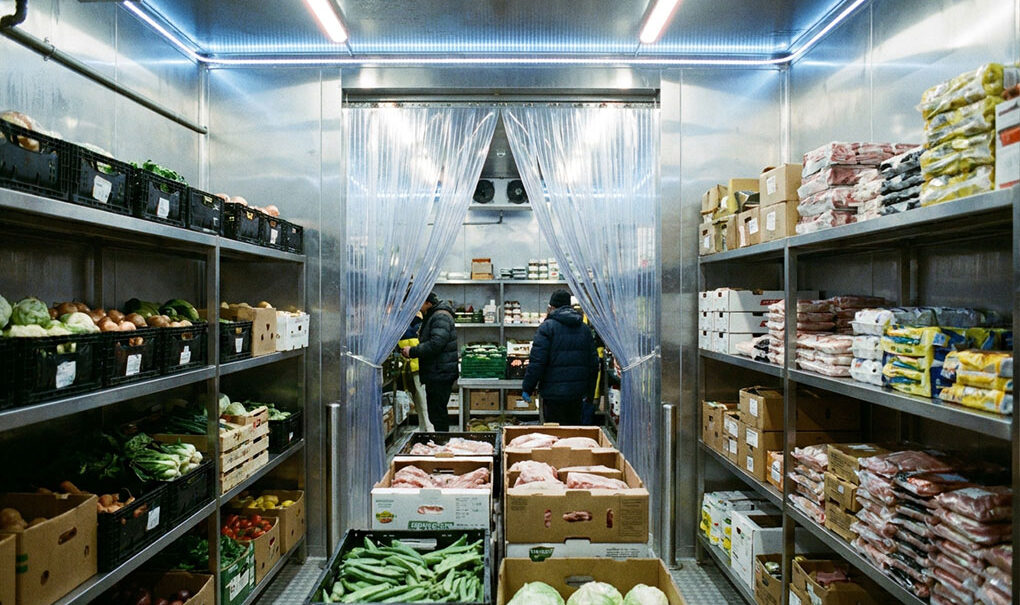
Coolroom Buying Guide: Sizing, Panels & Installation for Australian Kitchens
- Coolroom vs upright fridge: A coolroom makes sense when you need more than 1,000L of cold storage, require staff to physically enter the space, or receive bulk deliveries that can’t be broken down into individual fridge loads.
- Sizing formula: Calculate your peak cold storage volume in litres, add 30% headroom for airflow and restocking access, then size up to the next standard panel configuration.
- Floor or no floor: A coolroom with a floor suits installations on uneven surfaces or where drainage is difficult; no-floor models are more common and easier to install on a level concrete slab.
- Refrigeration unit placement: Remote condensing units reduce heat and noise in the coolroom area; self-contained units are simpler to install but exhaust heat into the space.
- Australian compliance: Coolrooms must hold 5°C or below under FSANZ Standard 3.2.2 — confirm the unit’s ambient temperature rating for your site conditions, not just its set point.
- Power: Most commercial coolroom refrigeration units require three-phase power — confirm your site’s electrical supply before ordering.
A coolroom — also called a walk-in refrigerator or cold room — is the most space-efficient bulk cold storage solution for commercial kitchens, hospitality venues, food manufacturers and retailers handling significant cold stock volumes. When your operation outgrows individual upright fridges and underbench units, a coolroom is the logical next step: a single, purpose-built refrigerated space that a person can walk into, stock and retrieve from efficiently.
This guide covers everything Australian operators need to know before buying or building a coolroom — sizing, panel construction, refrigeration units, floor configurations, compliance and the practical installation questions that catch buyers out after delivery.
When Does a Coolroom Make Sense?
A coolroom is the right choice when your cold storage demand exceeds what individual fridges can practically deliver. The right question isn’t “how many fridges do I have” — it’s whether your operation is structured around going to the cold storage, or cold storage coming to the kitchen.
You Need More Than 1,000L of Cold Storage
Two or three large upright fridges can technically provide this, but the cost of running multiple units, the maintenance complexity and the operational inefficiency of managing separate zones usually makes a single coolroom more practical and more cost-effective at this scale.
You Receive Bulk Deliveries
Meat, produce, dairy and beverage deliveries in commercial quantities arrive on pallets or in large quantities that can’t be efficiently broken down and loaded into individual fridges. A coolroom with direct delivery access — ideally from a loading dock or external door — is the right infrastructure for any operation receiving daily or weekly bulk deliveries.
Staff Need to Work Inside the Cold Storage
Prep work on large cuts of meat, portioning of bulk produce, assembly of large-scale catering items — any task that requires extended time in the cold storage space needs a coolroom, not a fridge. Staff cannot practically work inside an upright fridge.
You Need Segregated Cold Storage Zones
FSANZ food safety requirements often necessitate separate cold storage for different food categories — raw meat separate from ready-to-eat food, for example. A coolroom can be partitioned or multiple coolrooms installed to achieve this separation at scale.
The Real Comparison: Coolroom vs Multiple Upright Fridges
A common calculation operators don’t do before buying multiple upright fridges: the running cost of three large upright fridges over five years versus one properly sized coolroom. Three 1,400L upright fridges running continuously typically consume more energy than a single well-insulated coolroom of equivalent capacity — because each fridge has its own compressor, its own refrigerant circuit and its own heat rejection. A coolroom also requires one service call when it needs attention, not three. For any operation running more than two large upright fridges, the coolroom cost-of-ownership calculation is worth doing before the next fridge purchase.
How to Size a Coolroom
Sizing a coolroom to current stock levels is the most common mistake. A coolroom sized exactly to today’s peak load will be overcrowded within a year of business growth — and an overcrowded coolroom can’t maintain safe temperatures.
The sizing formula
Peak cold storage volume (L) × 1.3 = minimum coolroom internal volume (L)
Convert to floor area: Minimum volume (L) ÷ effective storage height (mm) = minimum floor area (m²)
Example: An operation needing 3,000L of cold storage at peak: 3,000 × 1.3 = 3,900L minimum. At an effective storage height of 1,800mm (allowing for floor clearance and head clearance), that’s approximately 2.2m². A standard 2.4m × 1.2m coolroom (2.88m²) provides adequate capacity with the required headroom for airflow.
| Operation Type | Typical Cold Storage Requirement | Coolroom Size Guide |
|---|---|---|
| Small café or restaurant | 1,000–2,000L | 1.8m × 1.2m to 2.4m × 1.2m |
| Medium restaurant or hotel kitchen | 2,000–5,000L | 2.4m × 1.8m to 3.0m × 2.4m |
| Large venue, catering operation | 5,000–10,000L | 3.0m × 3.0m to 4.8m × 3.0m |
| Food manufacturer or wholesaler | 10,000L+ | Custom configuration — pallet storage requirements dictate layout |
Panel Construction
Coolroom panels are the insulated wall, ceiling and floor sections that form the structure of the coolroom. Panel quality directly determines energy efficiency, temperature stability and lifespan.
Insulation thickness
Standard coolroom panels are 75mm or 100mm thick polyurethane foam insulation encased in steel or aluminium cladding. 75mm panels are adequate for most chilled coolrooms (0°C–5°C). 100mm panels are recommended for freezer rooms (-18°C to -25°C) or any installation in a high-ambient environment — a coolroom in an outdoor or partially covered position in Australian summer needs the additional insulation to maintain efficiency.
| Panel Thickness | Application | Notes |
|---|---|---|
| 75mm | Chilled coolrooms (0°C–5°C) in climate-controlled environments | Standard for most commercial kitchen coolrooms in Australia |
| 100mm | Freezer rooms (-18°C to -25°C); chilled rooms in high-ambient or outdoor positions | Required for freezer applications; strongly recommended for hot Australian climates or outdoor installations |
| 150mm+ | Deep freeze rooms (-25°C and below); large industrial cold stores | Specialist applications — medical, pharmaceutical, large-scale food production |
Panel cladding
Food-grade stainless steel interior cladding is the hygiene standard for any coolroom used for food storage — smooth, non-porous, easy to clean and resistant to the acids and cleaning chemicals used in commercial kitchen environments. Galvanised steel or aluminium interior cladding is acceptable for non-food-contact applications (beverage storage, general cold storage) but not recommended where food is stored directly.
Cam-lock panel connection
Quality coolroom panels connect via a cam-lock mechanism — a flush, tool-free locking system that creates an airtight, vapour-proof joint between panels without exposed fasteners. Cam-lock connections are the industry standard for modular coolroom construction and allow the coolroom to be disassembled and relocated if required.
Floor Configuration
No-Floor Coolroom (Most Common)
- Coolroom panels sit directly on an existing concrete slab — the floor of the building becomes the coolroom floor
- Requires a level, sealed concrete floor in good condition
- Easier and cheaper to install than a floor panel configuration
- More accessible for cleaning — no raised threshold or floor panel joins to collect debris
- Requires a floor seal strip around the base of the wall panels to prevent cold air escape at the base
- Best for: Most commercial kitchen and hospitality installations on a level concrete slab
Floor Panel Coolroom
- Insulated floor panels are included — the coolroom is fully self-contained and sits above the existing floor
- Required for installations on uneven surfaces or where the existing floor is not thermally adequate
- Necessary for freezer room applications where floor insulation is required to prevent frost heave beneath the slab
- Creates a raised threshold at the door — requires a ramped access plate for pallet trolleys and high-frequency foot traffic
- Higher installation cost than no-floor configuration
- Best for: Freezer rooms; installations on uneven surfaces; outdoor or partially covered positions
Refrigeration Units
The refrigeration unit is the mechanical heart of the coolroom — the compressor, condenser and evaporator system that maintains the internal temperature. Choosing the right configuration for your site has significant implications for installation cost, noise, heat management and long-term operating efficiency.
Self-Contained Unit (Monoblock)
- The entire refrigeration system — compressor, condenser and evaporator — is built into a single unit mounted through the coolroom wall or ceiling
- Simpler to install — no separate condensing unit or refrigerant piping run required
- Lower installation cost than remote systems
- Exhausts heat into the surrounding space — can be a problem in small, enclosed plant rooms or warm commercial kitchens
- Slightly louder than remote condensing configurations
- Best for: Smaller coolrooms (up to approximately 20m³), installations where a remote condensing unit isn’t practical, and sites where installation simplicity is a priority
Remote Condensing Unit
- The condensing unit (compressor and condenser) is located outside or in a separate plant room — connected to the evaporator inside the coolroom by refrigerant pipework
- Keeps heat and noise outside the kitchen or storage area
- Higher installation cost — requires licensed refrigeration mechanic for refrigerant pipework and commissioning
- Better performance in high-ambient environments — the condensing unit can be located in a cooler external position
- Preferred configuration for large coolrooms, multi-coolroom installations and any site where heat rejection in the kitchen is a problem
- Best for: Larger coolrooms (20m³+), multi-coolroom sites, commercial kitchens where heat management is critical
The Ambient Temperature Problem Most Buyers Miss
A self-contained coolroom refrigeration unit exhausting heat into a 35°C commercial kitchen in Australian summer is working significantly harder than its rated specifications — which are typically tested at 25°C or 32°C ambient. The practical consequence is a unit that struggles to hold temperature on the hottest days of the year, consumes significantly more energy than expected and has a compressor that reaches the end of its life years early. If your coolroom will be in or adjacent to a hot kitchen, the calculation in favour of a remote condensing unit — located on an external wall or on the roof — is usually straightforward once you factor in energy costs and compressor lifespan.
The Australian Factor
| Australian Condition | Impact on Coolroom Specification | What to Confirm |
|---|---|---|
| Summer ambient 35°C–45°C in some regions | Standard coolroom refrigeration units rated to 32°C ambient will underperform in hot Australian summers — particularly in Queensland, NT and inland NSW/VIC | Confirm the refrigeration unit’s rated ambient operating temperature and match it to your location’s peak summer conditions |
| Three-phase power requirement | Most commercial coolroom refrigeration units require three-phase power — single-phase units are available but limited in capacity | Confirm three-phase availability at your site before ordering — retrofitting three-phase power adds significant cost |
| FSANZ Standard 3.2.2 | Potentially hazardous food must be stored at 5°C or below — a coolroom must hold this under real operating conditions including door opening frequency and seasonal ambient temperature | Specify the unit’s temperature holding capability under load, not just its set point range |
| BCA and local council requirements | Building Code of Australia and local council planning requirements apply to coolroom installation — particularly for external condensing units and any structural modifications | Check local council requirements before installation — some zones require DA approval for external refrigeration plant |
| Local service availability | A coolroom refrigeration failure is a significant operational and stock loss event — service availability within 24–48 hours matters, particularly outside major cities | Confirm Australian service agents and parts availability for the refrigeration unit brand before purchasing |
Coolroom Doors
The door is the highest-traffic component of the coolroom — it opens and closes dozens or hundreds of times per day and is the primary source of temperature loss and energy consumption.
- Strip curtains: PVC strip curtains inside the door create a secondary barrier that significantly reduces cold air loss on every opening — standard specification for high-frequency access coolrooms. Inexpensive and effective; replace when strips become cracked or yellowed
- Self-closing hinges: Standard on all quality coolroom doors — the door returns to the closed position automatically without relying on staff discipline
- Safety release: A safety release handle on the inside of the coolroom door is a mandatory safety requirement — any person accidentally locked inside the coolroom must be able to exit independently
- Door heater strip: A low-wattage electric heating element around the door frame prevents the door seal from freezing to the frame — standard on freezer room doors, recommended in high-humidity environments for chilled rooms
- Vision panel: A small glass panel in the door allows staff to see into the coolroom before opening — reduces unnecessary door openings and improves safety awareness
- Door width: Standard coolroom doors are 900mm wide — confirm this accommodates your widest delivery or storage equipment, including pallet trolleys
Food Safety Compliance
Compliance Checklist
- Digital temperature display visible from outside the coolroom — staff should be able to check temperature without opening the door
- Temperature alarm set to alert when the internal temperature exceeds 5°C — critical for overnight stock protection
- Daily temperature logging as part of your HACCP food safety plan
- Safety release handle on inside of coolroom door — non-negotiable, mandatory
- Adequate internal lighting — sufficient for staff to work safely and read labels
- Non-slip flooring in wet coolroom environments
- Perforated or slatted shelving to allow air circulation — solid shelves block airflow and create warm pockets
Maintenance Schedule
Daily
- Log internal temperature — confirm holding at 5°C or below (chilled) or -18°C or below (frozen)
- Inspect door seals for full closure — check strip curtains are hanging correctly
- Clear any ice buildup around the evaporator or door frame
Weekly
- Clean interior walls, shelving and floor — remove all stock, wipe down with food-safe cleaner, allow to dry
- Inspect door seals for cracking or compression damage
- Clear the condensing unit of dust and debris — outdoor units accumulate leaves and debris around the condenser
Monthly to Annually
- Clean condenser coils on the refrigeration unit — blocked coils are the primary cause of coolroom refrigeration failure
- Check refrigerant charge — a gradual loss of refrigerant produces a unit that progressively struggles to hold temperature; this is only detectable by a licensed refrigeration mechanic
- Annual professional service inspection — refrigerant system, electrical components, door seal condition and safety release function
Frequently Asked Questions
What is the difference between a coolroom and a walk-in fridge?
They are the same thing — coolroom is the Australian term; walk-in fridge or walk-in refrigerator is the international equivalent. Both refer to a refrigerated room large enough for a person to enter. In Australian commercial kitchen and food service contexts, “coolroom” is the standard term. A coolroom holding temperatures below -10°C is typically referred to as a freezer room rather than a coolroom.
How long does it take to install a modular coolroom?
A standard modular coolroom installation typically takes one to two days for the panel assembly and refrigeration unit installation. This assumes the site is prepared — a level concrete slab, appropriate power supply confirmed, and clear access for panel delivery. Complex installations with remote condensing units, custom configurations or structural requirements may take longer. Refrigerant commissioning by a licensed refrigeration mechanic is a separate step and must be completed before the coolroom is used.
What temperature should a commercial coolroom run at?
FSANZ Standard 3.2.2 requires potentially hazardous food to be stored at 5°C or below. Set your coolroom to 2–4°C to maintain a safe buffer — a coolroom set at exactly 5°C will drift above compliance during busy delivery periods or high-access service windows. For freezer rooms, the standard holding temperature is -18°C or below. Verify temperature daily with an independent probe thermometer and log it for HACCP compliance.
Can a coolroom be installed outdoors?
Yes — modular coolrooms are regularly installed in outdoor or semi-covered positions across Australia. Outdoor installations require 100mm panel insulation to handle higher ambient temperatures, a remote condensing unit rated for outdoor use, weatherproof electrical connections and appropriate drainage. In extreme heat regions, additional consideration should be given to shading the condensing unit from direct sun — a condenser operating in direct 40°C+ sun works significantly harder than one in shade or on a cool south-facing wall.
Do I need council approval to install a coolroom?
In most cases, a modular coolroom installed inside an existing commercial building does not require council DA approval — it’s treated as a fit-out item rather than a structural change. However, external condensing units visible from the street, any structural penetrations through building walls, and coolrooms in certain heritage or residential zones may require approval. Check with your local council before installation, particularly for outdoor installations or any condensing unit mounted on an external wall or roof.
How much does a commercial coolroom cost in Australia?
A modular coolroom for a commercial kitchen typically ranges from $8,000–$15,000 for a standard chilled configuration (approximately 10–20m³) including panels, refrigeration unit and installation. Larger configurations, freezer rooms, remote condensing unit setups and custom configurations increase cost significantly. Ongoing energy costs and maintenance should be factored into the total cost of ownership calculation — a well-insulated coolroom with an energy-efficient refrigeration unit will have substantially lower operating costs over a 10–15 year lifespan than a budget unit.
Browse Commercial Refrigeration →
Also browse: Commercial Freezers · Upright Fridges · Under Bench Fridges · Chest Freezers · Contact Us