

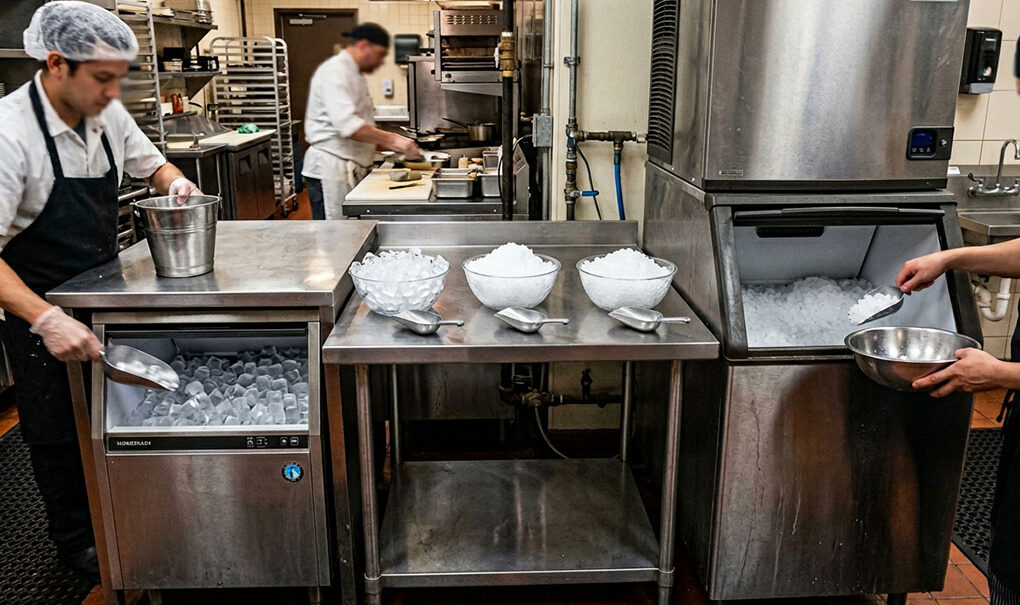
Commercial Ice Machine Types: A Detailed Guide for Australian Hospitality
- Machine format: Undercounter for bars and small restaurants; modular for hotels and high-volume venues; countertop for low-volume or self-serve applications.
- Ice format: Cube and half-cube for drinks service; flake for food and seafood displays; nugget for blended drinks and self-serve; crescent cube for high-clarity cocktail applications.
- Sizing: Calculate peak daily demand by operation type, then add 20–25% — rated output is measured under lab conditions, not your kitchen’s ambient temperature.
- Cooling: Air-cooled for most Australian installations; water-cooled only where ambient temperature consistently exceeds 30°C or ventilation cannot be resolved.
- Modular vs self-contained: Self-contained combines production and storage in one unit; modular separates them — giving independent control over output and bin capacity.
- Top brands: Scotsman and Hoshizaki for premium performance; Skope for reliable mid-range performance across the Australian market.
Choosing an ice machine in Australia involves two decisions that most buyers conflate: the machine format (undercounter, modular, countertop) and the ice format (cube, flake, nugget, crescent). Getting either wrong produces a machine that doesn’t do the job — the wrong ice type for your application, or the wrong production configuration for your volume.
This guide covers both in detail, plus how to size an ice machine correctly for your operation. It’s written for Australian hospitality operators who need to understand exactly what each ice maker type does, where it’s used, and how to match the right combination to their venue.
Ice Machine Formats Available in Australia
The machine format determines production capacity, installation footprint and how ice production and storage are configured. This is the first decision to make before comparing brands or ice types.
Undercounter Ice Machine
A self-contained unit combining the ice-making head and storage bin in a single cabinet, designed to fit beneath a standard bench. The standard ice maker choice for bars, small to mid-size restaurants, cafés and any operation where ice demand is consistent but not extreme. Connects to standard water and drainage infrastructure without major changes. Available in production outputs from 20 kg to 80+ kg per 24 hours.
Modular Ice Machine
Separates the ice-making head from the storage bin — each is specified and purchased independently. The head sits on top of the storage bin or a dispenser unit. This configuration allows production and storage to be scaled independently, making it the right ice machine for hotels, large restaurants, clubs and any venue with high or variable demand. Production outputs typically range from 80 kg to 500+ kg per 24 hours.
Countertop Ice Dispenser
A compact self-contained unit designed to sit on a bench surface. Suited to low-volume applications — office kitchens, reception areas, small healthcare settings and environments where ice demand is modest and consistent. Storage capacity is limited. Touch-free dispensing models are available and increasingly specified in healthcare and aged care settings across Australia.
Ice and Water Dispenser
Combines ice and chilled water dispensing in a single customer-facing unit. Designed for self-serve environments — accommodation, dining halls, hospitals, schools and institutional food service. Touch-free sensor activation is the standard for healthcare. Available in countertop and floor-standing configurations.
Self-Contained vs Modular — The Key Difference
This is the decision most buyers get wrong by defaulting to a self-contained undercounter machine when their volume justifies a modular setup.
Self-Contained (Undercounter)
- Ice production and storage in one cabinet
- Simpler installation — single water, drain and power connection
- Smaller footprint — fits under standard bench height
- Storage capacity is fixed by the cabinet size — cannot be expanded
- Production output typically 20–80 kg per 24 hours
- When the machine needs servicing, both production and storage are out of action simultaneously
- Best for: Bars, cafés, small to mid-size restaurants with consistent ice demand
Modular (Head + Bin)
- Ice-making head and storage bin are separate units
- Bin size is specified independently — scale storage without changing the head
- Multiple heads can be stacked on a single large bin for very high output
- Bin can be replaced without replacing the ice-making head, and vice versa
- Production output typically 80–500+ kg per 24 hours
- Larger footprint — requires dedicated floor space
- Best for: Hotels, clubs, large restaurants, high-volume venues with variable demand
Ice Types — A Detailed Guide
The ice format is determined by the ice-making head — and different heads produce fundamentally different ice. Choosing the wrong ice type for your application is a common and easily avoidable mistake for Australian venues.
Cube Ice
Cube ice is the most widely used ice format in commercial hospitality across Australia. It’s produced by freezing water in individual moulds, creating a dense, clear cube with a slow melt rate.
| Full Cube | Half Cube | |
|---|---|---|
| Size | Approximately 30–35mm per side | Approximately 30mm × 35mm × 18mm |
| Melt rate | Slowest — lowest dilution over time | Slightly faster than full cube due to greater surface area |
| Clarity | High — visually clean in premium glassware | High |
| Glass fill | Less efficient — fewer cubes per glass due to size | More efficient — fills glass well, good for high-volume service |
| Best for | Spirits, premium cocktails, whisky — where slow melt and presentation matter | General bar service, soft drinks, fountain drinks, high-volume venues |
Full cube is the choice for premium bar programmes where dilution control and ice presentation matter — a slowly melting full cube in a whisky or negroni is a deliberate quality signal. Half cube is the practical choice for high-volume service where glass fill efficiency and ice consumption matter more than slow melt.
Crescent Cube Ice
Crescent cube is a proprietary Hoshizaki ice format — a half-moon shaped cube produced by a different freezing method to standard cube ice machines. The curved shape creates a wedging effect in the glass that reduces splashing when drinks are poured and allows glasses to stack more easily in self-serve settings.
- Extremely clear and visually appealing — high clarity from the slow freeze method
- Very slow melt rate — comparable to full cube
- The wedging effect makes it particularly effective in tall glasses and pitchers
- Available only on Hoshizaki ice machines — the format is proprietary Hoshizaki technology
- Well suited to premium bar programmes, hotels and any venue where ice presentation is part of the brand
Flake Ice
Flake ice is produced by continuously freezing a thin layer of water on a drum or plate, then scraping it off in irregular flat flakes. The result is soft, pliable ice with a very high surface-area-to-mass ratio.
Flake Ice — Where It Works
- Seafood and fresh produce displays — flake moulds around product, maintains consistent contact temperature across the entire surface, and drains cleanly as it melts
- Fishmongers and fish markets — the standard format for commercial fish display and transport across Australia
- Salad bars and deli counters — keeps bowls and containers chilled from below without the pressure that cube ice can create
- Food transport and catering — packs around containers and products in transit, maintaining temperature without shifting
- Healthcare and injury treatment — the soft, pliable texture makes it suitable for therapeutic applications where cube ice would be too hard
Flake ice melts faster than cube ice and is not suited to drinks service — it dilutes beverages rapidly and has a texture most customers find unpleasant in a glass. Its value is entirely in chilling applications where surface contact and product conformity matter.
Nugget Ice
Nugget ice — also called chewable ice, pellet ice or sonic ice — is produced by compressing flake ice into small cylindrical nuggets. The compression creates a softer, more porous texture than cube ice, which means it absorbs the flavour of whatever it’s placed in and has a chewable consistency many customers actively prefer.
- Blended drinks and smoothies — nugget ice blends more smoothly than cube ice, extending blender life and producing more consistent results
- Self-serve beverage stations — the soft texture reduces injury risk from ice falling and is gentler on dispensing mechanisms
- Soft drink dispensing — absorbs the flavour of the drink, which many customers experience positively; the porous texture also means beverages chill faster on contact
- Healthcare and aged care — the chewable texture suits patients on modified texture diets and medication administration applications
- High-volume casual dining — fast food and casual dining chains specify nugget ice because customers respond positively to it and it fills cups efficiently
Air-Cooled vs Water-Cooled
All ice machines use a refrigeration system to produce ice — the difference is how heat is removed from that system.
Air-Cooled
- Removes heat by passing air over the condenser — requires adequate airflow around the unit
- More energy-efficient and lower running cost than water-cooled
- Performance degrades as ambient temperature rises above 30°C
- Requires clearance around the unit — typically 150mm minimum on sides and rear
- Adds heat to the surrounding environment — factor this into kitchen ventilation planning
- The right choice for the vast majority of Australian commercial kitchens
Water-Cooled
- Removes heat using a water circuit rather than airflow — requires cold water supply and drain
- Maintains rated output in hot, poorly-ventilated environments where air-cooled struggles
- Requires minimal clearance — can be installed in tighter spaces
- Significantly higher water consumption — check local water efficiency regulations before specifying
- Higher running cost than air-cooled due to water consumption
- Only justified where installation constraints make air-cooled impractical
How to Size an Ice Machine for Your Operation
Getting ice machine sizing right for an Australian venue requires understanding both the rated output figure on the spec sheet and the real-world factors that reduce it.
Why rated output is misleading
Every ice machine lists its production output in kilograms per 24 hours — but that figure is measured under laboratory conditions: typically 21°C ambient air temperature and 10°C incoming water temperature. In a real Australian kitchen, particularly in summer, actual output will be lower.
| Ambient Temperature | Approximate Output vs Rated |
|---|---|
| 21°C (lab conditions) | 100% of rated output |
| 25°C | Approximately 90–95% |
| 30°C | Approximately 80–85% |
| 35°C+ | Approximately 70% or below — significant performance degradation |
Ice demand by operation type
| Operation | Typical Ice Demand | Notes |
|---|---|---|
| Bar or restaurant | 1–2 kg per seat per service | Higher for cocktail bars; lower for wine-focused venues |
| Hotel | 5–8 kg per occupied room per day | Includes ice machines on guest floors plus bar and restaurant |
| Café | Varies by menu | Calculate by blended drink volume and any cold drink service |
| Fast food / casual dining | 1–1.5 kg per seat per service | Nugget ice fills cups more efficiently — factor this into calculations |
| Seafood display | Flake ice weight varies by display size | Calculate display surface area × required ice depth × daily refresh rate |
| Healthcare / aged care | Varies by bed count and application | Discuss with our team for institutional sizing |
The sizing formula
- Calculate your average daily ice consumption across all applications
- Identify your peak demand period — Saturday night service, full hotel occupancy, a summer function
- Add 20–25% above your peak estimate to account for real-world output variance and unexpected demand
- Choose a machine whose rated output meets or exceeds that buffered figure
Brand Guide
| Brand | Position | Ice Types Available | Strengths |
|---|---|---|---|
| Scotsman | Premium | Cube, half cube, flake, nugget | Italian-engineered, widest ice type range in Australia, strong modular lineup, excellent local service network, consistent high-output production |
| Hoshizaki | Premium | Crescent cube, flake | Japanese engineering, proprietary crescent cube technology, exceptional build quality, superior energy efficiency and longevity, very strong reliability record |
| Skope | Mid-Range | Cube, half cube | Purpose-built for Australian conditions, strong local service network, reliable undercounter and modular options, competitive pricing |
Matching Ice Machine Type to Your Operation
| Operation | Ice Type | Machine Format |
|---|---|---|
| Bar — cocktails and spirits | Full cube or crescent cube | Undercounter — 50–100 kg/day rated output |
| Bar — high-volume drinks service | Half cube | Undercounter or modular depending on volume |
| Restaurant — general drinks | Half cube | Undercounter — size to covers per service |
| Hotel — rooms and restaurants | Half cube or full cube | Modular — multiple heads and large bin |
| Café — smoothies and blended drinks | Nugget | Undercounter |
| Seafood display or fish market | Flake | Modular — high output to maintain display |
| Salad bar or deli counter | Flake | Undercounter or modular depending on display size |
| Healthcare or aged care | Nugget | Countertop dispenser with touch-free option |
| Fast food or casual dining | Nugget or half cube | Undercounter or modular depending on volume |
| Accommodation self-serve | Half cube or nugget | Ice and water dispenser — floor-standing |
Frequently Asked Questions
What is the best ice machine for a bar in Australia?
For a premium cocktail bar, a Hoshizaki crescent cube machine or a Scotsman full cube undercounter model delivers the slow melt rate and visual clarity that a quality bar programme requires. For a high-volume bar focused on general drinks service, a half cube undercounter machine from Scotsman or Skope is the practical choice. Nugget ice is suited to blended drink applications and self-serve stations but is not appropriate for cocktail service.
What is crescent cube ice and why does it matter?
Crescent cube is a proprietary ice format produced exclusively by Hoshizaki ice machines. The half-moon shape is created by a continuous freezing method rather than mould-based freezing, producing exceptionally clear, very slow-melting ice. The curved profile wedges in the glass, reduces splash when drinks are poured and stacks efficiently. It’s the preferred format for premium bar programmes and hotel beverage service where ice quality is part of the brand experience.
Can I use flake ice for drinks service?
Flake ice is not appropriate for drinks service. It melts significantly faster than cube ice, dilutes beverages rapidly, and has a texture most customers find unpleasant in a glass. Flake ice’s value is in chilling applications — seafood and produce displays, salad bars and food transport — where surface contact and product conformity are the priorities, not slow melt rate.
How much ice does a restaurant need per day?
A rough guide for Australian restaurants is 1–2 kg of ice per seat per service. A 60-seat restaurant doing two services needs 120–240 kg per day at peak — before factoring in any additional uses like food display or staff needs. Always add 20–25% above your peak estimate to account for real-world output variance below the machine’s rated figure, particularly in summer.
How do I know whether I need an undercounter or modular ice machine?
If your operation consistently needs more than 80 kg of ice per day, or if your current undercounter ice maker regularly runs low during peak service, a modular setup is worth assessing. The modular configuration lets you match production output and storage capacity independently. If you’re running two undercounter machines to keep up with demand, that’s a strong signal to move to a single appropriately-sized modular ice machine.
Why does an ice machine produce less than its rated output?
Rated output is measured under laboratory conditions — 21°C ambient air temperature and 10°C incoming water temperature. In a real Australian commercial kitchen, particularly in summer, higher ambient and water temperatures reduce production output by 10–20% in moderate conditions and more significantly in hot or poorly-ventilated environments. Always add a 20–25% buffer above your calculated peak demand when choosing a machine’s rated output.
What is the difference between nugget ice and cube ice?
Cube ice is dense, slow-melting and low-porosity — it chills a drink without absorbing its flavour and minimises dilution over time. Nugget ice is compressed flake ice — softer, more porous and chewable. It melts faster and absorbs the flavour of whatever it’s placed in, which many customers experience positively in soft drink and casual dining contexts. Nugget ice also blends more smoothly than cube ice. For premium bar programmes, cube ice is right. For casual dining, self-serve and blended drink applications, nugget ice often serves better.
Browse Commercial Ice Machines →
Also browse: Beverage Equipment · Commercial Bar Fridges · Ice Cream Makers · Contact Us