

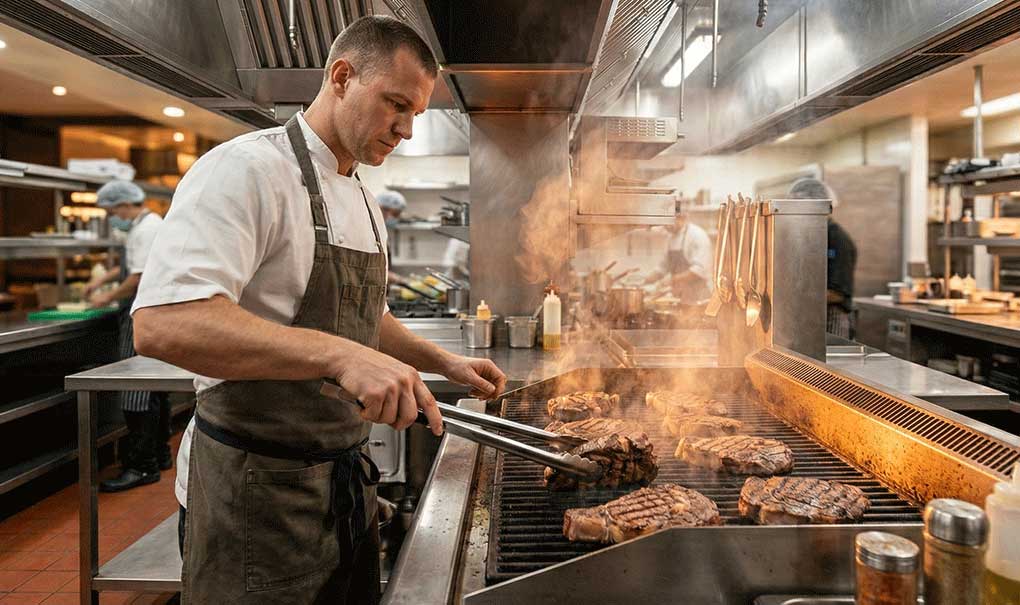
Commercial Char Grills Australia: 2026 Buyer’s Guide
Quick Summary
- Fuel type: Gas char grills dominate Australian commercial kitchens — instant heat, precise control, easy compliance with local gas standards.
- Burner type: Radiant burners for fast, high-heat searing; lava rock burners for that characteristic smoky flavour profile.
- Size: Match width to your cooking volume — 300mm for benchtop supplementary use, 600mm for regular service, 900–1200mm for high-volume operations.
- Mounting: Bench top for flexibility and space efficiency; floor stand or cabinet base for dedicated grill stations.
- Top brands: Blue Seal, Goldstein and Waldorf for premium build quality; Cookrite, FED and LKK for strong value.
- Cleaning: Daily grate brushing and weekly deep clean are essential — neglected grills degrade quickly and become a fire risk.
A commercial char grill is one of the hardest-working pieces of equipment in a professional kitchen. It runs at high heat for extended periods, handles high-value proteins day after day, and has a direct impact on the quality of some of your most popular dishes. Choosing the wrong model — undersized, underpowered or poorly suited to your workflow — creates bottlenecks, inconsistent results and unnecessary maintenance costs.
This guide covers everything you need to make a confident purchasing decision: burner types, sizing, mounting options, brand comparisons, installation requirements and maintenance. All models referenced are available through Snowmaster’s commercial char grill range.
What Is a Commercial Char Grill?
A commercial char grill uses high-intensity heat from below to cook food directly on cast iron or steel grates, producing the characteristic char marks, caramelised crust and smoky flavour that define grilled proteins, vegetables and seafood. Unlike a commercial cooktop or hot plate, a char grill exposes food to radiant heat and — in lava rock models — smoke produced when fat drips onto heated media.
In Australian commercial kitchens, virtually all char grills run on natural gas or LPG. Gas delivers instant, controllable, high-intensity heat and is significantly more practical for continuous service than electric alternatives.
Radiant vs Lava Rock Burners
The two primary burner configurations available in commercial char grills produce noticeably different cooking results. Understanding the difference is essential before selecting a model.
Radiant Burners
- Ceramic or steel radiant plates sit above the burner, distributing heat evenly across the grate
- Faster heat-up time and more consistent surface temperatures
- Cleaner operation — less smoke, easier to manage in enclosed kitchens
- Easier to clean — no lava rock media to replace
- Lower maintenance cost over time
- Best for: High-volume kitchens, enclosed spaces, operators prioritising consistency and speed
Lava Rock Burners
- Porous volcanic rock sits above the burner and absorbs heat, producing smoke when fat drips onto it
- Generates authentic smoky char flavour that radiant models cannot replicate
- Slightly slower to reach full temperature
- Lava rock needs periodic replacement as it becomes saturated with fat
- Requires more ventilation due to increased smoke production
- Best for: Steakhouses, BBQ-focused venues, operators where flavour profile is the priority
Choosing the Right Size
Commercial char grills are sized by cooking width. The right width depends on your peak-hour volume, the number of proteins you need to hold on the grill simultaneously, and your available bench or floor space.
| Width | Approx. Capacity | Best For | Example Models |
|---|---|---|---|
| 300mm | 4–6 portions simultaneously | Supplement to a larger cooking line, food trucks, small cafés | Cookrite AT80G3C-F, Goldstein BQG12-X, Waldorf CH8300G-B |
| 450mm | 6–8 portions simultaneously | Smaller restaurants, moderate grill volume | Blue Seal G593-B, Waldorf CH8450G-B |
| 600mm | 10–14 portions simultaneously | Busy restaurants, pub kitchens, regular grill-focused menus | Cookrite AT80G6C-F, Goldstein BQG24-X, Luus CS-6C |
| 900mm | 16–22 portions simultaneously | High-volume restaurants, steakhouses, hotel kitchens | Cookrite AT80G9C-F, Goldstein RBA36L, Luus CS-9C |
| 1200mm+ | 24+ portions simultaneously | Very high-volume operations, large catering, institutional kitchens | LKK CG12, FED QR-48E |
Bench Top vs Floor Stand
Most Common
Bench Top
Sits on a stainless steel bench or equipment stand. Flexible — can be repositioned as your kitchen layout evolves. Ideal for kitchens where the grill isn’t the central cooking station. Most 300mm–600mm models are bench top only.
Dedicated Grill Station
Leg Stand
Freestanding on integrated legs — a self-contained grill station. Eliminates the need for a separate bench, keeps the unit at the correct ergonomic working height, and is easier to clean underneath. Available on 450mm–600mm+ models such as the Blue Seal G594-LS and Waldorf CH8600G-LS.
Storage Included
Cabinet Base
Mounted on a stainless steel cabinet, providing enclosed storage directly beneath the grill for utensils, trays and equipment. Ideal when bench space is limited. Available on Cobra models such as the Cobra CB6 and Cobra CB9.
Space Saving
Countertop / Benchtop
Compact models like the FED QR-24E and LKK CG3 are designed to sit directly on a counter or pass, making them ideal for food trucks, pop-up operations and smaller venues where floor space is at a premium.
Brand Guide
| Brand | Position | Strengths | Best For |
|---|---|---|---|
| Blue Seal | Premium | Precision heat control, robust construction, consistent commercial performance | High-volume restaurants, hotels, operators who need long-term reliability |
| Goldstein | Premium | Australian-designed, wide range including radiant char broilers, strong after-sales support | Steakhouses, premium restaurants, operators wanting Australian-engineered equipment |
| Waldorf | Premium | Heavy-duty build, available in bench top and leg stand configurations, wide size range | High-volume operations needing durable, long-life equipment |
| Luus | Mid-Range | Australian brand, solid build quality, good heat distribution across the grate | Busy restaurants wanting quality without premium pricing |
| Cobra | Mid-Range | Cabinet base configurations, practical benchtop BBQ format | Venues wanting integrated storage beneath the grill |
| Cookrite | Value | Radiant burner design, strong value at entry and mid-range price points | Smaller operations, start-ups, secondary grill stations |
| FED | Value | Multi-burner benchtop range, good output at competitive price | Cafés, food trucks, venues needing reliable volume at lower cost |
| LKK | Value | Wide size range from 300mm to 1200mm, strong output-to-price ratio | Asian cuisine restaurants, high-volume operations on tighter budgets |
Installation Requirements
All gas char grills must be installed by a licensed gas fitter in compliance with Australian Standard AS/NZS 5601. Before purchasing, confirm the following with your installer:
Pre-Installation Checklist
- Gas type — confirm whether your kitchen runs natural gas or LPG; most models support both but may require a jet change
- Gas supply pressure and capacity — larger 900mm+ models have high BTU output requirements; confirm your supply line can handle the load
- Ventilation and exhaust — char grills produce significant heat, smoke and combustion gases; a commercial rangehood directly above is mandatory
- Clearance distances — maintain required clearances from combustible surfaces per AS/NZS 5601 and manufacturer specifications
- Bench or floor support — confirm your bench or floor can bear the weight, particularly for 900mm+ models
- Licensed gas fitter — required by law for all gas appliance connections in Australia
Cleaning and Maintenance
A char grill that isn’t cleaned properly accumulates carbonised fat, degrades heat distribution and becomes a fire risk. The cleaning process is straightforward but must be done consistently.
Daily Cleaning
- While the grill is still hot, brush the grates with a commercial grill brush to remove food residue and carbonised buildup
- Turn off the gas and allow the unit to cool before handling the grease tray
- Remove and empty the grease tray — never allow it to overflow, as accumulated fat is a fire hazard
- Wipe down the exterior with a food-safe stainless steel cleaner
Weekly Deep Clean
- Remove the grates and soak in hot water with a commercial degreaser
- Clean the radiant plates or lava rock tray — radiant plates can be wiped down; heavily soiled lava rock should be replaced
- Inspect burner ports for blockage and clear with a soft brush if needed
- Check the grease drainage channel and clean thoroughly
Frequently Asked Questions
What is the difference between a char grill and a griddle?
A char grill uses open grates over radiant or lava rock burners, exposing food to direct flame and producing char marks and smoke. A griddle uses a flat solid cooking plate — ideal for eggs, pancakes, bacon and high-volume flat items. Many commercial kitchens run both, positioned side by side on the cooking line. Snowmaster stocks both commercial char grills and commercial hot plates.
How do I clean a commercial char grill properly?
Brush the grates with a commercial grill brush while still hot after each service to remove food residue. Empty the grease tray daily — this is the most important step for fire safety. Weekly, remove the grates and soak in degreaser, clean the radiant plates or lava rock tray, and inspect the burner ports for blockage. Never use abrasive pads on cast iron grates as they damage the seasoned surface.
How do I season a commercial char grill?
Before first use, brush the clean grates with a thin coat of high-smoke-point oil — canola or rice bran oil work well. Run the grill at medium heat for 15–20 minutes to polymerise the oil into a protective, non-stick layer. Repeat this process periodically, particularly after deep cleaning, to maintain the seasoning.
Do commercial char grills run on natural gas or LPG?
Most models in Snowmaster’s range support both natural gas and LPG, but are typically configured for one at the factory. Switching between gas types requires changing the burner jets — a straightforward task for a licensed gas fitter. Always confirm the gas type when ordering and arrange installation by a licensed gas fitter as required by Australian law.
What size commercial char grill do I need?
Size your grill to your peak-hour output, not your average daily volume. A 600mm grill handles around 10–14 portions simultaneously and suits most busy restaurants. If your grill is running at full capacity for extended periods during service, size up. A 300mm model is suitable as a supplementary unit or for lower-volume operations; 900mm+ models are for dedicated grill-focused menus at high volume.
Do I need a rangehood above a commercial char grill?
Yes — a commercial rangehood or exhaust canopy positioned directly above the grill is mandatory. Char grills produce significant heat, smoke and combustion gases that must be captured and exhausted to comply with Australian building and health regulations. Consult your local council and a licensed mechanical services contractor before installation.
Snowmaster stocks over 50 commercial char grill models from Blue Seal, Goldstein, Waldorf, Luus, Cobra, Cookrite, FED and LKK. Our team can help you match the right size, burner type and mounting configuration to your kitchen layout and service volume.
Browse Commercial Char Grills →
Also browse: Commercial Cooktops · Commercial Hot Plates · Commercial Stoves · All Cooking Equipment · Contact Us