

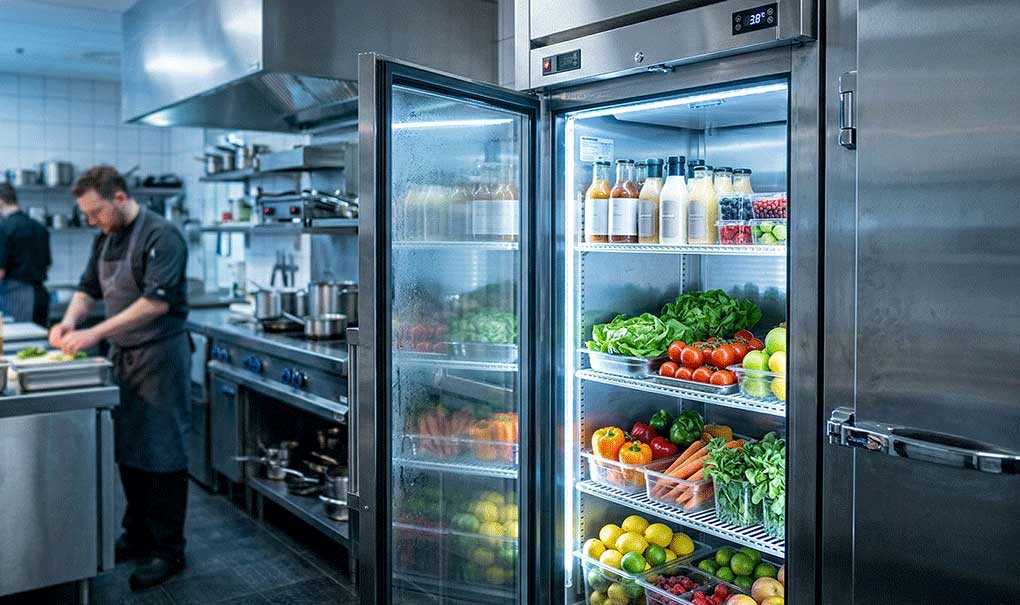
Commercial Upright Fridges Australia: 2026 Buyer’s Guide
Quick Summary
- Door type: Solid doors for kitchen storage and energy efficiency; glass doors for display, drinks and front-of-house visibility.
- Capacity: Size to your peak storage demand — 300–600L for single-door kitchen units, 600L+ for high-volume operations.
- Condenser position: Top-mount stays cleaner in dusty environments; bottom-mount is easier to access for servicing.
- Compliance: Australian Food Safety Standard 3.2.2 requires cold food to be held at or below 5°C — your fridge must maintain this reliably under load.
- Maintenance: Clean condenser coils monthly, check door seals weekly, and log temperatures daily to protect both food safety and your investment.
- Top brands: Skope and Turbo Air for premium performance; FED, Bromic and Polar for strong value across the mid-range.
A commercial upright fridge is the foundation of any professional kitchen’s cold chain.While finding the perfect high-capacity upright unit keeps your stock safe, you can explore our complete breakdown of solutions across all commercial fridges to completely fit out your commercial space.”
This guide covers everything you need to make a confident decision: fridge types, door configurations, capacity sizing, condenser position, key features, brand comparisons, Australian compliance requirements and a maintenance schedule to protect your investment long-term.
Types of Commercial Upright Fridges
The category “commercial upright fridge” covers several distinct product types, each suited to different roles in a hospitality or food service operation.
Most Common
Solid Door Storage Fridge
The workhorse of the commercial kitchen. Solid stainless steel doors minimise temperature fluctuation from opening and closing, making these the most energy-efficient option for back-of-house ingredient storage. Adjustable shelving handles everything from full gastronorm pans to smaller prep containers. Available in single, double and triple door configurations from 300L to 1400L+.
Display and Drinks
Glass Door Upright Fridge
Glass door models allow staff and customers to see contents without opening the door — reducing energy consumption in high-access environments and improving front-of-house presentation. Essential for bottled drinks, grab-and-go food, and any application where visibility drives sales. Available in single, double and triple door configurations.
Space Saving
Under-Bench Fridge
Fits beneath a stainless steel bench to maximise usable kitchen space. Ideal for prep stations where cold ingredients need to be within arm’s reach. Available with solid or glass doors and in drawer configurations. See Snowmaster’s full range of under-bench fridges.
Two in One
Fridge/Freezer Combo
A split-door unit combining refrigeration and freezer storage in a single footprint. Practical where floor space is limited and both functions are needed. Temperature zones are independently controlled. Available in side-by-side and top/bottom configurations across multiple brands.
Pizza and Prep
Pizza Prep Fridge
A counter-height fridge with a refrigerated prep surface on top for toppings and ingredients. Keeps everything cold and accessible during service. Also suited to sandwich prep and salad bars. See Snowmaster’s range of pizza prep fridges.
Drawer Access
Commercial Drawer Fridge
Pull-out drawer access rather than swing doors — ideal under cooking lines and prep benches where swinging doors would obstruct workflow. Particularly useful under char grills and cooktops. See Snowmaster’s range of commercial drawer fridges.
Solid Door vs Glass Door
This is the most common decision point when selecting an upright fridge. The right choice depends on where the unit will be positioned and how it will be used.
Solid Door — Back of House
- Superior insulation — less temperature fluctuation when opening
- More energy-efficient for high-access kitchen environments
- Better suited to hot kitchen conditions
- Stainless steel exterior is durable and easy to clean
- Contents not visible without opening
- Best for: Kitchen storage, ingredient fridges, cool rooms, prep stations
Glass Door — Front of House
- Contents visible without opening — reduces door openings and energy waste
- Drives impulse purchase for drinks and grab-and-go items
- Professional presentation for customer-facing environments
- Interior lighting enhances product visibility
- Glass requires more cleaning to maintain appearance
- Best for: Drinks displays, cafés, bars, delis, convenience stores
Sizing Your Fridge
Capacity is measured in litres. The right size depends on your daily stock volume, the number of staff accessing the unit, and how often you receive deliveries. A common mistake is buying to current volume — always factor in a busy service period and allow headroom for growth.
| Capacity | Configuration | Typical Use |
|---|---|---|
| Under 300L | Single door | Small cafés, food trucks, supplementary storage, staff rooms |
| 300–600L | Single door | Standard restaurant kitchen, single-station ingredient storage |
| 600–900L | Single or double door | Busy restaurants, pubs, hotels, high-volume cafés |
| 900–1200L | Double door | Large restaurant kitchens, catering operations, institutional kitchens |
| 1200L+ | Double or triple door | Central kitchens, large hotels, production facilities |
Top-Mount vs Bottom-Mount Condenser
The condenser position affects both maintenance access and long-term efficiency. Neither is universally better — the right choice depends on your kitchen environment.
| Top-Mount Condenser | Bottom-Mount Condenser | |
|---|---|---|
| Dust and grease accumulation | Less — heat rises, drawing less floor-level grease upward | More — sits at floor level where grease and dust accumulate |
| Cleaning access | Requires stepladder for coil cleaning | Easy floor-level access for coil cleaning |
| Kitchen heat impact | Exhausts heat upward — less impact on floor-level temperature | Exhausts heat at floor level — can affect under-bench equipment nearby |
| Best environment | Busy kitchens with high grease or dust | Cleaner environments where coil access matters |
Key Features to Look For
Self-Closing Doors
Essential in a busy kitchen where staff move quickly and doors get left ajar. A self-closing mechanism protects both food safety and energy efficiency. Most commercial-grade units include this as standard — always confirm before purchasing.
Adjustable Shelving
Full-height adjustable shelving accommodates gastronorm pans, tall containers and varying stock configurations. Look for epoxy-coated or stainless steel shelves that are removable for cleaning.
Digital Temperature Display and Alarms
External digital temperature displays let staff verify the unit is operating correctly without opening the door. Temperature alarm functions alert staff if the cabinet drifts outside safe range — critical for HACCP compliance and protecting high-value stock.
Castors
Lockable castors allow the unit to be repositioned for cleaning behind and beneath — a significant hygiene advantage in any commercial kitchen. Most models 600L+ include castors as standard.
Door Configuration — Split Doors
On double-door models, split or independent door sections mean staff only expose half the cabinet contents when accessing one section. This reduces temperature fluctuation during peak service and lowers energy consumption.
Australian Food Safety Compliance
Key compliance considerations:
- Ambient temperature rating: Australian commercial kitchens can reach 35°C+ in summer. Confirm the unit is rated to maintain 3°C internal temperature at your kitchen’s peak ambient temperature — many budget units are only rated to 25°C or 32°C ambient
- Temperature logging: Many councils and health authorities require documented temperature records. A fridge with a built-in digital display and alarm simplifies this significantly
- RCM certification: All electrical appliances must carry the Regulatory Compliance Mark for Australian sale
- Clearance requirements: Most units require adequate ventilation clearance around the condenser — follow manufacturer specifications to maintain efficiency and warranty
Brand Guide
| Brand | Position | Strengths | Best For |
|---|---|---|---|
| Skope | Premium | New Zealand-engineered, built for Australian conditions, extensive service network, strong energy ratings | High-volume operations, venues needing long-term reliability and local support |
| Turbo Air | Premium | High-performance compressors, superior temperature stability, wide range of glass door display models | Drinks display, deli, retail and high-access front-of-house environments |
| Hoshizaki | Premium | Japanese engineering, exceptional build quality and longevity, strong energy efficiency | Operators prioritising long lifespan and minimal maintenance |
| Bromic | Mid-Range | Australian brand, strong warranty support, reliable across a broad range of configurations | Restaurants, cafés and catering operations wanting solid quality with local support |
| Skipio | Mid-Range | Korean engineering, competitive pricing, good temperature stability and feature set | Mid-volume kitchens wanting quality above entry-level without premium pricing |
| Polar | Mid-Range | Wide range of glass and solid door models, strong value across the mid-range | Cafés, small restaurants, hospitality start-ups |
| FED | Value | Largest range in Snowmaster’s catalogue, reliable entry-level to mid-range across all configurations | Budget-conscious operators, start-ups, secondary storage units |
| Atosa | Value | Strong value at entry level, good capacity-to-price ratio on single and double door models | Cost-sensitive operations, food trucks, smaller venues |
Common Buying Mistakes
Avoid These
- Buying to current volume, not peak demand — a fridge that’s full at current levels will be dangerously overcrowded as your business grows; always size up
- Ignoring ambient temperature rating — a unit rated to 25°C ambient will struggle in an Australian summer kitchen; always check the rated operating range
- Not measuring access routes — confirm the unit fits through your loading dock, corridor and kitchen entry before ordering, not after delivery
- Choosing glass doors for a hot kitchen — glass door units are less efficient in high-ambient environments; solid doors are the right choice for back-of-house
- Prioritising purchase price over running costs — a cheap fridge with a poor energy rating will cost more over three years than a quality unit bought at a premium
- Skipping local warranty support — always confirm Australian service agents are available; a fridge that fails mid-service with no local technician is an operational crisis
Maintenance Schedule
A commercial fridge running continuously in a hot environment requires consistent maintenance to perform reliably and meet its rated lifespan of 8–12 years.
Daily
- Check and log the internal temperature — confirm it is holding at or below 5°C
- Wipe down door handles and exterior surfaces with a food-safe cloth
- Check door seals are closing fully — a worn or dirty seal is the most common cause of temperature drift
Weekly
- Clean interior shelves and walls with warm water and a food-safe cleaner — avoid bleach and abrasive scourers on stainless steel
- Inspect door gaskets for cracks, tears or mould buildup — replace immediately if damaged
- Check that ventilation clearances around the unit are maintained and not blocked by stock or equipment
Monthly
- Clean condenser coils with a soft brush or vacuum — dust and grease buildup on the condenser is the leading cause of compressor overload and early failure
- Check evaporator coils for ice buildup — excessive ice indicates a door seal issue or defrost system fault
- Clean the drain pan and drainage tube to prevent overflow and mould
Frequently Asked Questions
What temperature should a commercial fridge run at?
Australian Food Safety Standard 3.2.2 requires potentially hazardous food to be stored at 5°C or below. Most commercial kitchens set their upright fridges to 2–4°C to maintain a safe buffer. The unit should hold this temperature reliably under load — not just when empty or during a cool part of the day.
What is the difference between a commercial fridge and a domestic fridge?
Commercial fridges are built for continuous operation in high-ambient environments, with heavy-duty compressors, thicker insulation, commercial-grade door seals and components rated for years of constant use. Domestic fridges are designed for home use — typically 8–10 openings per day in a climate-controlled room. Placing a domestic fridge in a commercial kitchen will result in premature failure, void the warranty and may not maintain safe temperatures under load.
How long should a commercial upright fridge last?
With proper maintenance, a quality commercial upright fridge should last 8–12 years. Budget units under continuous heavy use may last 4–6 years. The single biggest factor in longevity is condenser coil maintenance — a clean condenser keeps the compressor running efficiently and within its rated load.
Should I choose a solid door or glass door commercial fridge?
Solid doors for back-of-house kitchen storage — they’re more energy-efficient in hot environments and maintain temperature better under heavy access. Glass doors for front-of-house, drinks display and any application where visibility drives sales or reduces unnecessary door openings. If a unit will be in direct customer view, glass is almost always the right choice.
What size commercial fridge do I need?
Calculate your maximum single-delivery stock volume and add 25% as a buffer. For most busy restaurant kitchens, a 600L single-door solid unit is the baseline — double door models (900–1200L) suit higher-volume operations. Don’t size to your current quiet-period needs; size to your busiest service period with room to grow.
How often should commercial fridge coils be cleaned?
Monthly in a typical commercial kitchen — more frequently in environments with high grease or dust production. Blocked condenser coils force the compressor to work harder, increasing energy consumption and accelerating wear. It’s a five-minute job that directly affects both running costs and unit lifespan.
Snowmaster stocks over 140 commercial upright fridges from Skope, Turbo Air, Hoshizaki, Bromic, Polar, FED, Atosa and more. Our team can help you match the right capacity, door type and configuration to your kitchen layout and budget.
Browse Commercial Upright Fridges →
Also browse: Under-Bench Fridges · Drawer Fridges · Commercial Freezers · Pizza Prep Fridges · Contact Us