

Hospitality Ware Washing & Sizing Guide 2026
Quick Summary
- Machine type: Under-bench and glasswashers for low-to-medium volume; pass-through for busy restaurants; conveyor for high-volume operations.
- Output: Match cycles per hour to your peak cover count — running out of clean crockery mid-service is a preventable problem.
- Water temperature: Australian food safety requires a final rinse at 82°C minimum to achieve sanitisation without chemicals.
- Water softener: Essential in hard water areas — limescale buildup is the leading cause of premature commercial dishwasher failure in Australia.
- Installation: Requires plumbed hot and cold water, a drainage connection, adequate ventilation and in most cases a dedicated electrical circuit.
- Top brands: Washtech and Eswood for Australian-designed reliability; Classeq for strong mid-range value; Adler for entry-level underbench units.
In a busy commercial kitchen, the dishwasher is the one piece of equipment that affects every single service. A machine that can’t keep pace with cover count creates a cascade of problems — waiting staff standing idle, chefs holding plated food, customers waiting for tables that can’t be reset. Choosing the right machine for your volume, space and water conditions is one of the most operationally significant decisions you’ll make when fitting out a kitchen.
This guide covers every machine type available, how to match output to your operation, key technical specifications, Australian compliance requirements, brand comparisons and a maintenance schedule. Ready to buy ? search the full range of commercial dishwashes at Snowmaster and save now!
Machine Types: Which One Do You Need?
Commercial dishwashers are not one-size-fits-all. The right machine type depends entirely on your daily cover count, available space and what you’re washing.
Up to 150 covers/day
Glasswasher
A compact undercounter machine designed specifically for glassware. Shorter cycle times (90–120 seconds), lower wash temperature to protect glassware, and a smaller basket size optimised for stemware and pint glasses. Essential for bars, pubs and venues where glass throughput is the primary need. Shop commercial glasswashers.
Up to 200 covers/day
Under-Bench Dishwasher
Sits beneath a stainless steel bench and handles a full range of crockery, cutlery, glassware and small pans. The standard choice for small to medium restaurants, cafés and kitchens where space is limited. Cycle times of 90–180 seconds, output of 20–40 racks per hour. Shop under-bench dishwashers.
200–500 covers/day
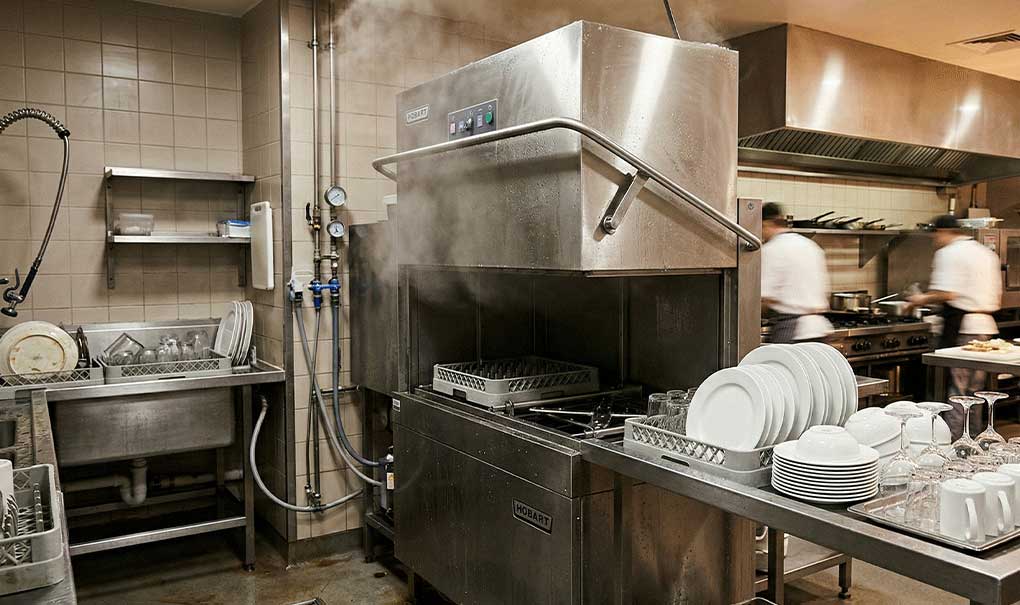
Pass-Through Dishwasher
A hood-style machine where racks slide through from one side and exit the other — a continuous flow rather than a load-and-wait process. Significantly faster than under-bench units, handling 40–100 racks per hour. Requires a inlet bench and outlet bench either side. Shop pass-through dishwashers.
500+ covers/day
Conveyor Dishwasher
The highest-throughput option — a continuous conveyor belt carries racks through multiple wash and rinse zones without stopping. Output of 100–250+ racks per hour. Used in hotels, hospitals, large venues, universities and institutional kitchens where volume justifies the footprint and investment. Shop conveyor dishwashers.
Pots and Pans
Utensil and Pot Washer
Designed for the items that standard dishwashers struggle with — large pots, pans, gastronorm trays, baking sheets and kitchen utensils. Higher water pressure and larger chamber dimensions handle the volume and size of commercial cookware. Shop utensil and pot washers.
All-in-One
Warewasher
A broad-capacity machine handling the full range of kitchen items — crockery, glassware, cutlery, pots and trays — in a single unit. Suited to operations that need flexibility across all item types without running separate machines. Shop warewashers.
Matching Output to Your Cover Count
The most common sizing mistake is buying a machine based on space rather than throughput. Output is measured in racks per hour — each standard rack holds approximately 25 dinner plates, 25 glasses or a set of cutlery for 25 covers.
| Daily Covers | Recommended Machine | Min. Output Required | Example Models |
|---|---|---|---|
| Up to 60 | Under-bench dishwasher | 20+ racks/hr | Adler DWA2050, Eswood SW500 |
| 60–150 | Under-bench dishwasher (higher spec) | 35+ racks/hr | Washtech XG, Classeq C400 |
| 150–300 | Pass-through dishwasher | 50+ racks/hr | Washtech M1, Eswood ES25 |
| 300–500 | Pass-through (high output) | 80+ racks/hr | Washtech M2, Eswood ES32 |
| 500+ | Conveyor dishwasher | 120+ racks/hr | Washtech conveyor range, Eswood conveyor range |
Key Technical Specifications
Wash and Rinse Temperature
Commercial dishwashers operate at significantly higher temperatures than domestic machines. The wash cycle typically runs at 55–65°C to remove food soils. The final rinse is the critical sanitisation step — Australian food safety standards require a minimum rinse temperature of 82°C to achieve thermal sanitisation without relying solely on chemical sanitisers. Always confirm the final rinse temperature of any machine you’re considering.
Cycle Time
Shorter cycle times mean higher throughput but also higher energy and water consumption per hour. Under-bench units typically run 90–180 second cycles. Pass-through machines run 90–120 second cycles. For most busy operations, a 90-second cycle machine will outperform a 3-minute cycle machine with a similar rack capacity — the compound difference across a service is significant.
Water Consumption
Expressed in litres per rack, water consumption directly affects your operating costs. Premium machines use as little as 2–3 litres per rack on pass-through models. Under-bench units typically use 3–5 litres per rack. Over a year of full service, the difference between an efficient and an inefficient machine can amount to thousands of litres and a meaningful difference in utility costs.
Boiler Capacity
The wash boiler heats the wash water; the rinse boiler (where present) heats rinse water separately to 82°C+. Machines with a dedicated rinse boiler recover temperature faster between cycles and maintain consistent sanitisation under sustained load. For high-volume operations, a dedicated rinse boiler is essential — not optional.
Water Quality and Softeners
Limescale buildup is the leading cause of premature commercial dishwasher failure in Australia. Hard water — which affects most of Australia’s major cities — deposits calcium and magnesium onto heating elements, boilers and spray arms, reducing efficiency and eventually causing element failure.
Most commercial dishwashers include a built-in salt-based water softener. Confirm that yours is filled and correctly set before first use — this is frequently overlooked during installation and is the first thing a service technician will check when a machine underperforms.
Installation Requirements
Pre-Installation Checklist
- Hot and cold water supply — plumbed connections required; confirm supply pressure meets manufacturer minimum (typically 0.5–3 bar)
- Drainage — gravity drain or pump drain depending on the machine; confirm the drain outlet is at the correct height relative to the machine
- Electrical supply — most commercial dishwashers require a dedicated 15A or 20A circuit; larger pass-through and conveyor machines may require 3-phase power
- Ventilation — commercial dishwashers produce significant steam; adequate kitchen ventilation or a condensation hood above the machine is required
- Inlet and outlet benches — pass-through dishwashers require a soiled inlet bench and clean outlet bench of the correct height either side
- Licensed plumber — required for all water and drainage connections in a commercial premises in Australia
- Floor clearance and access — confirm the machine can be delivered through your access routes before ordering
Brand Guide
| Brand | Position | Strengths | Best For |
|---|---|---|---|
| Washtech | Premium | New Zealand-designed and engineered for Australian water conditions, excellent service network, wide range from glasswashers to conveyor machines, strong energy and water efficiency ratings | Operations requiring long-term reliability, high-volume service, venues with hard water |
| Eswood | Premium | Australian brand, built specifically for local conditions, strong after-sales support, full range from glasswashers through conveyor systems | Operators prioritising local support and Australian-designed equipment |
| Classeq | Mid-Range | UK-engineered, reliable across glasswashers and underbench units, strong value at mid-range price points, easy to service | Bars, pubs, smaller restaurants needing reliable mid-range performance |
| Adler | Value | Competitive entry-level pricing across glasswasher and underbench range, solid performance for lower-volume operations | Start-ups, smaller cafés, venues with lower daily cover counts |
| FED | Value | Budget-friendly glasswasher and underbench options, reliable entry-level performance | Cost-sensitive operations, secondary machines, lower-volume venues |
Common Buying Mistakes
Avoid These
- Undersizing for peak volume — a machine that can’t keep pace with Saturday dinner service creates a bottleneck that affects the entire operation; always size to your busiest service
- Ignoring water hardness — failing to use or configure the built-in water softener in a hard water area is the fastest way to destroy a commercial dishwasher; check your local water hardness before purchase
- Buying without confirming 3-phase availability — larger pass-through and conveyor machines require 3-phase power; confirm your premises has it before ordering
- Forgetting inlet and outlet benches — a pass-through machine without properly sized benches either side creates a workflow disaster; budget for these as part of the installation
- Prioritising purchase price over operating costs — a cheap machine with high water and energy consumption will cost significantly more over 5 years than a premium efficient unit
- No local service agent — a dishwasher failure mid-service is an emergency; always confirm Australian service agents are available before purchasing
Maintenance Schedule
A commercial dishwasher maintained correctly will run reliably for 8–12 years. Neglected machines fail within 3–5 years — usually from limescale, blocked spray arms or deteriorated door seals.
After Every Service
- Remove and clean the filter — a blocked filter is the most common cause of poor wash results and is the first thing to check if dishes are coming out dirty
- Clean the wash and rinse arms — remove and flush under running water to clear any blocked nozzles
- Wipe down the interior and door seals with a food-safe cloth
- Leave the door slightly ajar overnight to allow the interior to dry and prevent mould
Weekly
- Descale the interior with a commercial descaling solution — frequency depends on your water hardness; in hard water areas this may need to be done more often
- Check the door seals for cracks, tears or buildup that would prevent a proper seal
- Inspect the spray arms for physical damage or blocked nozzles
- Check detergent and rinse aid dosing is correctly set — overdosing wastes chemical and causes residue; underdosing leaves food soils and spots
Monthly
- Descale the boiler and heating elements — particularly important in hard water areas
- Check the water softener salt level and top up as required
- Inspect all water connections and drainage for leaks or blockage
- Run a full service cycle with a commercial machine cleaner
Frequently Asked Questions
What is the difference between a glasswasher and a commercial dishwasher?
A glasswasher is a smaller, purpose-built machine optimised for glassware — shorter cycles, lower wash temperature (to protect glass), and a basket sized for stemware and pint glasses. A commercial dishwasher handles the full range of crockery, cutlery, glassware and small kitchen items. If your primary need is glass throughput in a bar or pub, a dedicated glasswasher is faster and more efficient for that purpose. If you need to wash a mix of items, an under-bench dishwasher is more practical.
What rinse temperature is required for commercial dishwashers in Australia?
Australian food safety standards require a final rinse temperature of at least 82°C to achieve thermal sanitisation. This is the critical step that kills pathogens without relying solely on chemical sanitisers. Always confirm the rated final rinse temperature of any commercial dishwasher before purchasing — this is a non-negotiable compliance requirement.
Do I need a pass-through or under-bench dishwasher?
If your daily cover count is consistently above 150–200, a pass-through dishwasher will handle the throughput far more efficiently than an under-bench unit. Pass-through machines allow a continuous rack-in, rack-out workflow rather than load-and-wait cycles. The tradeoff is space — you’ll need a soiled inlet bench on one side and a clean outlet bench on the other, which requires a dedicated dishwash area. Under-bench machines are the right choice for smaller operations where space is limited and throughput requirements don’t justify the footprint.
How important is a water softener for a commercial dishwasher?
Critical in most Australian locations. Hard water deposits limescale on heating elements, boilers and spray arms — reducing efficiency, increasing energy consumption and eventually causing element failure. Most commercial dishwashers include a built-in salt-based water softener. Ensure it is correctly configured at installation and the salt level is checked monthly. In very hard water areas (Adelaide, Brisbane, parts of Perth), a separate inline water softener is also worth considering.
Why are my dishes coming out dirty or spotted?
The most common causes are a blocked filter (clean after every service), insufficient rinse aid dosing, low rinse temperature, limescale buildup on spray arms or blocked spray arm nozzles. Start by cleaning the filter and checking spray arm nozzles — these account for the majority of wash quality complaints. If the problem persists, check your rinse aid dosing pump and water softener salt level.
How long should a commercial dishwasher last?
A well-maintained commercial dishwasher from a quality brand should last 8–12 years. The primary factors affecting lifespan are water softener maintenance (to prevent limescale), filter cleaning frequency and door seal condition. Machines in hard water areas that are not regularly descaled typically fail within 3–5 years regardless of brand quality.
Snowmaster stocks commercial dishwashers, glasswashers, pass-through machines, conveyor systems and pot washers from Washtech, Eswood, Classeq, Adler and FED — with delivery across Australia and local service support.
Browse Commercial Dishwashers →
Also browse: Glasswashers · Under-Bench Dishwashers · Pass-Through Dishwashers · Inlet Benches · Contact Us