

Commercial Bar Glasswasher Guide: Choosing the Right Machine for Your Venue
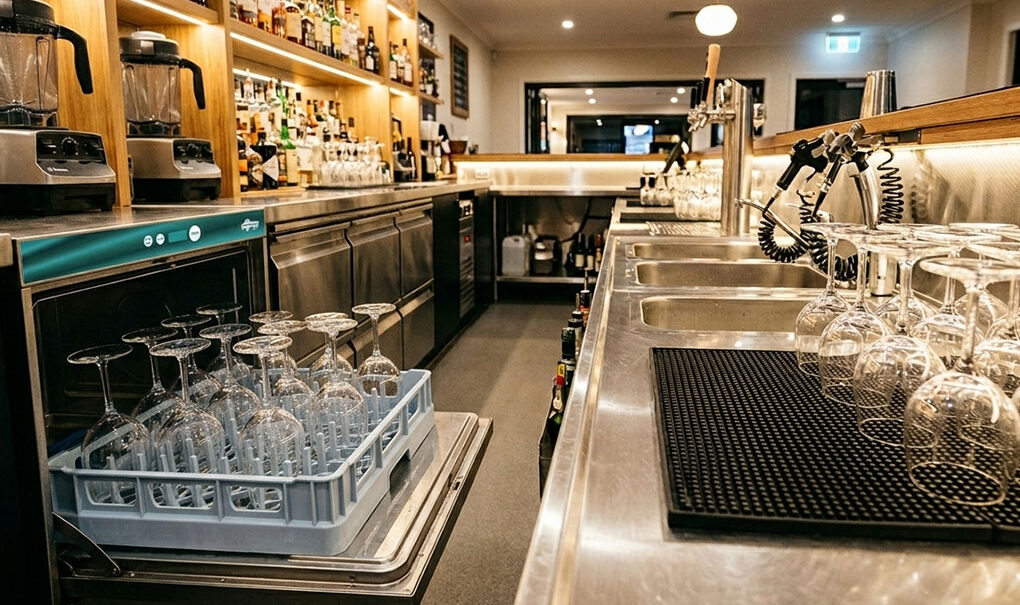
A commercial glasswasher is one of the most important pieces of equipment behind any bar — and one of the most commonly underspecified by new operators. The right machine processes a full rack of glasses in 90–120 seconds, returns them clean, spot-free and ready to serve, and sits under the bar so bartenders manage their own glassware without waiting on the kitchen. The wrong choice creates service failures on the nights you can least afford them.
- Glasswasher vs dishwasher: A dedicated commercial glasswasher uses lower temperatures and gentler pressure than a commercial dishwasher — it protects glassware from etching and breakage while delivering a spot-free finish that a standard dishwasher cannot reliably achieve on stemware.
- Size to your busiest hour: Calculate your peak glassware turnover per hour — not your average — and match the machine’s rack capacity accordingly. Running out of clean glasses during a Friday night service is a service failure that a correctly sized machine prevents.
- Underbench is the standard for bars: Most restaurant and bar commercial glasswashers are underbench models that sit behind the bar, allowing bartenders to manage their own glassware without sending everything to the kitchen.
- Hard water is a common problem in Australia: Mineral deposits leave spots and film on glasses. If your venue is in a hard water area, specify a model with a built-in water softener or budget for an external filtration system.
- Industry standard: The Eswood SW400 Smartwash is the benchmark underbench commercial glasswasher for Australian bars and restaurants — drain pump included as standard, no commissioning required, up to 1,200 glasses per hour.
For new operators planning a bar fit-out, choosing the right commercial glasswasher is a straightforward decision once you understand the key variables — venue type, glass throughput, water quality and installation requirements. This guide covers all of them. Browse Snowmaster’s full glasswasher range to see all available models.
Glasswasher vs Commercial Dishwasher — Why the Distinction Matters
A commercial dishwasher and a commercial glasswasher are not interchangeable for bar applications. The differences are meaningful for both glassware quality and bar workflow.
| Glasswasher | Commercial Dishwasher | |
|---|---|---|
| Wash temperature | Lower — typically 50–55°C wash, 60–65°C rinse | Higher — typically 60–65°C wash, 82–85°C rinse |
| Water pressure | Gentler spray pattern designed for stemware | Higher pressure suited to plates and cookware |
| Result on glassware | Spot-free, clear finish — no etching or cloudiness | Risk of etching, cloudiness and thermal shock on fine stemware over time |
| Cycle time | 90–120 seconds per rack | 120–180 seconds per rack |
| Location | Under the bar — bartender-managed | Back of house — kitchen-managed |
| Best for | Wine glasses, beer glasses, cocktail glassware, cups | Plates, bowls, cookware, trays |
Commercial Glasswasher Sizing by Venue Type
Small Bar or Café
A compact underbench glasswasher with a single rack capacity of 25–30 glasses and a 90-second cycle suits a small bar or café serving up to 60–80 covers. The Washtech XG and Classeq C400 are well-suited to tight bar spaces — both are designed for low water consumption in constrained locations. One machine is typically sufficient for this venue size.
Restaurant Bar (80–150 covers)
A mid-range underbench glasswasher with a rack capacity of 30–40 glasses and cycle options suits a restaurant bar serving 80–150 covers. Look for a model with variable cycle settings — a quick rinse for lightly soiled glasses during service and a longer wash cycle for heavily soiled or lipstick-marked glassware. The Washtech GM and Eswood SW400 are strong options at this volume.
High-Volume Bar or Pub (150+ covers)
A high-volume venue needs either a high-capacity underbench model or a dedicated pass-through glasswasher behind the bar. At 150+ covers with an active bar service, calculate your peak glass turnover — a venue serving 200 covers with table wine service and cocktails may turn 600–800 glasses in a three-hour service window. A machine that cannot keep up will create a clean-glass shortage mid-service.
Function or Event Venue
Function venues face extreme peak demand — a room of 200 guests at a cocktail event can generate hundreds of glasses in a single hour. For function venues, specify a pass-through glasswasher with a high rack-per-hour throughput, or plan for two underbench units operating simultaneously. Pre-event glass staging is also essential — ensure you have sufficient glass inventory to cover the first hour of service while the machines work through the initial load.
Commercial Glasswasher Features to Specify
Cycle Time and Throughput
Cycle time is the primary throughput variable. A 90-second cycle processes 40 racks per hour; a 120-second cycle processes 30 racks per hour. Multiply your rack capacity by your cycles per hour to get your maximum glass throughput. Always calculate this against your peak service hour, not your average — a machine that keeps up on a quiet Tuesday will fail on a busy Friday night if it is underspecified.
Water Softener and Hard Water Compatibility
Hard water is a significant issue in many Australian cities — Brisbane, Adelaide and parts of Sydney and Perth have notably hard water. Hard water leaves mineral deposits on glassware, producing a white film or spotting that no amount of rinsing removes. When specifying a glasswasher for a hard water area, choose either a model with a built-in water softener or plan for an external inline softener. This is not optional for venues serving premium wine or cocktails — spotted glasses undermine the presentation of every beverage served.
Drain Pump
A built-in drain pump is required if your waste outlet is elevated above the machine’s drain level — a common situation in bar fit-outs where the machine sits below the bar counter and the waste outlet is in the wall above. Confirm your plumbing configuration before purchasing. A machine without a drain pump installed into an elevated-drain position will not drain correctly and will require a costly retrofit.
Power Supply
Most underbench glasswashers operate on a standard 15-amp single-phase supply — the same as a domestic power point, but requiring a dedicated circuit. Some higher-capacity models require a three-phase supply. Confirm your bar’s electrical supply before specifying a model, particularly in older venues where three-phase power may not be available at the bar position.
Noise Level
An underbench glasswasher operates in the bar — not in a back-of-house kitchen. Noise level matters, particularly in wine bars, fine dining venues and any operation where the bar is adjacent to dining. Look for models with insulated doors that reduce operating noise. Washtech’s GM model features an insulated door specifically to reduce noise and heat output during operation.
The Industry Standard — Eswood SW400 Smartwash
For most Australian bar and restaurant operators, the Eswood SW400 Smartwash is the benchmark underbench commercial glasswasher. Eswood is a Goldstein brand — an Australian commercial kitchen equipment manufacturer established in 1932 — and the SW400 is the machine that appears behind the bar in venues across the country from small wine bars to hotel restaurants.
| Specification | Detail |
|---|---|
| Throughput | Up to 1,200 glasses per hour |
| Wash cycles | 60, 90 and 120 seconds — select to suit soil level |
| Water consumption | 1.9 litres per cycle — among the lowest in its class |
| Door opening height | 325mm — accommodates tallest stemware and large jugs |
| Dimensions | 435W × 530D × 690H mm |
| Power supply | 240V / 50Hz / single phase — standard bar circuit |
| Included as Standard | Notes |
|---|---|
| Drain pump | Fitted as standard — no retrofit required for elevated waste outlets |
| Detergent and rinse aid dispensers | Built in — no external dosing equipment needed |
| 430 × 360mm glass rack | Supplied; also accepts 400 × 400mm dish racks |
| Power cord, water and drain hoses | Supplied ready for installation; no commissioning required |
| Double-skinned door | Reduces heat and sound emissions during operation |
| Self-cleaning cycle | Easily removable spray arms and filters for daily maintenance |
HACCP and Compliance Features
The SW400’s one-touch control panel includes digital wash and rinse temperature displays — designed specifically for easy HACCP recording. Temperature visibility during operation simplifies compliance documentation and gives operators confidence that every cycle is meeting hygiene standards. The Thermostop function ensures the set rinse temperature is achieved before the cycle completes, preventing under-temperature rinses that would otherwise compromise sanitisation.
Operational Advantages
The self-diagnostic system identifies faults accurately, reducing service call-outs and keeping repair costs predictable. All service components are front-accessible, which minimises downtime when maintenance is required. The pressed wash tank and coved internal corners reduce bacteria accumulation and simplify daily cleaning — important in a bar environment where the machine is operated by bar staff rather than dedicated kitchen hands.
Commercial Glasswasher Installation Checklist
Before You Order
- Measure the underbench cavity — confirm height, width and depth clearance; glasswashers are typically 600mm wide × 600mm deep, but heights vary; measure your bar cavity before specifying a model
- Check drain outlet height — if your waste outlet is above the machine’s drain port, specify a model with a built-in drain pump
- Confirm power supply — most underbench glasswashers require a dedicated 15-amp single-phase circuit; confirm availability at the bar position with your electrician before ordering
- Check water hardness — contact your local water authority or use a test strip; if hardness exceeds 200 ppm, specify a model with a built-in softener or plan for an external softener
- Hot or cold water inlet — some glasswashers require a hot water connection (typically 60°C); others heat their own water from a cold supply; confirm the inlet requirement against your bar plumbing
- Ventilation — glasswashers produce steam during operation; confirm your bar has adequate ventilation or extraction, particularly in enclosed bar designs
Common Mistakes New Operators Make
Avoid These
- Using the kitchen dishwasher for bar glassware — high wash temperatures etch and cloud fine stemware over time; a dedicated glasswasher pays for itself in reduced glassware replacement costs alone at a wine-focused venue
- Undersizing for peak service — calculate glass throughput at your busiest hour; a machine that cannot keep pace during a Friday dinner service will cause a clean-glass shortage that stops bar service
- Ignoring water hardness — spotted glasses are the most common glasswasher complaint; most are caused by hard water, not machine fault; address the water quality before assuming the machine is the problem
- Not confirming drain configuration before purchase — retrofitting a drain pump after installation is avoidable with a ten-minute plumbing check before ordering
- Forgetting detergent and rinse aid — a glasswasher without correctly dosed detergent and rinse aid will not produce clean, spot-free results regardless of the machine’s quality; budget for chemical consumables as an ongoing operating cost
Frequently Asked Questions
Do I need a glasswasher if I already have a commercial dishwasher?
For most bar operations, yes. A commercial dishwasher runs at higher temperatures and pressures that are designed for plates and cookware — not stemware. Repeated cycles in a standard dishwasher will etch and cloud fine wine glasses and cocktail glassware over time. A dedicated glasswasher protects your glassware investment, produces a spot-free finish and keeps bar operations independent from the kitchen dishwashing cycle. It also allows bartenders to manage their own glassware behind the bar rather than waiting on the kitchen.
How many glasses can a commercial glasswasher clean per hour?
An underbench glasswasher with a 90-second cycle and a 25-rack capacity processes approximately 40 racks per hour. At 16 glasses per rack, that is around 640 glasses per hour — sufficient for most restaurant bar applications. High-volume venues or function operations should specify a model with a shorter cycle time or a pass-through configuration for higher continuous throughput.
Why do my glasses come out spotted even after washing?
Spotting on glassware after washing is almost always caused by one of three things: hard water mineral deposits, insufficient rinse aid dosing, or a blocked rinse arm. Check your water hardness first — if it exceeds 200 ppm, a water softener is the fix. If water hardness is within acceptable range, check that your rinse aid dispenser is set correctly and that the rinse arms are clear of blockages. Regular cleaning of the rinse arms and filter is part of daily maintenance on any glasswasher.
What is the difference between an underbench and a pass-through glasswasher?
An underbench glasswasher loads and unloads from the top — the operator places a rack in, closes the lid and starts the cycle. A pass-through glasswasher allows a rack to enter from one side and exit from the other, enabling continuous loading without waiting for each cycle to complete. Pass-through models suit higher-volume venues where throughput is the primary constraint. Most restaurant and small to mid-volume bar applications are well-served by an underbench model.
Can I finance a glasswasher through Snowmaster?
Yes. All Snowmaster glasswashers are available through SilverChef Rent-Try-Buy, Geared Finance and Shift Payments. SilverChef approvals up to $65,000 take as little as 10 minutes — bring your photo ID, ABN and proof of business address. Read our commercial kitchen equipment finance guide for a full explanation of each option, or apply for SilverChef finance through Snowmaster directly.
Snowmaster stocks commercial glasswashers from Washtech, Classeq, Eswood, Winterhalter and Adler — underbench and pass-through models available for delivery across Australia. Our team can help you match the right machine to your bar layout, glass volume and water supply.
Browse Commercial Glasswashers →
Also browse: Commercial Dishwashers · Bar Fridges · Beverage Equipment · Finance Options · Contact Us