

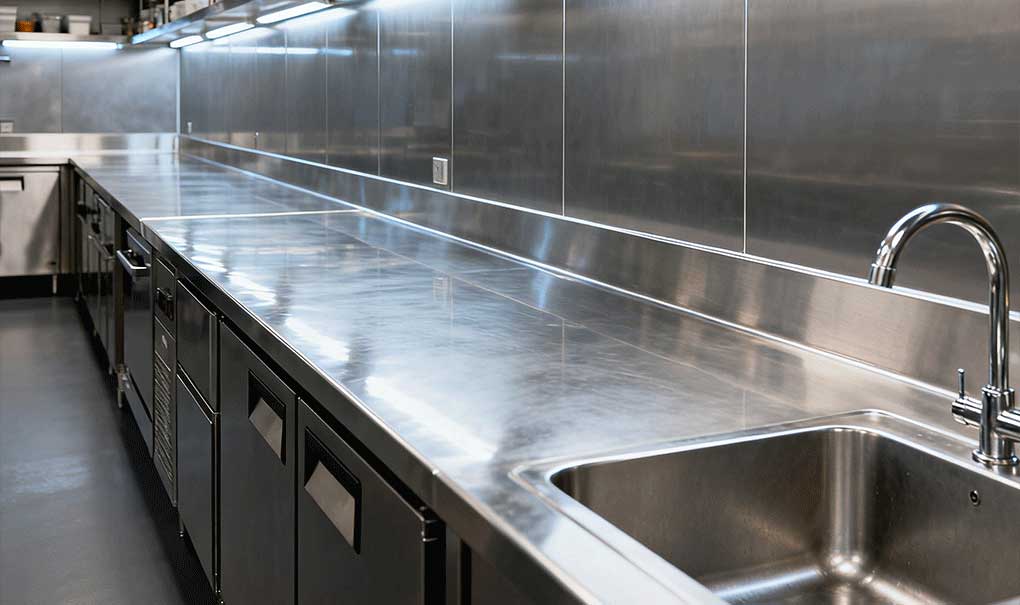
Stainless Steel Benches for Commercial Kitchens: The Complete Guide
- Steel grade: 304 grade for any wet zone, near sinks, or direct food contact — 430 is for dry storage only. When in doubt, buy 304.
- Gauge: 16-gauge suits most commercial kitchens; 14-gauge for heavy equipment stands; 18-gauge for shelving and low-demand areas.
- Splashback: Required for any bench positioned against a wall — prevents food and water reaching the wall surface and simplifies FSANZ compliance.
- Sink type: Double sink for most commercial wash-up areas; single for supplementary positions; pot sink for oversized cookware.
- Dishwasher benches: Size your inlet and outlet benches generously — cramped dishwasher runs are one of the most common kitchen bottlenecks.
- Top brand: FED supplies the full Snowmaster stainless range — 141 products across 12 sub-categories, all manufactured to commercial Australian standards.
Stainless steel is the backbone of every serious commercial kitchen. It lines your prep areas, holds your sinks, organises your shelving, and anchors your dishwashing runs. Yet for something so fundamental, it is surprisingly easy to buy the wrong thing — the wrong grade for a wet zone, the wrong gauge for heavy equipment, or bench lengths that choke your traffic flow.
This guide covers the full range of stainless steel kitchen equipment available through Snowmaster: workbenches, kitchen benches with splashbacks, mobile workbenches, corner benches, sinks, overshelves, pot shelves, wall shelves, and dishwasher inlet and outlet benches. Whether you are fitting out a new commercial kitchen or replacing ageing infrastructure, here is what you need to know. Browse the full range of stainless steel benches to see all available configurations.
304 vs 430 Grade — Which Do You Need?
The grade of stainless steel is the single most important specification decision you will make. In Australia’s commercial kitchen market, you will primarily encounter two grades: 304 and 430.
Grade 304
- Contains 18% chromium and 8% nickel — excellent corrosion resistance
- Resists moisture, acids, and chloride-based cleaning agents
- Non-magnetic; the industry standard for commercial kitchen equipment
- Required for any surface near sinks, dishwashers, or plating areas
- Ideal for coastal locations and high-humidity environments
- Best for: All wet zones, direct food contact surfaces, any bench near water
Grade 430
- Contains 17% chromium, no nickel — magnetic and more budget-friendly
- Less corrosion-resistant than 304; not suitable for wet environments
- Appropriate for dry storage and general prep away from water sources
- Lower upfront cost, but significantly shorter lifespan in wet conditions
- Avoid chlorine-based cleaners — they accelerate corrosion in 430 grade
- Best for: Dry storage benches, indoor areas with good ventilation, budget fitouts in dry zones only
Steel Gauge: Understanding Thickness
Gauge measures the thickness of the steel sheet. A lower gauge number means thicker, heavier steel — so 14-gauge is stronger than 18-gauge.
| Gauge | Thickness | Best Use |
|---|---|---|
| 14-gauge | ~2mm | Heavy-duty benches supporting large equipment — combi ovens, planetary mixers, spiral mixers. High-traffic prep stations in large kitchens. |
| 16-gauge | ~1.6mm | The commercial workhorse. Suits the vast majority of kitchen bench applications — standard prep, equipment stands, dishwasher benches. |
| 18-gauge | ~1.2mm | Light commercial. Fine for shelving, overshelves and low-demand prep areas. Not recommended for holding heavy equipment. |
Workbenches and Kitchen Benches
Kitchen benches and workbenches form the foundation of your prep workflow. Snowmaster stocks an extensive FED range in widths from 300mm to 1800mm, with and without splashbacks.
Stainless Steel Kitchen Benches
The standard choice for any bench positioned against a wall. The built-in splashback prevents food and water from reaching the wall, simplifying cleaning and maintaining FSANZ compliance. Available in 600mm to 1800mm widths with adjustable feet.
Stainless Steel Tables
Freestanding configuration without splashback — suited for island positions away from walls. The open design allows trolleys, bins, and storage containers to slide underneath. Available with or without undershelves.
Mobile Workbenches
Mounted on heavy-duty lockable castors for full repositioning flexibility. Ideal for kitchens that serve multiple functions, off-site catering, or whenever a prep station needs to move for deep cleaning.
Corner Workbenches
Maximises corner spaces that would otherwise be awkward. Designed to meet adjacent benches cleanly, creating a continuous working surface. Available with splashback and ideal for full bench run fitouts.
Commercial Sinks: Single, Double, and Pot Sinks
Selecting the correct sink configuration is about more than capacity — it is about complying with food safety requirements and supporting efficient workflow.
Single Sinks
- Compact solution for smaller operations or secondary sink positions
- Typically include a splashback and lower shelf for storage
- Suitable where space is limited and wash volume is low
- Browse commercial single sinks →
Double Sinks
- Twin-basin configuration allows simultaneous washing and rinsing
- The standard for most commercial kitchen wash-up areas
- Often required by local council or state health authority for certain operations
- Most models include a pot shelf below for storing large cookware
- Browse commercial double sinks →
Pot Sinks
Deep, large-capacity sinks for oversized cookware that will not fit in a commercial dishwasher. Essential for kitchens running large-format stockpots, baking trays, or catering-grade cookware. Reinforced construction handles the weight of full commercial pots.
Stainless Steel Shelving: Overshelves, Wall Shelves, and Pot Shelves
Effective use of vertical space is what separates a well-organised kitchen from a cramped one. Plan your shelving at the same time as your bench configuration — the widths and heights need to align.
Stainless Steel Overshelves
Mounts directly to the workbench frame, sitting 400–450mm above the bench surface. Single-tier and double-tier configurations available. Double-tier overshelves dramatically increase storage capacity without adding any floor space.
Stainless Steel Wall Shelves
Solid-surface or pipe-frame configurations, fixed directly to the kitchen wall. Solid shelves suit wet storage applications. Pipe shelves allow better air circulation for dry goods. Available in widths from 600mm to 1800mm.
Stainless Steel Pot Shelves
Heavy-duty lower-mounted shelves designed to hold the weight of large stockpots, baking dishes, and commercial cookware. Reinforced construction handles significantly higher loads than standard wall shelves.
Stainless Steel Shelves
Tough, hardwearing kitchen shelving for general storage. Ideal for ingredients, containers, and equipment within easy reach of prep stations. A well-planned vertical storage system can effectively double your usable storage without adding floor space.
Dishwasher Inlet and Outlet Benches
A critical and often overlooked part of any warewashing setup. Without proper inlet and outlet benches, your dishwashing operation becomes a bottleneck — staff cannot pre-sort dishes efficiently, and clean items have nowhere safe to stack and air-dry.
Inlet Benches
- Sits on the dirty side of your dishwasher
- Provides a hygienic staging area for pre-scraping, sorting and loading racks
- Built-in splashback and lower shelf are standard features
- Available in left and right-hand configurations
- Minimum 900mm — size generously; cramped inlets slow the entire cycle
- Browse inlet benches →
Outlet Benches
- Receives clean, hot items exiting the dishwasher
- Must be large enough for items to cool and air-dry before returning to storage
- Available in left and right-hand outlet orientations
- Suits under-bench, pass-through, and conveyor dishwashers
- Plan for at least two full racks of clean items stacked simultaneously
- Browse outlet benches →
Planning Your Kitchen Layout
The best stainless steel equipment will not help if it is arranged poorly. The following principles apply to any commercial kitchen bench layout.
Layout Planning Checklist
- Work triangle — position your main prep bench to connect your cooking stations and cold storage (upright fridges, under-bench fridges) in a logical flow that minimises staff travel during service
- Traffic flow clearances — minimum 900mm for a single-person aisle; 1200–1500mm for two-person aisles in medium and large operations
- Kitchen zoning — use your bench layout to create clear cold prep, hot prep, plating, and dishwashing zones; physical separation reduces cross-contamination risk and simplifies staff training
- Vertical storage planning — plan your overshelves and wall shelves at the same time as your bench run; a well-planned vertical system can effectively double your usable prep-area storage without adding floor space
- Bench sizing — add 20% to your initial estimate; in a busy service, every surface fills quickly with mise en place, plated dishes, equipment, and ingredients
- Adjustable feet — commercial kitchen floors are rarely perfectly even; confirm any bench you select has adjustable feet for a firm, level setup
Cleaning and Maintenance
Stainless steel is durable but not indestructible. Proper care extends its life and maintains the food-safe surface integrity required by Australian health regulations under Standard 3.2.3.
Daily Cleaning
- Use warm water with a mild detergent and a soft cloth or non-abrasive pad
- Always wipe in the direction of the steel’s grain — wiping against the grain causes micro-scratches that trap bacteria over time
- After cleaning, rinse thoroughly with clean water to remove detergent residue
- Dry with a clean cloth to prevent water spots and mineral deposits
Deep Cleaning and Sanitisation
- Use a food-safe commercial sanitiser approved under AS 4674 (construction and fitout of food premises)
- Always follow manufacturer’s dilution and contact time instructions
- For tougher grime, use a non-abrasive specialised stainless steel cleaner
- Surface discolouration (rainbow-like staining) is caused by heat and is aesthetic only — commercial stainless cleaners with mild abrasive will restore the finish
What to Avoid
- Steel wool and abrasive pads — scratch the surface and create areas for bacteria to colonise
- Bleach-based cleaners on 430 grade — the chlorine accelerates corrosion; use only on 304 grade and rinse thoroughly
- Acidic foods left sitting — citrus, tomato, and vinegar left on the surface for extended periods can cause pitting
- Carbon steel utensils — can leave rust deposits on the stainless surface
- Wrong grade for the location — a 430-grade bench in a wet dishwashing area will rust within months; always confirm grade before purchase
Common Buying Mistakes
Avoid These
- Choosing 430 grade for wet areas — the most costly mistake; a 430-grade bench near a sink or dishwasher will rust quickly; the upfront saving is quickly erased by replacement costs
- Underestimating bench length — add 20% to your initial estimate; more bench space is almost always better in a commercial kitchen
- Not planning overshelves at the same time — overshelves are easy to add later but heights and widths must align with your bench; plan together to ensure correct sizing
- Wrong sink size for your volume — a single sink in a high-volume operation is a constant bottleneck; match your configuration to your actual throughput and regulatory requirements
- Insufficient dishwasher outlet bench — clean items stacking up blocks the dishwasher exit and slows the entire cycle; plan for at least two full racks of clean items simultaneously
- Ignoring adjustable feet — a bench without adjustable feet wobbles on uneven floors, creating an unstable and potentially dangerous work surface
Frequently Asked Questions
What is the best stainless steel grade for a commercial kitchen sink?
Grade 304 is the correct choice for commercial kitchen sinks. Its nickel content gives it the corrosion resistance needed to withstand constant water exposure, acidic food residues, and commercial cleaning chemicals. Grade 430 is not recommended for sink applications and will rust in a wet environment.
What gauge stainless steel bench do I need?
16-gauge suits the vast majority of commercial kitchen applications — standard prep benches, equipment stands, and dishwasher benches. Choose 14-gauge if the bench will support heavy equipment such as a combi oven or planetary mixer. 18-gauge is appropriate for shelving and low-demand areas only.
Do I need a splashback on my stainless steel bench?
Yes, for any bench positioned against a wall. A splashback prevents water, grease, and food debris from reaching the wall surface, which greatly improves hygiene and simplifies cleaning. Splashbacks are formed as part of the bench top during manufacture and cannot be retrofitted after purchase — decide at the time of ordering.
What size dishwasher inlet bench do I need?
A minimum of 900mm is the practical starting point. For higher-volume operations or kitchens with pass-through dishwashers, a 1200mm or 1500mm inlet bench allows staff to pre-sort and rack dishes without creating a queue at the machine.
What is the difference between an overshelf and a wall shelf?
An overshelf is a freestanding unit that mounts directly to the workbench frame, sitting above the bench top — no wall fixing required. A wall shelf is fixed to the wall independently of any bench. Overshelves are used directly above prep benches; wall shelves suit general storage away from benches.
How do I choose between a single and double sink?
A double sink is the standard for most commercial kitchen wash-up areas — the twin-basin configuration allows simultaneous washing and rinsing, which is an important hygiene consideration and is often required by local food safety regulations. A single sink suits supplementary positions or smaller operations with low wash volume. A pot sink is needed for any operation running large-format cookware that will not fit in a standard dishwasher.
Snowmaster stocks over 140 stainless steel products from FED across every configuration you will need — kitchen benches, mobile benches, corner benches, single and double sinks, pot sinks, overshelves, wall shelves, pot shelves, and dishwasher inlet and outlet benches. Delivery across Australia.
Browse Stainless Steel Equipment →
Also browse: Kitchen Benches · Stainless Steel Tables · Double Sinks · Overshelves · Contact Us