

Commercial Conveyor Dishwasher Buying Guide Australia 2026
Quick Summary
- Who needs one: Any operation washing 80+ racks per hour — pubs, clubs, hotels, large restaurants, aged care facilities, stadiums, and event venues.
- Capacity: Snowmaster’s range runs from 100 racks/hour (Eswood ES100) up to 240 racks/hour (Washtech CD240 / CDE240).
- Stages: Two-stage (wash + rinse) suits most operations; three-stage adds a pre-wash tank; four-stage adds a pre-rinse for the highest-volume environments.
- Heat condensing: Washtech CDE models add a heat recovery unit that captures steam and hot air — significantly reducing kitchen humidity and energy costs over time.
- Power: Conveyor dishwashers run on three-phase 415V power — confirm your electrical supply before purchasing.
- Brands: Eswood for proven Australian reliability; Washtech for broader configuration range including premium heat condensing models.
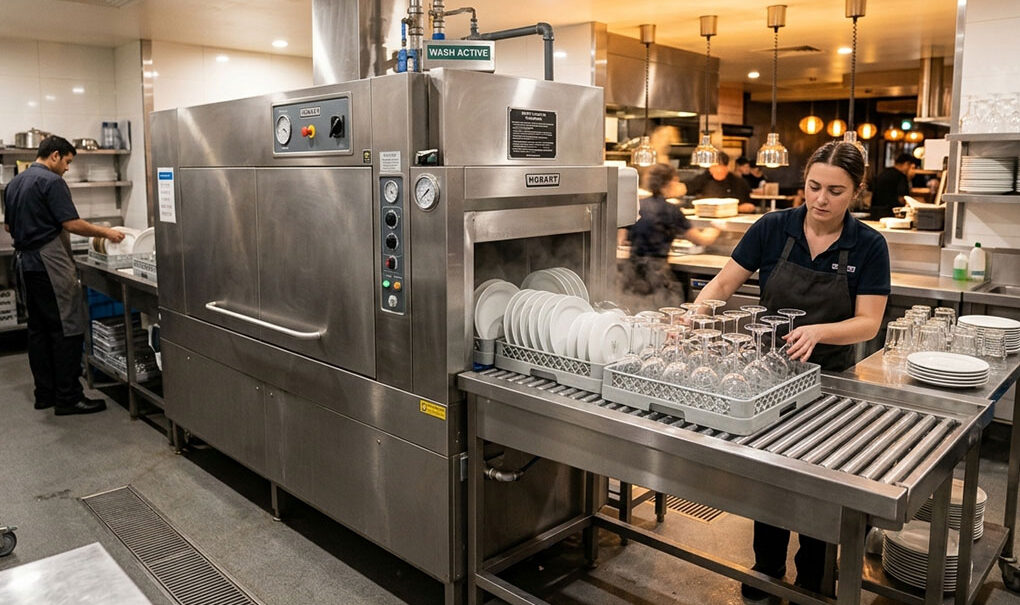
A commercial conveyor dishwasher is the warewashing engine of high-volume hospitality. Where an under-bench dishwasher washes one rack at a time and a pass-through dishwasher handles medium volume, a conveyor machine runs continuously — items loaded at one end travel through wash, rinse and dry zones on a belt, emerging clean at the other end without stopping the cycle.
For the right operation, a conveyor dishwasher transforms what would otherwise be an exhausting, labour-intensive bottleneck into a smooth, predictable process. For the wrong operation, it’s an expensive machine running at a fraction of its capacity. This guide covers how to determine which side of that line you’re on — and how to choose the right unit if a conveyor is the answer.
Browse the full range of commercial conveyor dishwashers at Snowmaster.
Conveyor vs Pass-Through vs Under-Bench: Which Do You Need?
The three commercial dishwasher types serve fundamentally different volume levels. Choosing the right type before comparing models within that type is the most important decision you’ll make.
| Type | Typical Capacity | Best For | Entry Price |
|---|---|---|---|
| Under-Bench | 20–40 racks/hour | Small cafés, bars, low-volume kitchens | ~$2,000+ |
| Pass-Through | 40–80 racks/hour | Mid-size restaurants, pubs, catering kitchens | ~$6,000+ |
| Conveyor | 100–240+ racks/hour | Hotels, clubs, aged care, stadiums, large venues | ~$18,500+ |
Who Uses a Conveyor Dishwasher?
Hotels & Resorts
Hotels and Function Venues
Banquet and conference venues turning over hundreds of covers per sitting need conveyor throughput to clear tables at pace. A 200-cover function generates more warewashing in two hours than a mid-size restaurant produces in a full day.
Licensed Venues
Pubs and Clubs
RSLs, sporting clubs and large pubs combine high glassware volume with food service requirements. Conveyor machines handle the glass-to-plate mix efficiently, particularly when paired with commercial glasswashers for the bar side.
Care Facilities
Aged Care and Healthcare
Centralised kitchen operations serving large resident or patient populations require consistent, compliant warewashing throughput across every service. Conveyor machines deliver the reliability and sanitation temperatures required by AS 4674 and relevant health standards.
Institutional
Schools, Hospitals and Stadiums
Centralised catering operations, event kitchens and stadium concessions face intense but irregular peaks. A conveyor dishwasher manages those peaks without requiring large additional labour — one or two operators can run the machine continuously.
Wash Stages: Two, Three, or Four?
The number of wash stages determines the machine’s cleaning thoroughness and its ability to handle heavily soiled loads. More stages add length, cost, and water consumption — but also improve results on difficult loads.
Two-Stage (Wash + Rinse)
- Pre-scrape by hand, then wash tank, then final hot rinse
- Suits operations with reasonable pre-scraping discipline and moderate soil levels
- Shorter machine footprint — better for tighter warewashing areas
- Lower water and energy consumption than three or four-stage
- Models: Washtech CD120, Washtech CDE120
- Best for: Most hotels, restaurants, and clubs with good pre-scrape practices
Three-Stage (Pre-Wash + Wash + Rinse)
- Dedicated pre-wash tank loosens heavy soiling before the main wash cycle
- Better results on heavily soiled loads — food service, banqueting, kitchen pots
- Reduces detergent consumption by removing heavy soil before the main wash
- Longer machine but significantly more forgiving of inconsistent pre-scraping
- Models: Washtech CD180, Washtech CDE180, Eswood ES150, Eswood ES160
- Best for: High-volume kitchens, aged care, banqueting operations
Standard vs Heat Condensing: The Washtech CDE Series
One of the most significant decisions in the Snowmaster conveyor range is whether to specify a standard CD model or a premium CDE model with Washtech’s integrated heat condensing unit.
Standard (CD Series)
Heat Condensing (CDE Series)
- Integrated heat recovery unit captures steam and hot exhaust air before it enters the kitchen
- Significantly reduces kitchen humidity — important in enclosed or poorly ventilated areas
- Recovers heat energy to pre-heat incoming water, reducing energy consumption
- Better staff comfort during long dishwashing runs
- Higher upfront cost — offset by energy savings and reduced ventilation requirements
- Models: CDE120, CDE180, CDE240
Model Guide: Eswood vs Washtech
Snowmaster’s conveyor range is split between two brands, each with a distinct product philosophy.
| Model | Brand | Capacity | Stages | Heat Condensing | Price (ex GST) |
|---|---|---|---|---|---|
| Eswood ES100 | Eswood | 100 racks/hr | 2 | No | $18,500 |
| Eswood ES150 | Eswood | 150 racks/hr | 3 | No | $25,722 |
| Washtech CD120 | Washtech | 120 racks/hr | 2 | No | $26,255 |
| Eswood ES160 | Eswood | 160 racks/hr | 3 | No | $31,432 |
| Washtech CD180 | Washtech | 180 racks/hr | 3 | No | $35,171 |
| Washtech CD240 | Washtech | 240 racks/hr | 4 | No | $51,022 |
| Washtech CDE120 | Washtech | 120 racks/hr | 2 | Yes | POA |
| Washtech CDE180 | Washtech | 180 racks/hr | 3 | Yes | POA |
| Washtech CDE240 | Washtech | 240 racks/hr | 4 | Yes | POA |
Eswood
- Australian brand with a long track record in commercial warewashing
- ES range offers three capacity tiers: 100, 150 and 160 racks/hour
- Strong value at the entry and mid-range conveyor price points
- Top-mounted control panel away from water splash zones
- Electronic temperature control with digital display for wash and rinse cycles
- Best for: Operations wanting proven Australian reliability at competitive pricing
Washtech
- Broader range: 120 to 240 racks/hour across standard and premium CDE configurations
- Only brand in the Snowmaster range offering heat condensing technology
- Four-stage CD240/CDE240 for the highest-volume applications
- CDE series suited to enclosed warewashing areas or operations prioritising energy recovery
- Best for: Operations needing higher throughput, heat condensing, or four-stage wash capability
How to Size Your Conveyor Dishwasher
Buying a conveyor that’s too small creates a bottleneck that defeats the purpose of the machine. Buying one that’s too large wastes capital and operating costs. The right sizing starts with an honest assessment of your peak warewashing demand.
Sizing Calculation
- Count your peak covers: How many covers does your operation turn over at peak service? A 200-cover restaurant might generate 400–600 individual pieces of crockery and cutlery per service.
- Estimate racks per service: A standard 500x500mm rack holds approximately 20–25 plates or 25–36 glasses. Divide your total pieces by rack capacity to estimate racks per service.
- Identify your service window: If 150 racks need to be washed in a 2-hour service window, you need a minimum of 75 racks/hour — a conveyor entry point. If that same volume needs to clear in 90 minutes, you need 100 racks/hour minimum.
- Add a 20% buffer: Always size up slightly. Peak service is rarely perfectly uniform — a 20% buffer prevents the machine from being the constraint during your busiest moments.
- Account for future growth: If you’re planning to expand covers or add a function room in the next 2–3 years, size for that capacity now rather than replacing the machine later.
Installation Requirements
A conveyor dishwasher is a significant infrastructure commitment, not a plug-in appliance. Plan your installation carefully before ordering.
Pre-Installation Checklist
- Three-phase power (415V/50Hz/3N) — all conveyor dishwashers in this range require three-phase power; confirm your switchboard has the capacity and a licensed electrician can run a dedicated circuit to the machine location
- Hot water supply — most models connect to a hot water supply at 60°C minimum; confirm your hot water system can deliver the required flow rate (Eswood ES100: up to 350 litres/hour)
- Water pressure — confirm adequate mains pressure at the installation point; low pressure affects rinse temperature and cycle performance
- Drain connection — gravity drain models (including Eswood ES100) require the machine to be positioned above the drain outlet; confirm floor waste position before planning machine placement
- Inlet and outlet bench space — conveyor machines require inlet benches for sorting and loading and outlet benches for stacking clean items; allow at least 1200–1500mm on each side
- Exhaust ventilation — standard CD models require an exhaust canopy positioned above the machine to extract steam and hot air; CDE models significantly reduce (but do not eliminate) this requirement
- Floor drainage — ensure adequate floor drainage around the machine position; spillage during loading and unloading is normal in high-volume dishwashing operations
- Ceiling height — conveyor machines have a fixed height profile; confirm adequate ceiling clearance including any exhaust canopy above
Understanding Operating Costs
The purchase price of a conveyor dishwasher is only part of the cost picture. Operating costs over the machine’s life — typically 10–15 years for a well-maintained unit — often dwarf the upfront investment.
| Cost Factor | What to Consider |
|---|---|
| Water consumption | The Eswood ES100 consumes up to 350L/hour at maximum capacity. At full operation across a 4-hour service, that’s 1,400L — factor this into your water costs, particularly in water-restricted regions. |
| Energy consumption | Conveyor dishwashers draw significant power — the ES100 runs at 23.5kW. Three-phase power is cheaper per kW than single-phase, but total consumption is substantial. CDE heat condensing models partially offset this through heat recovery. |
| Detergent and rinse aid | High-volume machines consume chemicals at scale. Three and four-stage machines with pre-wash tanks can reduce detergent usage in the main wash by removing heavy soiling earlier in the process. |
| Labour | A conveyor typically requires 1–2 operators: one loading dirty items, one unloading and stacking clean items. The machine itself runs continuously without intervention. |
| Maintenance | Regular descaling, filter cleaning, and spray arm inspection are essential. Neglected machines develop scale buildup that reduces wash temperature, increases energy consumption, and shortens machine life. |
Maintenance
A conveyor dishwasher running at 120–240 racks/hour accumulates scale, food debris, and chemical residue faster than any other dishwasher type. Consistent maintenance is non-negotiable.
After Every Service
- Drain and flush the wash and pre-wash tanks completely
- Remove and clean all filters and strainer baskets — blocked filters reduce wash pressure and temperature
- Wipe down the interior curtains and conveyor belt
- Leave the machine open to air-dry overnight — closed machines trap moisture and develop odour
Weekly
- Remove and inspect all spray arms — clear blocked nozzles with a fine wire or compressed air
- Check wash and rinse temperatures are reaching specification (wash: 60–65°C; rinse: 82°C minimum) using a calibrated thermometer
- Inspect the conveyor drive system and belt for wear or misalignment
- On water-cooled or heat condensing models, check water connections and confirm flow is unobstructed
Common Maintenance Failures
- Scale buildup on heating elements — hard water causes rapid scale accumulation on heating elements, reducing efficiency and eventually causing element failure; descale on a regular schedule appropriate to your water hardness
- Blocked spray arms — the most common cause of poor wash results; a spray arm with 20% of nozzles blocked delivers noticeably worse cleaning performance at the affected rack positions
- Insufficient rinse temperature — if rinse temperature drops below 82°C, items will not sanitise correctly and will emerge wet rather than flash-drying; check elements and thermostat calibration immediately
- Conveyor belt drift — belts can drift sideways over time; check alignment weekly and adjust per the manufacturer’s guidance before it becomes a machine stoppage issue
- Filter neglect — running a conveyor with blocked filters forces the pump to work harder, reduces wash pressure, and accelerates pump wear; filters must be cleaned after every service
Common Buying Mistakes
Avoid These
- Undersizing for peak demand — buying a 100 rack/hour machine for an operation that genuinely needs 140 racks/hour at peak means the machine is the constraint from day one; size for your peak, not your average
- Ignoring bench infrastructure — a fast conveyor surrounded by inadequate inlet and outlet bench space will be immediately limited by the speed at which staff can load and unload it; plan the full dishwashing run, not just the machine
- Underestimating power requirements — three-phase 415V is not available in all buildings without infrastructure upgrades; confirm your electrical supply before purchasing
- Choosing standard over CDE in an enclosed space — standard CD models vent significant heat and steam into the kitchen; in an enclosed warewashing area without a large exhaust canopy this creates serious staff welfare and condensation issues
- Not accounting for water hardness — hard water areas (most of inland and northern Australia) require more frequent descaling and may require a water softener; factor this into your operating cost assessment
- Buying on price alone without comparing stages — a two-stage machine costs less but requires more consistent pre-scraping discipline; a three-stage machine is more forgiving and often the better long-term value in high-volume environments
Frequently Asked Questions
What is the difference between a conveyor dishwasher and a pass-through dishwasher?
A pass-through dishwasher washes one rack at a time — staff load a rack, the door closes, the cycle runs (typically 60–120 seconds), then the rack is removed. A conveyor dishwasher runs continuously — items travel through wash and rinse zones on a moving belt without stopping the cycle. Conveyor machines are designed for operations needing 100+ racks per hour; pass-through machines suit 40–80 racks per hour.
Do conveyor dishwashers need three-phase power?
Yes. All conveyor dishwashers in Snowmaster’s range require 415V three-phase power (415V/50Hz/3N). This is standard in commercial premises but not always available without an electrical infrastructure upgrade. Confirm your switchboard capacity and discuss a dedicated circuit with a licensed electrician before purchasing.
What does the rack-per-hour rating mean in practice?
The rack-per-hour rating is the machine’s maximum throughput under ideal conditions. In practice, your real-world throughput will be somewhat lower — limited by how quickly staff can load and unload, pre-scrape consistency, and any interruptions during service. A good rule of thumb is to plan for 80% of the rated capacity as your sustainable service throughput, and use the rated capacity as your peak buffer.
What is a heat condensing unit on a conveyor dishwasher?
A heat condensing unit (fitted to Washtech CDE models) captures the steam and hot exhaust air that a standard conveyor machine vents into the kitchen. It condenses that steam back to water, recovers the heat energy to pre-warm incoming rinse water, and returns drier, cooler air to the kitchen environment. The result is lower kitchen humidity, better staff comfort, and reduced energy consumption — at a higher upfront cost.
How much water does a conveyor dishwasher use?
Water consumption varies by model and load. The Eswood ES100 consumes up to 350 litres per hour at maximum capacity. Scaled across a 3–4 hour service, this represents significant water usage. Three and four-stage machines use more water in total but can be more efficient per rack when running at capacity, as the pre-wash tank reduces the soil load on the main wash tank and extends the time between tank changes.
How long does a commercial conveyor dishwasher last?
A well-maintained conveyor dishwasher from a quality brand should last 10–15 years in commercial use. The key variables are water hardness (hard water accelerates scale damage), maintenance frequency, and daily cleaning discipline. Machines in operations that consistently clean filters, descale on schedule, and maintain correct wash temperatures significantly outlast those that don’t.
Snowmaster stocks commercial conveyor dishwashers from Eswood and Washtech — 100 to 240 racks per hour, two to four-stage wash configurations, and standard or heat condensing models. Finance available from $33.54 + GST/day. Our team can help you match the right configuration to your volume, space, and infrastructure.
Also browse: Pass-Through Dishwashers · Under-Bench Dishwashers · Glass Washers · All Dishwashers · Contact Us