

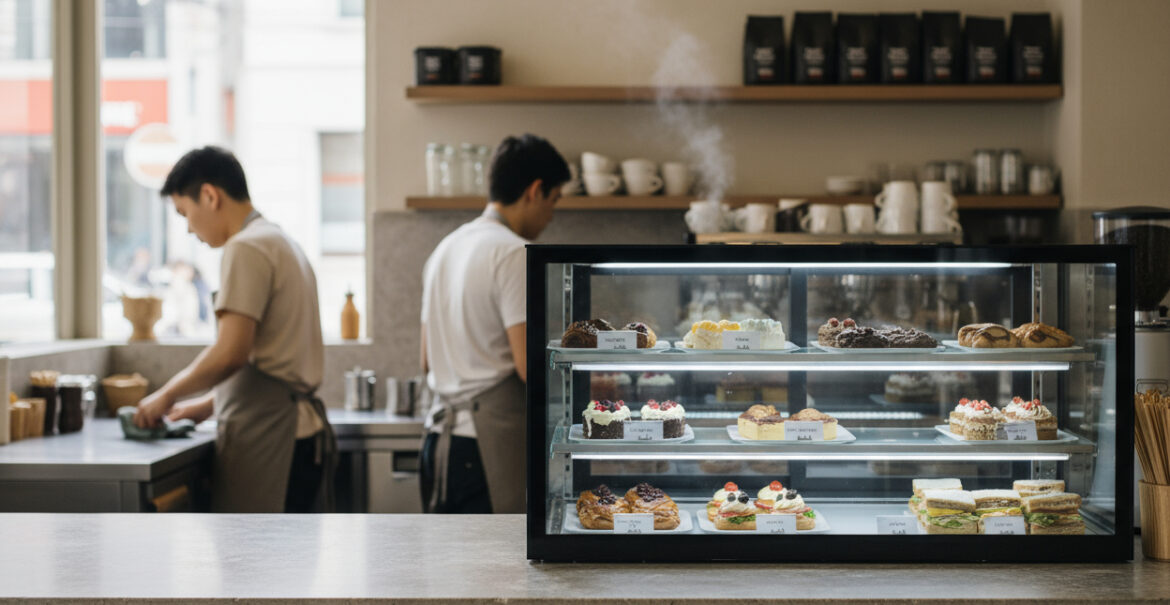
Cake Display Buying Guide 2026: Elevate Your Dessert Presentation
- Type: Benchtop for impulse sales near the register; floor-standing curved or square glass for full counter integration; vertical rotating display for premium patisseries with tall product.
- Cooling: Fan-forced (dynamic) cooling is essential — static cooling creates temperature stratification and hot spots that melt icing and dry out sponge.
- Temperature: 2°C–8°C is the correct range for cakes and pastries — below 2°C dries out sponge; above 8°C risks cream breakdown and bacterial growth.
- Glass: Double-glazed or Low-E coated glass prevents condensation fogging and reduces heat ingress from the room.
- Placement: Away from direct sunlight, heat sources and air conditioning vents — all three cause temperature instability and compressor strain.
- Compliance: FSANZ Standard 3.2.2 requires chilled food to be held at or below 5°C — confirm your unit holds this reliably under real trading conditions.
A cake display fridge is one of the few pieces of commercial equipment that does two jobs simultaneously — it keeps product safe and it sells product. The right unit showcases your cakes and pastries under proper lighting at the correct temperature, drives impulse purchases at the point of sale, and protects the integrity of delicate fillings and finishes through an entire trading day.
Getting it wrong is expensive in multiple directions: product quality suffers, food safety is at risk, and the presentation that should be working for you actively undermines it. This cake display fridge buying guide covers everything you need to choose the right unit — types, cooling systems, glass specifications, sizing, placement, compliance, maintenance and top brands.
Types of Cake Display Fridges
Cake display fridges come in several formats, each suited to different store layouts, product ranges and service styles. Choosing the right format before comparing models saves time and avoids buying the wrong configuration entirely.
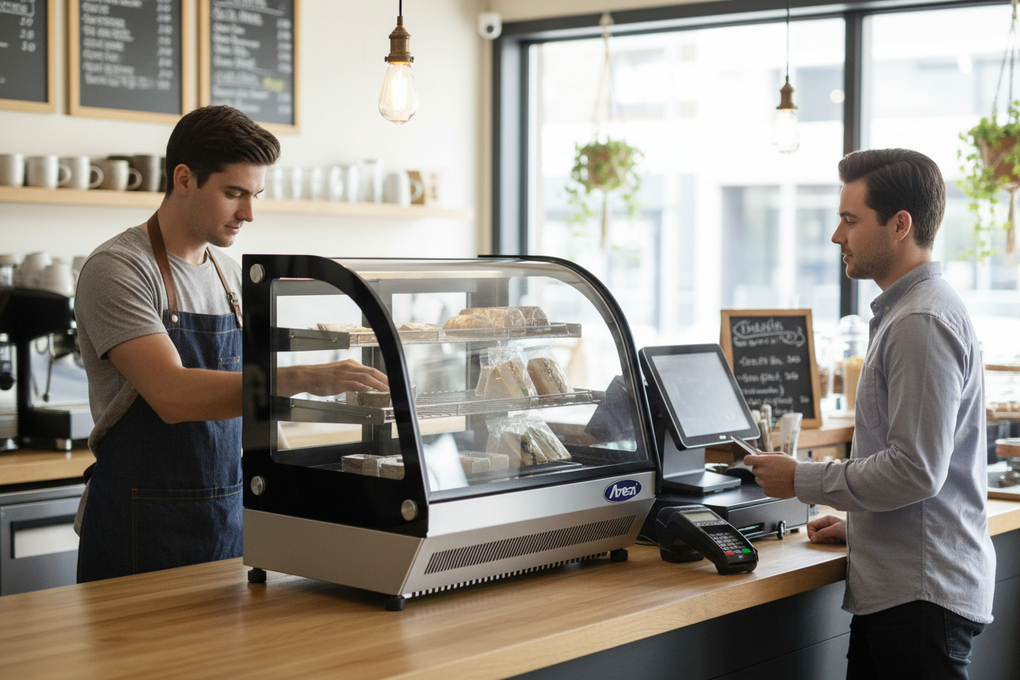
Benchtop / Countertop Display
Sits directly on the service counter, typically near the register. Small footprint, high visibility for customers already at the point of purchase. Suited to cafés with limited floor space, grab-and-go operations, and venues displaying a small rotating selection of slices and small cakes rather than a full patisserie range.
Floor-Standing Curved Glass Display
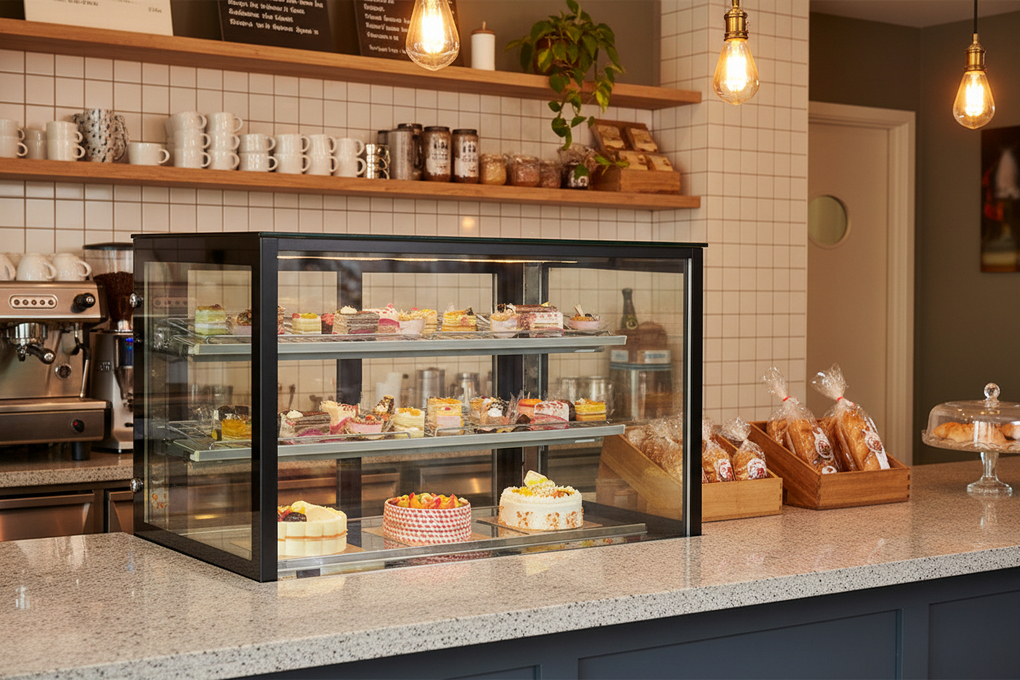
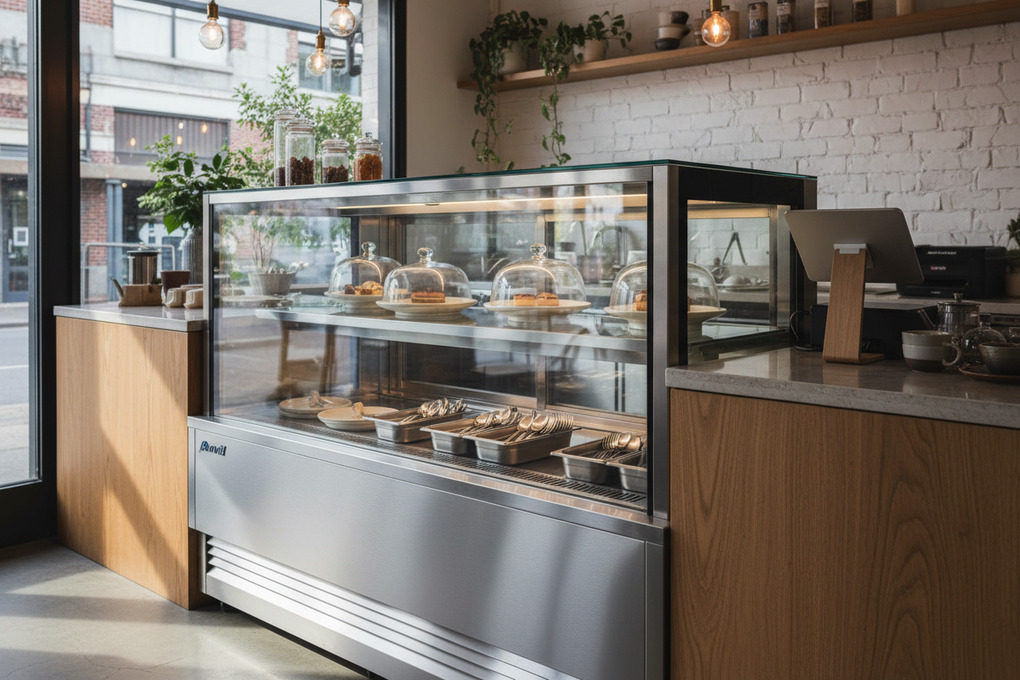
The standard configuration for cafés, bakeries and patisseries. Integrates into a continuous counter line, curved glass front gives a classic, elegant look. Multiple shelves with rear sliding or hinged staff-access doors. Available in widths from 900mm to 2400mm+ for multi-section configurations.
Floor-Standing Square Glass Display
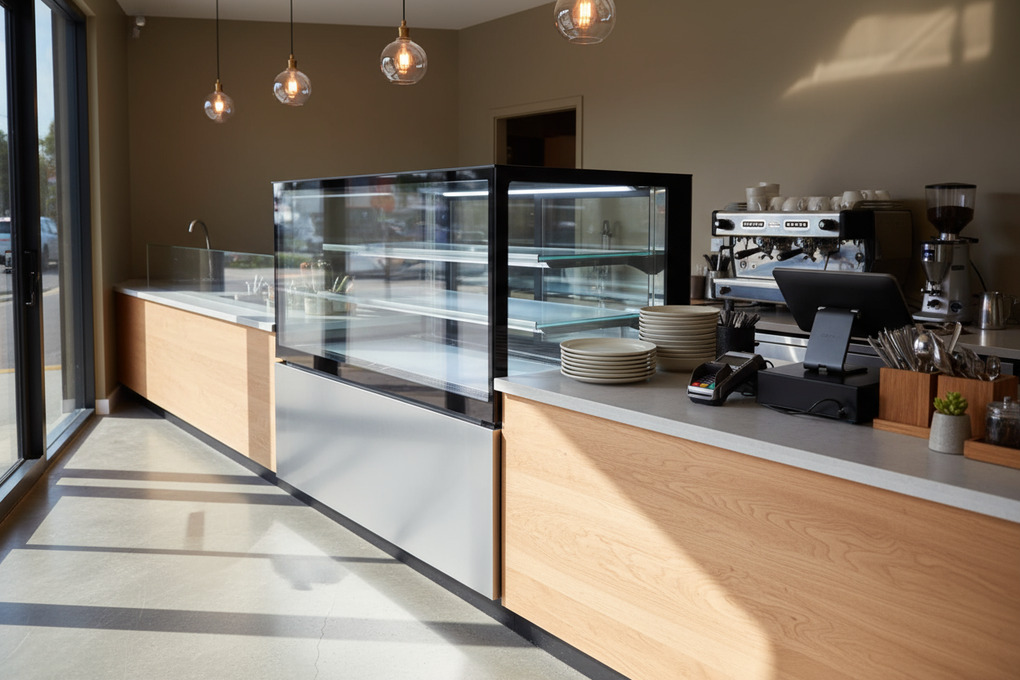
Same footprint as curved glass models but with flat glass panels for a clean, contemporary look. Maximises the visible shelf edge area. Suits venues with a modern fit-out where curved glass would feel dated. Performance is equivalent to curved glass models of the same specification.
Vertical Rotating Display
Tall upright unit with motorised rotating shelves — product rotates slowly in front of customers, maximising visibility of every item from every angle. The rotation catches the eye from a distance and is one of the most effective impulse purchase drivers available. Requires adequate ceiling clearance and more floor depth than standard counterline models.
Cooling and Humidity Control
Fan-forced vs static cooling
Fan-forced (dynamic) cooling circulates cold air continuously through the cabinet using a fan and evaporator system. Static cooling relies on cold air settling by gravity without circulation. For a cake display, fan-forced is the only acceptable choice. Static cooling creates temperature stratification — warmer at the top, colder at the bottom — which means different shelves are operating at different temperatures simultaneously. In a unit holding buttercream, ganache and cream-filled pastry, that inconsistency shows up in product quality quickly.
Temperature range
The correct operating range for a cake display fridge is 2°C–8°C. This is a narrow band with consequences at both ends:
| Temperature | Effect on Product |
|---|---|
| Below 2°C | Sponge dries out and stiffens; chocolate and ganache lose sheen; pastry texture degrades |
| 2°C–5°C | Optimal for cream fillings, custards and most chilled patisserie |
| 5°C–8°C | Acceptable for most cake products; upper limit for FSANZ compliance on potentially hazardous food |
| Above 8°C | Cream and custard fillings at food safety risk; buttercream softens; icing begins to weep |
Humidity management
Too much humidity causes condensation on packaging and glass surfaces. Too little causes product to dry out and crack. Quality cake display fridges manage this passively through precise insulation and evaporator design. Some models use heated glass elements to prevent condensation forming on the interior glass surface — useful in high-humidity environments. This is a meaningful feature difference between entry-level and mid-range models.
Refrigerant
Look for units using R290 (hydrocarbon) refrigerant. R290 has a low global warming potential and offers superior thermal efficiency — translating to lower energy bills and gentler, more consistent cooling cycles that are easier on delicate product.
Essential Design and Display Features
Glass quality
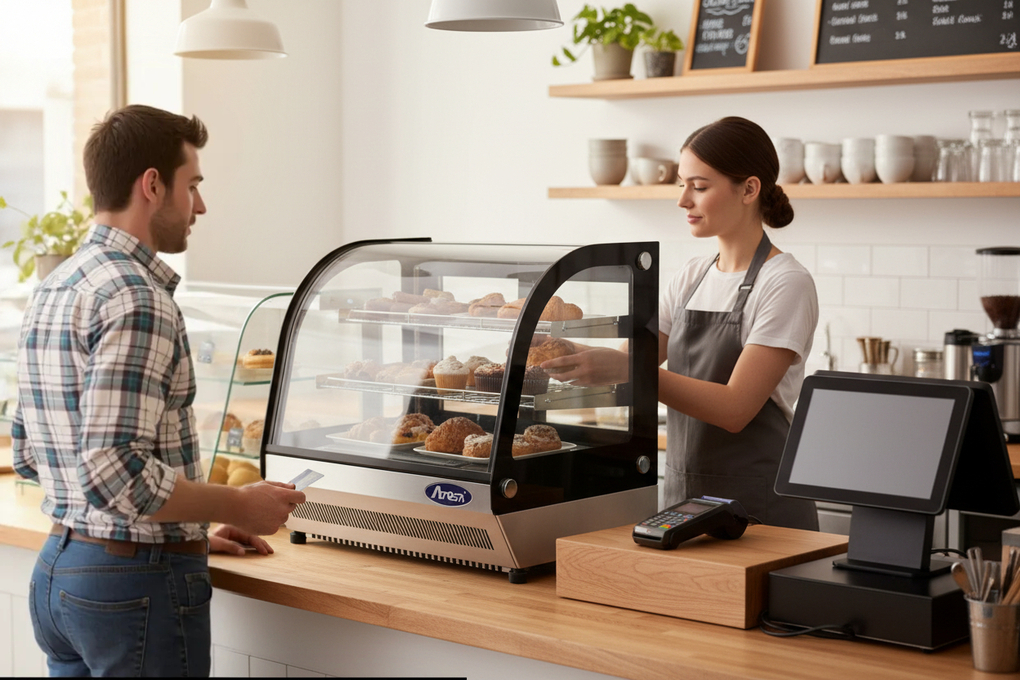
Double-glazed glass with a sealed air gap, or Low-E (low emissivity) coated glass, is essential. Single-glazed glass allows heat to transfer from the room into the cabinet, forces the compressor to work harder and causes condensation fogging on the interior surface. Low-E coated glass goes further — a microscopically thin metallic coating reflects infrared heat away from the cabinet, making it the better specification in warm climates, north-facing venues or any location with significant sun exposure.
Lighting
Lighting is directly connected to sales. Product that’s poorly lit looks flat and unappetising. The standard is vertical LED strips positioned at the sides or corners of each shelf tier — 4000K–5000K (cool white) colour temperature enhances white icing, cream and pastry finishes. LED generates negligible heat; avoid any display still using fluorescent tubes.
Shelving and accessibility
Shelves must be adjustable, removable for cleaning, and robust enough to handle the weight of whole cakes. Stainless steel or glass trays that slide out make restocking and cleaning significantly faster. Rear sliding or hinged staff-access doors should allow easy restocking without disturbing the front display.
Rotating displays
Premium vertical displays feature motorised rotating shelves. The slow, continuous rotation catches the eye from a distance and ensures every product gets visibility — not just the items at eye level on the front shelf. For a patisserie with a wide, visually elaborate product range, a rotating display is one of the most effective impulse purchase tools available.
Sizing and Placement
Sizing
Don’t size by litres alone. The relevant measurements are shelf dimensions relative to your largest products, the number of display positions at peak trading, and how the unit integrates with your existing counter run. A unit that fits 40 small tarts may not fit 8 whole cakes — measure both your largest product and your average display load.
Placement
Placement Mistakes That Cost You
- Direct sunlight — UV and infrared heat load overwhelms even a well-specified compressor; a display in direct sun will struggle to hold temperature on a warm day and will fail early
- Near ovens or hot equipment — ambient heat forces the compressor to run continuously; running costs increase and compressor lifespan drops significantly
- Under or beside air conditioning vents — rapid localised temperature drops stress the compressor and can cause uneven cooling across the display
- Away from customer sightlines — a cake display that customers can’t see from the entry or the counter queue isn’t doing its sales job; position for maximum visibility before worrying about convenience for staff
Australian Food Safety Compliance
- Temperature logging: Most health authorities require documented temperature records. A unit with an external digital temperature display simplifies this — staff can check and log without opening the display
- Hygienic construction: FSANZ requires smooth, non-absorbent, easily cleanable surfaces. Stainless steel interior and tempered glass are the standard — avoid units with exposed seams or hard-to-reach corners where product debris can accumulate
- Staff vs customer access: Ensure the staff service door (typically rear-access sliding panels) keeps product separated from direct customer contact
- RCM certification: All electrical appliances sold in Australia must carry the Regulatory Compliance Mark — confirm before purchasing any imported model
Common Buying Mistakes
Avoid These
- Placing the display near heat or direct sun — heat ingress causes icing to melt, chocolate to sweat and the compressor to run constantly, leading to premature failure
- Underestimating required capacity — overcrowding shelves reduces air circulation, creates hot spots and produces inconsistent product quality; size for peak trading, not average
- Buying a general-purpose fridge instead of a cake display — general fridges lack the humidity control and gentle airflow needed for delicate desserts; product will dry and crack
- Blocking airflow with solid containers on shelves — solid storage containers block the vertical flow of cold air, undermining the fan-forced system entirely
- Neglecting condenser cleaning — a dirty condenser reduces cooling efficiency significantly and often voids the warranty; clean monthly minimum
Brand Guide
| Brand | Position | Strengths | Best For |
|---|---|---|---|
| Exquisite | Premium | Exceptional presentation features, curved glass, multi-tiered rotation, superior internal lighting, precise temperature management | High-end patisseries and bakeries where visual presentation is the primary sales driver |
| Thermaster | Premium | Robust, reliable cooling systems, energy-efficient operation, built for busy high-volume bakery environments | High-volume bakeries needing durable, consistent performance through a long trading day |
| Skope | Mid-Range | High-performance energy-efficient display refrigeration, advanced digital controls, easy temperature fine-tuning | Cafés and bakeries wanting proven Australian-market performance with strong local service support |
| Williams | Mid-Range | Visually appealing modern designs, excellent insulation, consistent temperature throughout the cabinet | Venues prioritising longevity and consistent temperature over several service hours |

Pre-Purchase Checklist
Before You Buy
- Does the unit hold a stable temperature between 2°C and 8°C?
- Does it use fan-forced cooling for even air distribution?
- Does it use R290 hydrocarbon refrigerant for energy efficiency?
- Is the glass double-glazed or Low-E coated to minimise condensation?
- Does it use vertical LED strips to illuminate all shelves evenly?
- Is the capacity adequate for your peak service volume without overcrowding?
- Are the shelves adjustable and removable for cleaning?
- Is a rotating display included if your product range and venue justify it?
- Is the condenser easily accessible for monthly cleaning?
- Have you confirmed the unit fits your counter run and integrates with adjacent equipment?
Maintenance Schedule
Daily
- Wipe exterior glass with a streak-free food-safe glass cleaner and microfibre cloth — fingerprints and condensation streaks are visible to customers and undermine the display’s presentation
- Remove all product at close of trade and wipe interior shelves to remove crumbs, sugar residue and cream spills
- Check and log internal temperature
- Inspect door seals — a damaged seal allows warm air ingress and causes the compressor to overwork
- Clean magnetic door seals — critical for maintaining cold air retention and energy efficiency
Weekly
- Remove and wash shelves and display trays separately in warm water with a food-safe cleaner
- Clean door gaskets with a damp cloth — sugar and cream residue causes gaskets to deteriorate faster
- Check that ventilation clearances around the unit are maintained
Monthly
- Clean condenser coils with a soft brush or vacuum — in a bakery environment where flour is airborne, monthly is the minimum; in a flour-heavy production bakery, clean more frequently
- Clean or replace the air intake filter if fitted
- Verify thermostat accuracy with an independent probe thermometer
Frequently Asked Questions
What temperature should a cake display fridge run at?
2°C–8°C for most cakes and pastries. The FSANZ compliance threshold for potentially hazardous food (anything with cream, custard or egg-based fillings) is 5°C or below. Set your display to 3°C–4°C to maintain a safe buffer — a unit set at exactly 5°C with no buffer will drift above compliance on a warm trading day.
Can I store drinks in a cake display fridge?
Technically yes, but it’s the wrong tool. A cake display is optimised for gentle cooling at 2°C–8°C with humidity management suited to pastry. Drinks are better served from a commercial bar fridge — designed for colder, drier storage and faster access. Mixing drinks and cakes in the same display also dilutes the visual impact of the display itself.
How does a cake fridge control humidity?
Quality units manage humidity passively through precise insulation and specific evaporator design. Some models actively regulate it using heated glass elements to prevent external moisture from condensing on the cold interior glass surface. This is a meaningful feature difference between entry-level and mid-range models — worth specifying in high-humidity environments.
Are rotating cake displays worth the premium?
For premium patisseries and bakeries where impulse purchase conversion is a priority, yes. The slow rotation catches the eye from a distance and ensures every product gets visibility — not just the front-shelf items. It makes most sense when the product range is diverse and visually elaborate enough to justify the movement. A rotating display showing three types of muffins is wasted; one showing twelve varieties of elaborate cakes works.
Should I choose curved or square glass?
Primarily an aesthetic decision. Curved glass suits a classic patisserie or traditional bakery fit-out. Square glass suits a modern, minimalist space. Both perform equivalently when double-glazed to the same specification. Choose based on your venue’s fit-out and brand aesthetic — the performance difference is negligible.
Can a cake display be used for cold cuts or sandwiches?
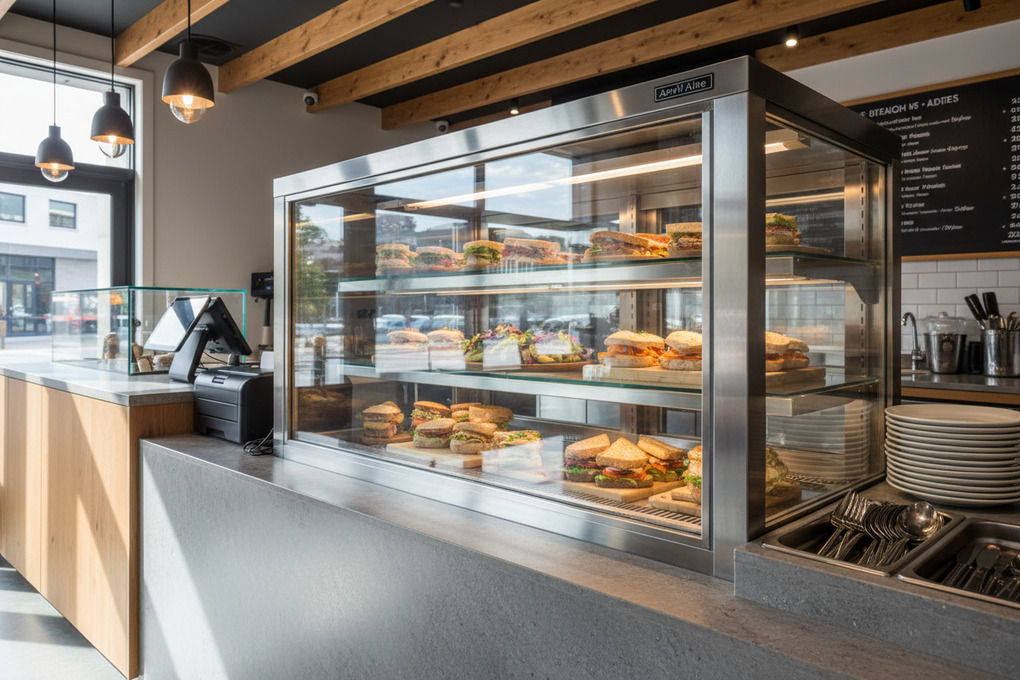
Yes, but dedicated deli display fridges or cold food displays are better suited. Cake fridges prioritise presentation and humidity over rapid service access — the workflow and airflow design are optimised for delicate pastry, not high-turnover deli service.
How often should the condenser be cleaned?
Monthly at minimum in a standard café or restaurant. In a bakery where flour is airborne, as often as fortnightly. A flour-coated condenser reduces cooling efficiency significantly and causes the compressor to run hot — it’s a five-minute job that directly affects running costs, temperature performance and unit lifespan.
Also browse: Deli Display Fridges · Cold Food Displays · Bar Fridges · Ambient Displays · Contact Us