

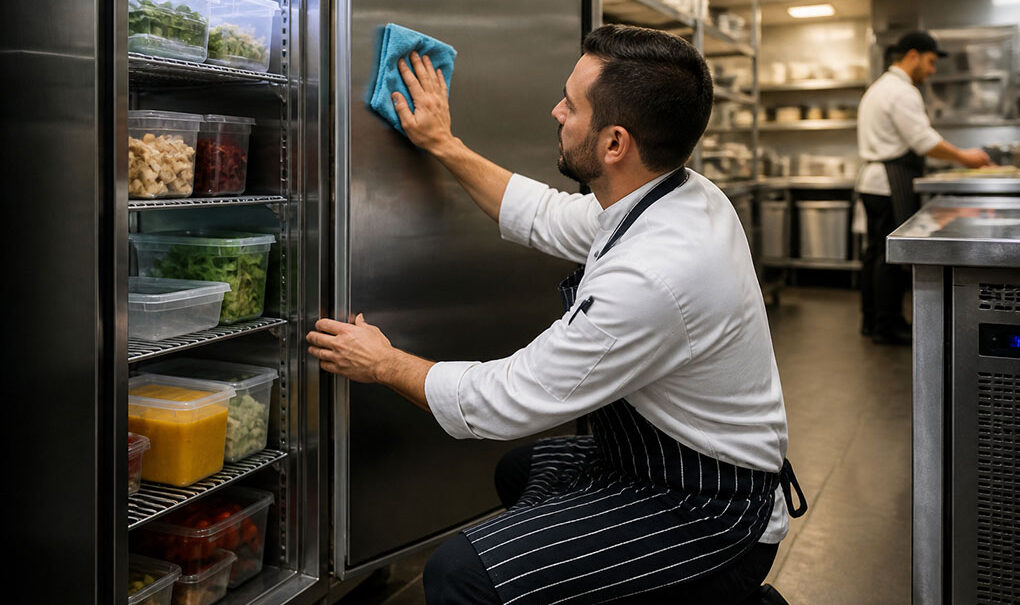
How to Clean a Commercial Fridge: Complete Cleaning Guide
Quick Summary
- Frequency: Daily surface wipe-downs, weekly deep internal clean, monthly condenser coil maintenance — this is the minimum for a commercial kitchen operating under FSANZ requirements.
- Most overlooked task: Condenser coil cleaning — blocked coils force the compressor to overwork, increase energy consumption and dramatically shorten unit lifespan.
- Biggest risk: Bacteria growth, mould, food spoilage and a fridge that can’t hold 5°C under real service conditions.
- Australian compliance: FSANZ Standard 3.2.2 requires potentially hazardous food to be stored at 5°C or below — your cleaning and maintenance schedule directly affects your ability to meet this requirement reliably.
- Best system: Combine a scheduled cleaning routine with FIFO stock rotation and clear staff accountability — the cleaning schedule only works if staff follow it consistently.
If you need to know how to clean a commercial fridge properly, the answer is more involved than a quick wipe-down. Regular, thorough cleaning is essential for food safety compliance, refrigeration performance and long-term equipment life. A dirty commercial fridge creates bacteria growth, mould, unpleasant odours, inefficient cooling and higher electricity costs — and in a food safety inspection, it creates compliance problems that are entirely avoidable.
For cafés, restaurants, hotels, catering businesses and commercial kitchens across Australia, refrigeration hygiene is not optional. This step-by-step guide explains exactly how to clean a commercial fridge and how to maintain it for long-term performance.
Why Commercial Fridge Cleaning Matters
Food Safety
Reduce Bacteria Risk
Spills, leaks and old stock create the conditions for bacteria and mould growth inside refrigeration units. Cross-contamination between raw and ready-to-eat food is a direct health risk — and a dirty fridge accelerates it.
Efficiency
Lower Energy Costs
Dirty condenser coils and blocked airflow force your fridge to work harder and consume significantly more power. A fridge with blocked coils can use 20–30% more energy than a clean, well-maintained unit.
Longevity
Protect Equipment Life
Regular maintenance reduces strain on compressors and refrigeration systems. The single biggest cause of early commercial fridge failure in Australian kitchens is neglected condenser coil cleaning — not component fault.
Compliance
Meet Food Standards
FSANZ Standard 3.2.2 requires potentially hazardous food to be held at 5°C or below. A fridge that can’t maintain this temperature due to poor maintenance is a compliance failure regardless of its set point.
How to Clean a Commercial Fridge: Step by Step
Step 1 — Turn Off and Unplug
Before cleaning, safely switch off the unit and disconnect power where appropriate. This protects staff safety and allows internal surfaces to be cleaned properly without the refrigeration system actively cycling. For large upright units that take time to recover temperature, plan cleaning during a period when the fridge can be offline — end of service or before the next delivery.
Step 2 — Remove All Food and Stock
Empty every shelf, drawer and storage compartment. Check every product while removing stock — this is the best opportunity to identify expired, damaged or unlabelled items before they become a food safety problem.
Discard Immediately
- Expired food — check use-by and best-before dates on everything
- Mouldy products — do not transfer to another fridge
- Damaged or compromised packaging — contamination risk
- Unlabelled opened items — cannot confirm safety or date
- Anything with questionable freshness — when in doubt, throw it out
Step 3 — Remove Shelves, Trays and Inserts
Removable components should be cleaned separately in warm water with food-safe detergent. Cleaning them in place misses the grime that builds up on shelf supports, brackets and ledges underneath. Allow to dry fully before reinserting — wet shelves placed back in a fridge create the conditions for mould growth.
Step 4 — Clean the Interior
Use a food-safe cleaning solution with a soft cloth or non-abrasive sponge. Avoid bleach-based products on stainless steel interiors — they can cause corrosion over time. Focus on:
- Walls and internal ceiling — spatter accumulates here and is often missed
- Shelf supports and brackets — grime buildup under shelves is a common inspection failure point
- Door seals and the channel they sit in
- Internal corners — debris accumulates here and is hard to reach
- Drain channels and the drain outlet — blocked drains cause water pooling and mould
- Internal ledges and any fixed components
Step 5 — Sanitise All Food Contact Surfaces
Cleaning removes visible dirt and food residue. Sanitising reduces bacteria to safe levels. These are two separate steps — cleaning first, then sanitising. Use a commercial food-safe sanitiser appropriate for refrigeration environments and allow surfaces to air-dry fully before reloading stock. Australian food safety guidance is available through Food Standards Australia New Zealand.
Step 6 — Clean the Door Seals
Door gaskets trap food debris, moisture and mould in their folds — and a compromised seal is one of the most common causes of temperature drift in commercial fridges. Use a soft brush and food-safe cleaner to clean seals thoroughly without damaging the rubber. Inspect the seal while cleaning — any cracking, tearing or permanent deformation means it needs replacing. A new gasket costs less than $50 and prevents both a food safety breach and an unnecessarily high energy bill.
Step 7 — Clean the Condenser Coils
Condenser coil cleaning is the most important maintenance task for commercial fridge longevity — and the most commonly skipped.
Coil Cleaning Checklist
- Switch power off before accessing the condenser
- Locate the condenser — front grille access on bottom-mount units, top access on top-mount units
- Use a vacuum with a soft brush attachment or a dedicated coil brush to remove dust and debris
- Work carefully to avoid bending the condenser fins — bent fins restrict airflow
- Clean the surrounding grille and ventilation area while you have access
- On bottom-mount units, pull the fridge out and clean the floor underneath — grease and debris accumulate here
The Real Cost of Skipping Condenser Cleaning
In a busy Australian commercial kitchen, the condenser coils on a bottom-mount underbench fridge can be coated in grease and dust within three months of no cleaning. A fully blocked condenser forces the compressor to run at maximum load continuously — the fridge struggles to hold temperature in summer, energy consumption climbs steadily and the compressor fails well before its rated lifespan. The repair or replacement cost runs into thousands of dollars. Monthly cleaning with a soft brush takes five minutes. It’s the highest-return maintenance task in commercial refrigeration — and the most neglected. In bakery environments where airborne flour coats coils even faster, clean every fortnight.
Step 8 — Clean the Exterior
Wipe down handles, control panels, ventilation grilles and all external surfaces. For stainless steel exteriors, wipe with the grain to maintain finish quality and avoid surface scratching. Don’t neglect the top of the unit — grease and dust accumulate there and can fall into ventilation areas.
Step 9 — Organise Stock Before Reloading
A full clean-out is the best opportunity to improve fridge organisation. Poor organisation is one of the most common causes of food safety breaches in commercial kitchens — cross-contamination between raw and ready-to-eat food, expired stock hidden at the back of shelves, unlabelled containers.
Best Practice Storage
- FIFO stock rotation — first in, first out on every reload
- Date label everything that gets opened or transferred to a container
- Store raw meat on the lowest shelves — below ready-to-eat food
- Use gastronorm storage bins for consistent stacking
- Leave 20% headroom — a packed fridge recovers temperature slowly
Avoid These
- Unlabelled containers — untraceable in a food safety incident
- Blocking internal airflow with overcrowded shelves
- Storing expired products at the back where they won’t be seen
- Mixed raw and ready-to-eat storage at the same level
- Warm food placed directly into the fridge — raises internal temperature
Step 10 — Restart and Verify Temperature
Once cleaned and reloaded, restore power and confirm the fridge returns to the correct operating temperature before service. FSANZ Standard 3.2.2 requires potentially hazardous food to be held at 5°C or below — set point is not the same as confirmed temperature. Use an independent probe thermometer to verify, not just the unit’s built-in display. Log the temperature as part of your HACCP documentation. If the fridge struggles to recover to set temperature within a reasonable time, inspect the condenser and door seals before assuming a compressor fault.
How Often Should You Clean a Commercial Fridge?
| Task | Recommended Frequency | Notes |
|---|---|---|
| Surface wipe-down and handle cleaning | Daily | Part of opening and closing routine |
| Door seal inspection and wipe-down | Weekly | Check for damage while cleaning |
| Full internal deep clean | Weekly | Remove all shelves and stock |
| Condenser coil cleaning | Monthly | Fortnightly in bakery or high-grease environments |
| Temperature verification with independent probe | Daily | Log for HACCP compliance |
| Professional service inspection | Annually | More frequently for high-use production kitchens |
Common Commercial Fridge Cleaning Mistakes
Avoid These
- Using harsh chemicals on stainless steel interiors — bleach and abrasive scourers damage the surface finish and create crevices where bacteria can harbour; use food-safe cleaners designed for refrigeration
- Ignoring door seals — a dirty or damaged seal is the most common cause of temperature drift and one of the easiest problems to fix before it becomes a compliance issue
- Skipping condenser coil cleaning — the single most damaging maintenance oversight in commercial refrigeration; blocked coils cause compressor overload and dramatically shorten equipment lifespan
- Reloading warm food immediately after cleaning — warm food raises the internal temperature and forces the compressor to work harder to recover; allow food to cool to near-fridge temperature before reloading
- Blocking internal airflow with overcrowded shelves — cold air needs to circulate to maintain even temperature; a packed fridge creates warm pockets that put food at risk
- No FIFO discipline on reload — restocking without rotating means older product gets pushed to the back and expires unnoticed; cleaning day is the best time to enforce proper rotation
Frequently Asked Questions
How often should a commercial fridge be cleaned in Australia?
Daily surface wipe-downs and handle cleaning, weekly deep internal cleans with shelf removal, and monthly condenser coil maintenance is the minimum standard for a commercial kitchen operating under FSANZ requirements. In high-grease or high-flour environments — busy kitchens, bakeries — condenser cleaning should be fortnightly. Health authority inspections assess refrigeration hygiene as part of food safety compliance; a documented cleaning schedule supports this significantly.
Can dirty condenser coils damage a commercial fridge?
Yes — and it’s the leading cause of early commercial fridge failure in Australian kitchens. Dirty condenser coils prevent the refrigeration system from dissipating heat efficiently, forcing the compressor to run at maximum load continuously. The result is a unit that struggles to hold temperature in summer, uses 20–30% more energy than it should, and has a compressor that fails well before its rated lifespan. Monthly coil cleaning with a soft brush takes five minutes and directly prevents this.
What cleaner should I use inside a commercial fridge?
Use a food-safe commercial cleaner specifically formulated for refrigeration environments. Avoid bleach-based products on stainless steel interiors — they cause surface corrosion over time and create crevices where bacteria can harbour. Avoid abrasive scourers for the same reason. After cleaning, apply a food-safe sanitiser and allow surfaces to air-dry completely before reloading stock. Your cleaning chemical supplier can recommend products that meet Australian food safety requirements.
Should commercial fridges be sanitised after cleaning?
Yes — cleaning and sanitising are two separate steps that both need to happen. Cleaning removes visible dirt, grease and food residue. Sanitising uses a food-safe sanitiser to reduce bacteria on cleaned surfaces to safe levels. Sanitising without cleaning first is ineffective — the sanitiser can’t reach surfaces covered in residue. Clean first, then sanitise, then allow to dry before reloading.
What temperature should a commercial fridge operate at in Australia?
FSANZ Standard 3.2.2 requires potentially hazardous food to be stored at 5°C or below. In practice, set your fridge to 2–4°C to maintain a safe buffer — a unit set at exactly 5°C will drift above compliance during a busy service when the door is opened frequently in a hot kitchen. Verify temperature daily with an independent probe thermometer, not just the unit’s built-in display, and log it for HACCP documentation.
How do I know if my commercial fridge door seal needs replacing?
Close the fridge door on a sheet of paper. If you can pull the paper out without resistance, the seal is no longer creating an adequate air barrier. Also inspect the seal visually — cracking, tearing, permanent compression or mould that can’t be cleaned out are all signs of a seal that needs replacing. A replacement gasket typically costs less than $50 and is one of the highest-return maintenance investments in commercial refrigeration.
Snowmaster stocks commercial fridges from Skope, Turbo Air, Hoshizaki, Bromic, Skipio, Polar, FED and Atosa — upright, underbench, drawer, display and specialist configurations. If your current refrigeration is struggling to hold temperature or costing more to run than it should, our team can help you assess the right replacement.Browse Commercial Fridges →
Also browse: Upright Fridges · Under Bench Fridges · Commercial Freezers · Contact Us