


Commercial Meat Slicers & Deli Slicers Buying Guide 2026
Introduction: Precision, Safety, and Profitability with Your Commercial Meat Slicer
A commercial meat slicer is the cornerstone of productivity for any Australian deli, butcher shop, restaurant, or high-volume catering operation. The right slicer offers far more than just speed; it ensures unmatched consistency in every cut, which is vital for portion control, presentation, and maximizing product yield. Investing in precision equipment directly boosts profitability by reducing food waste.
However, selecting a slicer involves balancing several critical factors: motor power, blade size, drive mechanism, and compliance with stringent Australian FSANZ (Food Standards Australia New Zealand) hygiene standards. This **commercial meat slicers buying guide** will walk you through the essential considerations for choosing a machine—from the compact manual model to the fully automatic conveyor—that perfectly aligns with your volume, budget, and safety protocols.
We will cover the distinctions between Blade Size (220mm to 370mm), the critical differences between Belt Drive and Gear Drive models, and discuss trusted Australian brands like Grange, Noaw, and RFE. Ultimately, this guide helps you choose the best Meat Slicers for your daily volume.

Too Long; Didn’t Read? Here’s the Short Version
- Drive: Choose Belt Drive (21 models available, lower cost, quieter) for Light/Medium use, or Gear Drive (10 models) for Heavy-Duty/Hard Cheese slicing.
- Size: Standard blades are 250mm to 300mm. Select 350mm or larger (370mm) for whole hams and large volumes.
- Type: Choose Manual or Automatic (6 models available) for high speed and consistency.
- Safety: Look for permanently attached knife guards, gauge plate interlock, and no-volt release features.
- Hygiene: Ensure the design uses anodized aluminum or stainless steel with rounded surfaces to simplify cleaning per HACCP standards.
- BOH Complement: For bulk storage of sliced meats, complement your station with a Commercial Drawer Fridge or Under Bench Fridge.
Drive Mechanisms: Belt vs. Gear vs. Automatic
The mechanical drive system you choose is arguably the most critical factor affecting the slicer’s price, noise level, and ability to process dense products like hard cheese and cured meats. You currently see three main options when selecting your slicer: Belt Drive, Gear Drive, and Automatic.
Belt Drive (21 Models Available)
Belt-driven systems are the most common (accounting for 21 models in our inventory) and are typically found in light to medium-duty slicers.
- Mechanism: A flexible belt transfers power from the motor to the blade.
- Pros: They are quieter, generally more affordable upfront, and easier to repair by replacing the belt.
- Cons: The belt may slip or break under heavy load (e.g., hard salami), meaning they are unsuitable for continuous, heavy-duty processing.
Gear Drive (10 Models Available)
Gear-driven systems are the hallmark of heavy-duty, robust performance, accounting for 10 models in our selection.
- Mechanism: Power transfers directly through a system of interlocking metal gears.
- Pros: They offer significantly higher power and torque (HP), consequently making them ideal for high-volume slicing of dense, hard products.
- Cons: They are louder, more expensive, and more complex to repair.
Automatic Drive (6 Models Available)
Automatic slicers (6 models available) include a powered carriage mechanism, simplifying high-volume operation.
- Mechanism: Combines a powerful motor (often gear-driven) with a second motor to automate carriage movement.
- Pros: Offers the highest speed and consistency, significantly reducing labor and operator fatigue.
- Cons: Higher initial cost and increased maintenance complexity due to dual motor systems.
In summary, if you slice hard cheeses or heavy meats for more than 4 hours a day, a **Gear Drive** system is mandatory. For lighter use (e.g., pre-cooked ham, vegetables), a **Belt Drive** provides excellent value.
Blade Size: Matching Diameter (220mm – 370mm) to Product
The size of the blade dictates the maximum product height and width you can slice, directly impacting your efficiency. Your selection options range from the compact 220mm blade up to the very large 370mm diameter.
Blade Size Breakdown
| Blade Size (mm/inches) | Models Available | Best Suited For |
|---|---|---|
| 220mm – 250mm (9″ – 10″) | 8 Models | Light-Duty cafes, small cuts, cooked meats. Excellent entry price point. |
| 300mm (12″) | 11 Models | The versatile standard for most delis; handles medium-sized loaves/cheeses. |
| 350mm – 370mm (14″ – 15″) | 13 Models | Heavy-Duty processing of whole hams, large deli cuts, and high-volume operations. |
Therefore, always select a blade diameter slightly larger than the largest product you commonly slice (e.g., large prosciutto or whole bone-in ham).
Blade Material
The material dictates longevity and ease of sharpening.
- Stainless Steel: Offers strong durability and corrosion resistance, simplifying daily cleaning per hygiene standards.
- Chromium-Plated Carbon Steel: Provides a harder edge and better edge retention, although it requires diligent cleaning to prevent rust.
Furthermore, ensure the blade is smooth, as smooth blades provide clean, uniform cuts for most deli products (ham, roast beef). Serrated blades are generally reserved for tough, fibrous meats or bread.
Motor Power (HP)
The motor should have enough horsepower (HP) or wattage to slice dense products without stalling.
| Usage Type | Horsepower (HP) | Typical Power (Watts) |
|---|---|---|
| Light Use (Café) | 0.25 HP | 150 – 200W |
| Medium Use (Deli) | 0.5 HP | 250 – 350W |
| Heavy Use (Butcher/Supermarket) | 1 HP+ | 550W+ |
Slicer Classification: Duty Cycles and Power
Choosing the right slicer starts with honestly assessing your daily duty cycle. Commercial slicers are not built for constant, non-stop use; instead, they are rated for specific operational hours. Using a light-duty slicer for heavy-duty work will cause the motor to overheat and fail quickly.
Duty Classifications Explained
- Light-Duty Slicers (0.25 HP): Designed for use up to 2 hours per day. These are perfect for small cafes, low-volume sandwich shops, or offices that slice pre-cooked meats and soft vegetables occasionally.
- Medium-Duty Slicers (0.5 HP): Built for 2 to 4 hours of operation per day. These suit mid-sized restaurants and specialty delis. Furthermore, they handle hard cheeses and some cured meats effectively.
- Heavy-Duty Slicers (1 HP+): Engineered for 4+ hours of continuous operation. These are mandatory for busy butchers, supermarkets, and large institutional kitchens that process whole hams, hard cheeses, and high volumes of cold cuts daily.
Therefore, always choose a slicer rated for the next tier of usage beyond your current needs to ensure longevity and efficiency during peak periods.
Manual vs. Automatic: Choosing the Right Type for Your Deli Slicer
The choice between manual and automatic operation depends directly on the required volume and staffing levels.
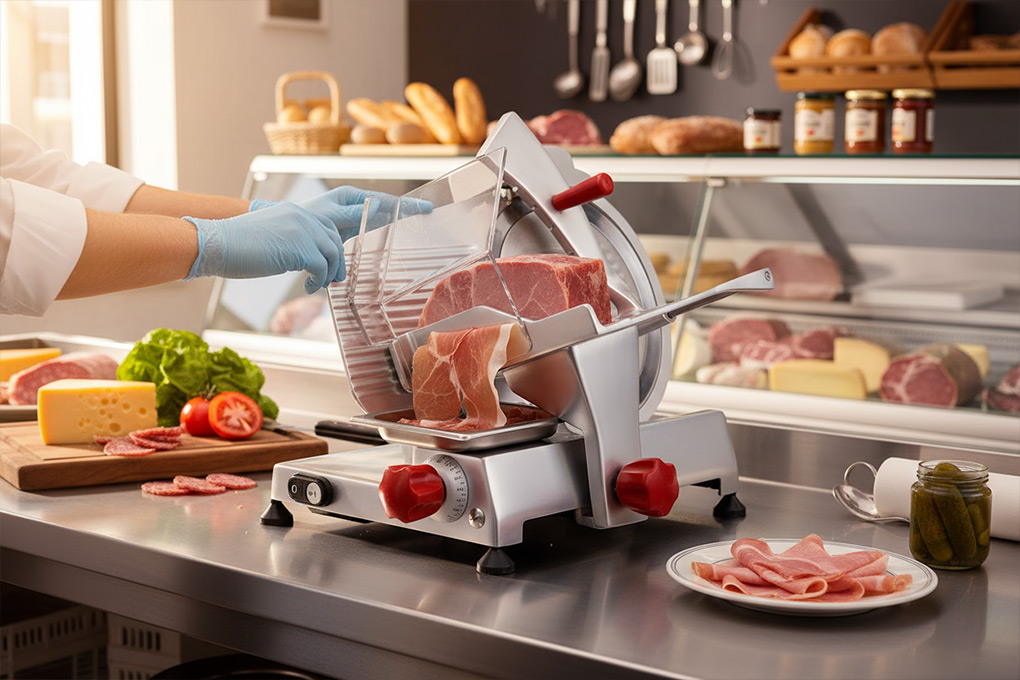
Manual Gravity-Feed Slicers
Manual slicers are gravity-fed, meaning the operator uses muscle power to guide the carriage back and forth across the blade.
- Best For: Small delis, fine dining (for charcuterie where slicing speed is less critical than precision), and budget-conscious operations.
- Advantages: They are more affordable, require simpler maintenance, and allow the operator greater control over the presentation of delicate meats.
- Disadvantages: Production speed is limited by operator stamina and skill, and consequently, they are prone to accidents during high-volume periods due to fatigue.
Automatic & Semi-Automatic Slicers
Automatic slicers use a motor to move the carriage continuously, requiring the operator only to load the product and adjust settings.
- Best For: Supermarkets, high-volume delis, and centralized food preparation facilities.
- Advantages: They offer high speed and consistent precision (up to 60 slices per minute), reduce labor costs, and minimize operator fatigue.
- Semi-Automatic Models: These require the operator to press a button to initiate the slice cycle, offering a balance of speed and control.
In contrast to automatic models, where speed is paramount, products like prepared salads often require specialized temperature control in an open design, such as a Salad Bar Fridge, rather than rapid slicing.
Critical Safety and Ergonomic Features
In a commercial kitchen, safety is paramount, especially with sharp cutting tools. FSANZ regulations place significant emphasis on user safety and hygiene protocols during operation and cleaning.
Mandatory Safety Features
Look for the following features to protect staff and meet safety certification requirements:
- Fixed Ring Guard: A permanently attached guard that minimizes accidental blade contact and is essential for preventing cuts.
- Gauge Plate Interlock: A safety mechanism that ensures the thickness gauge plate must be closed to the ‘zero’ position before the carriage or knife can be removed for cleaning. This prevents accidental contact with the blade edge.
- No-Volt Release: If a power interruption occurs, this feature requires the user to manually restart the slicer, preventing the machine from starting unexpectedly when power returns.
- Safety Switches: Easily accessible ON/OFF switches, often moisture-proof, that allow for immediate shutdown.
Ergonomics and Design
Ergonomics reduce operator fatigue and, consequently, the risk of accidents.
- Rear-Mounted Meat Grip: This extension or grip enhances safety, particularly when handling larger products.
- Easy-Glide Carriage: The carriage should move smoothly with minimal force required by the operator.
- Stable Base: Non-slip rubber feet are essential to prevent movement during heavy slicing tasks.
In summary, investing in safe design protects both your staff and your business liability.
HACCP and FSANZ Cleaning Requirements for Commercial Slicer Selection
Meat slicers are designated as high-risk equipment for microbial harbourage (a place where bacteria can hide), therefore, FSANZ and HACCP guidelines require rigorous, often daily, cleaning and sanitization.
Design for Disassembly (Ease of Cleaning)
The biggest hygiene factor is the slicer’s construction. Look for features that simplify the cleaning process:
- Rounded Surfaces: Rounded edges and seamless surfaces are easier to wipe down than squared corners, preventing food debris buildup.
- Removable Parts: The carriage, meat grip, product tray, and sharpening stone should be easily removed without tools.
- Anodized Aluminum/Stainless Steel: These corrosion-resistant materials withstand daily sanitizing chemicals and water exposure.
**Note:** Due to the risk of cross-contamination, you should clean and sanitize the slicer immediately after slicing raw meat, and again after slicing cooked meat or cheese.
Sanitization Protocol (HACCP)
Cleaning must always precede sanitizing. FSANZ recommends the following protocol for food contact surfaces like slicers:
- Pre-Clean: Scrape or wipe off visible food scraps.
- Wash: Disassemble the slicer and wash components thoroughly with hot water and detergent. Pay special attention to niche areas, such as the blade guard and motor seal.
- Rinse: Rinse thoroughly with clean water.
- Sanitise: Apply a chemical sanitizing solution (like a bleach dilution) or expose the parts to hot water (at least 77°C) for the required contact time.
- Air Dry: Allow components to air dry completely before reassembly.
Furthermore, ensure staff use appropriate PPE, including cut-resistant gloves, during the cleaning process, since cleaning is when most blade accidents occur.
Slicer Versatility: Hot vs. Cold vs. Cheese
The optimal slicer choice is often determined by the temperature and density of the products you process most frequently.
Cold & Cooked Meats (Ham, Roast Beef)
These products are sliced easiest when chilled, requiring standard 12–14 inch blades and reliable motors. Moreover, a gravity feed system is generally preferred as it guides the product naturally.
Hard Cured Meats (Salami, Pepperoni)
Hard, dense products require higher motor power (medium- to heavy-duty classification) and a gear-driven transmission to prevent the motor from stalling. These items benefit from a larger blade (13–14 inches) to maintain a smooth, uniform cut.
Soft/Hot Meats & Raw Poultry
Soft items can smear or tear if the blade is dull or the motor is weak. Therefore, these require an extremely sharp, smooth blade and a precise thickness adjustment. For instance, while you can slice raw meat on a commercial slicer, strict and immediate sanitization is mandatory afterward to prevent cross-contamination.
Cheese
Slicing cheese presents a unique challenge because its fat content can create drag, slowing the blade and causing smearing or clumping. Consequently, many specialized cheese slicers feature a non-stick coating on the blade or use higher torque motors. If your main product is cheese, opt for a gear-driven, heavy-duty unit.
In contrast, preparation tasks like grinding require a Commercial Meat Mincer, and large batch prep often uses a Commercial Food Processors.
Top Australian Slicer Brands (Grange, Noaw, RFE)
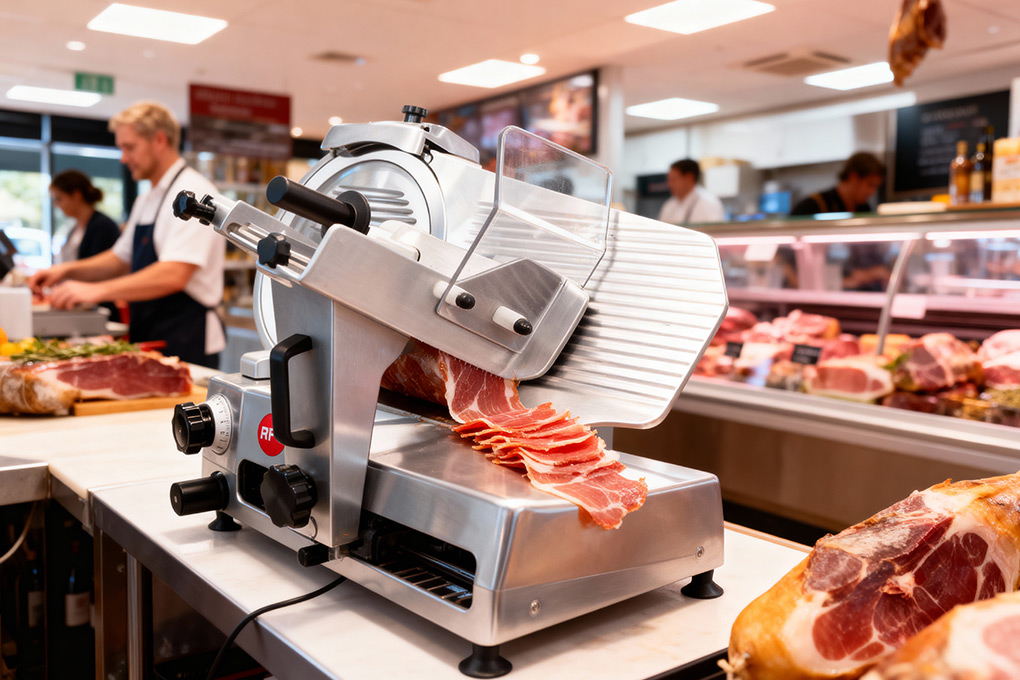
Selecting a brand with a strong presence in Australia ensures readily available parts, technical support, and compliance with local standards. The top sellers in the Australian market include Noaw, RFE, and Grange, which offer a full spectrum of sizes and drive types.
Noaw
A respected Italian brand famous for its precision, durability, and extensive range, including the iconic **flywheel slicers** used for traditional charcuterie. Noaw offers heavy-duty manual, semi-automatic, and automatic slicers.
RFE
RFE offers a wide range of reliable slicers, from medium-duty manual **Belt Drive** models to advanced **Gear Drive** units (e.g., the RFE UNI series) capable of heavy cheese slicing. They offer one of the largest selections of blade sizes, catering to all kitchen needs.
Grange
Grange focuses on robust, affordable manual and **Belt Drive** slicers, which means they are ideal for busy delis and catering operations looking for longevity and value at a competitive price point.
Hobart and Apuro/Birko
These brands offer premium (Hobart) and affordable (Apuro/Birko) solutions across various **Blade Sizes** and drive types, ensuring a complete market selection.
Cost, Warranty, and Maintenance
The purchasing price of a meat slicer varies dramatically depending on its duty rating, automation, and blade size.
Price Guide (AUD) – Based on Commercial Meat Slicers Buying Guide Data
| Duty Cycle | Drive / Size Focus | Price Range (Approx. AUD) | Model Examples |
|---|---|---|---|
| Light | Belt Drive (220mm – 250mm) | $650 – $1,300 | Grange GRB220C, Noaw NS220 |
| Medium | Belt Drive (300mm) | $1,300 – $3,000 | Grange GRB300L, Noaw NS300 |
| Heavy-Duty | Gear Drive (350mm – 370mm) | $3,000 – $7,000 | Noaw NS350HD, RFE UNI350G |
| High Volume/Specialty | Automatic/Flywheel (330mm+) | $8,000 – $15,000+ | Noaw NS300M Flywheel, Noaw NS350HDA |
Warranty and Service
Commercial slicers typically come with a 12-month parts and labour warranty. However, read the fine print carefully, as improper cleaning or using a light-duty slicer for heavy-duty work can **void your warranty**. Furthermore, purchasing from a local supplier ensures quick access to service technicians and spare parts, minimizing costly downtime.
Sharpening and Maintenance
Regular blade sharpening is crucial for safety and cut quality. Many modern slicers feature a **built-in sharpening system**, making daily upkeep straightforward. A sharp blade is safer because it requires less force, reducing the risk of slippage.
Pre-Purchase Checklist: Your Commercial Meat Slicers Buying Guide Summary
Use this checklist to ensure your chosen commercial meat slicer meets all operational, safety, and hygiene requirements.
- Duty Cycle: Is the slicer rated for Light, Medium, or Heavy-Duty use? (Must match/exceed your peak daily needs.)
- Blade Size: Is the diameter (220mm – 370mm) adequate for your largest products?
- Drive Type: Is the drive **Belt Drive** (light/medium) or **Gear Drive** (heavy)?
- Safety: Does it include a fixed knife guard and gauge plate interlock?
- Type: Is Manual or Automatic best suited for your volume and staffing?
- Power: Is the motor sufficient (0.5 HP+ for most delis)?
- Hygiene: Are the carriage, blade, and sharpener easily removable for cleaning?
- Construction: Is it durable stainless steel or anodized aluminum?
- BOH Storage: Have you planned adjacent chilled storage for prep, such as a Under Bench Fridge or a Commercial Upright Fridge?
Frequently Asked Questions
What is the difference between light and heavy-duty slicers?
Light-duty slicers are rated for under two hours of use per day and have lower horsepower (0.25 HP). In contrast, heavy-duty slicers are built for all-day use (4+ hours) and feature more powerful motors (1 HP+) and gear-driven transmissions.
Can I slice cheese on a meat slicer?
Yes, however, cheese often requires a medium to heavy-duty, **Gear-Driven** slicer to prevent sticking and motor stall. You must also clean the slicer immediately after slicing cheese, as the fats leave residue that is difficult to remove.
How often should I clean a commercial slicer?
You should clean and sanitize the slicer at a minimum of every four hours of continuous use, and immediately after slicing different product types (e.g., switching from raw meat to cooked ham) to comply with FSANZ cross-contamination rules.
Do I need a built-in sharpener?
A built-in sharpening system is highly convenient and encourages staff to maintain the blade daily. A sharp blade is crucial for clean cuts, reducing operator effort, and consequently improving safety.
What is a flywheel slicer?
A flywheel slicer is a traditional, manually operated slicer (often red or black cast iron) that uses a large, hand-cranked flywheel to spin the blade. They are prized for ultra-thin precision (ideal for cured meats) and aesthetics, though they are often very expensive (e.g., $10,000+).
Conclusion: Your Investment in Precision
A commercial meat slicer is not just a purchase—it is a long-term investment in your food business’s efficiency, portion control, and safety. Prioritize the correct duty cycle (Light, Medium, or Heavy) and look for mandatory safety features like the gauge plate interlock. Ultimately, the commitment to proper daily cleaning and maintenance per HACCP standards will define the machine’s longevity.
Explore our full range of Meat Slicers and complementary butchery equipment, including Commercial Meat Mincers, Vacuum Sealers for portioning and storage, and specialized chilling units like Dry Aging Cabinets.