

Best Commercial Food Processors Australia: 2026 Expert Buyer’s Guide
Quick Summary
- Motor: Choose induction for heavy-duty use (especially 5 kg+ of cheese or veg daily); universal motors suit lighter tasks.
- Format: Bowl-style for sauces, dips and controlled batches; continuous-feed for high-volume slicing and grating.
- Compliance: Always confirm RCM certification and magnetic safety interlocks before purchasing.
- Top brand: Robot Coupe is the industry benchmark for commercial food processors in Australia.
- Avoid: Domestic units, undersized bowls, and buying on price alone — all common and costly mistakes.
Selecting the right commercial food processor is a critical decision for any Australian hospitality business. The right model can dramatically reduce preparation time, improve consistency and lower labour costs during busy service periods.
A commercial food processor is not a larger version of a domestic appliance — it is a high-performance piece of professional food preparation equipment designed for repetitive, high-volume tasks: slicing vegetables, grating cheese, emulsifying sauces and preparing bulk ingredients. Whether you operate a restaurant, café, catering business, bakery or institutional kitchen, this guide explains what to look for, how to avoid costly mistakes, and how to choose a processor that supports long-term operational efficiency.
When to Use a Commercial Food Processor
High Volume
Restaurants and Catering
Speed and output are critical. A continuous-feed processor allows staff to process large quantities of vegetables or cheese without stopping to empty a bowl. If you regularly prep more than 5 kg of ingredients at a time, a heavy-duty induction motor model is recommended. High-volume kitchens often pair prep equipment with commercial fridges or commercial freezers to streamline the workflow from preparation to storage.
Compact Kitchens
Cafés and Small Venues
Space efficiency matters. A compact bowl-style processor is ideal for smaller venues producing dips, sauces, chopped vegetables and smaller prep batches. These venues commonly rely on space-saving refrigeration such as under-bench fridges or under-bench freezers to maximise usable kitchen space.
Institutional
Production and Central Kitchens
Consistency and durability are priorities. Large operations benefit from powerful induction motors and continuous-feed systems that handle repetitive slicing and grating throughout the day, supported by high-capacity storage like commercial upright fridges and commercial upright freezers.
Bakeries
Bakeries and Pastry Kitchens
Bowl-style processors excel at emulsifying, blending and preparing pastry fillings. Look for models with multiple blade options and a robust induction motor to handle dense ingredients without strain.
Key Features to Consider
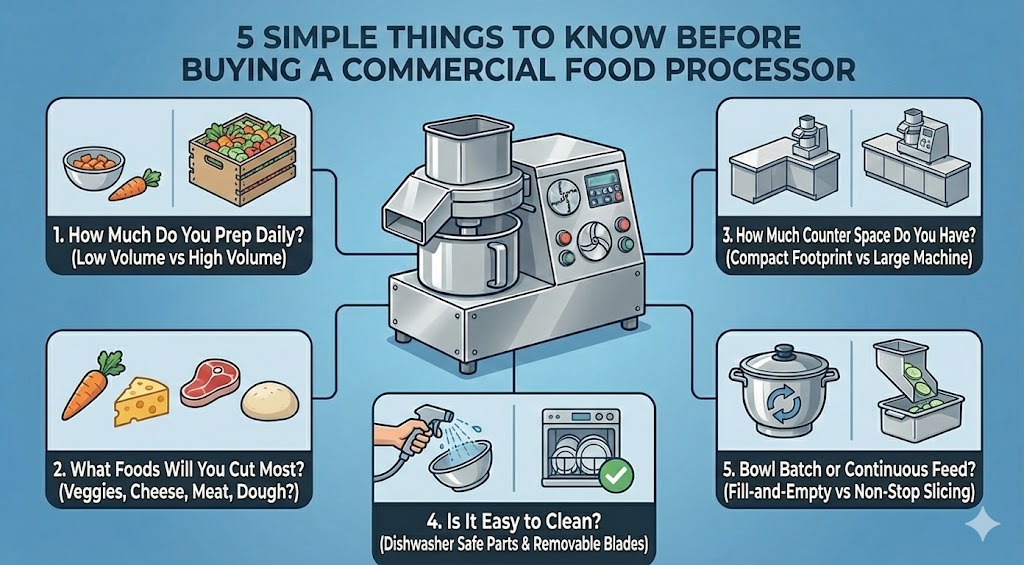
Motor Type: Induction vs Universal
Induction Motor — Recommended
- Quiet, brushless operation
- Built for heavy-duty, extended-run use
- Longer lifespan in demanding commercial settings
- Essential for 5 kg+ daily grating or slicing
- Higher upfront cost, lower total cost of ownership
Universal Motor — Light Duty
- Lighter and generally more affordable
- Louder during operation
- Suited to lower-volume or intermittent use
- Not recommended for continuous heavy loads
- Lower upfront cost, shorter lifespan under pressure
Bowl vs Continuous Feed
| Format | Best For | Limitation |
|---|---|---|
| Bowl-style | Sauces, dips, emulsifying, controlled batch prep | Must stop to empty bowl between batches |
| Continuous feed | High-volume slicing, grating and julienning without interruption | Less suited to wet or paste-style preparations |
| Combination | Versatile operations needing both functions | Higher cost; assess whether both modes are genuinely needed |
Blade and Disc Options
Look for interchangeable discs covering slicing, dicing, grating and julienne cuts. Adjustable thickness settings improve versatility and support a wider menu range without additional equipment.
Australian Safety and RCM Compliance
Confirm the unit is RCM certified for electrical compliance in Australia. Magnetic safety switches that stop the motor instantly when the lid is opened are essential in commercial environments — both for staff safety and insurance compliance.
Build Quality and Cleaning
Stainless steel construction, food-safe removable components and easy-clean designs reduce downtime between prep sessions and support ongoing hygiene compliance. Avoid units where blades or discs are difficult to access safely for cleaning.
Featured Models
Snowmaster supplies Robot Coupe — the industry benchmark for commercial food processors in Australia, trusted by professional kitchens globally for durability, precision and long-term performance.
Bowl Processor · Cafés and Restaurants
Robot Coupe R201 XL Ultra
Ideal for cafés and smaller restaurants requiring reliable bowl-style processing. Its powerful induction motor and stainless steel bowl handle sauces, dips, chopping and emulsifying tasks with consistent results.
Continuous Feed · High Volume
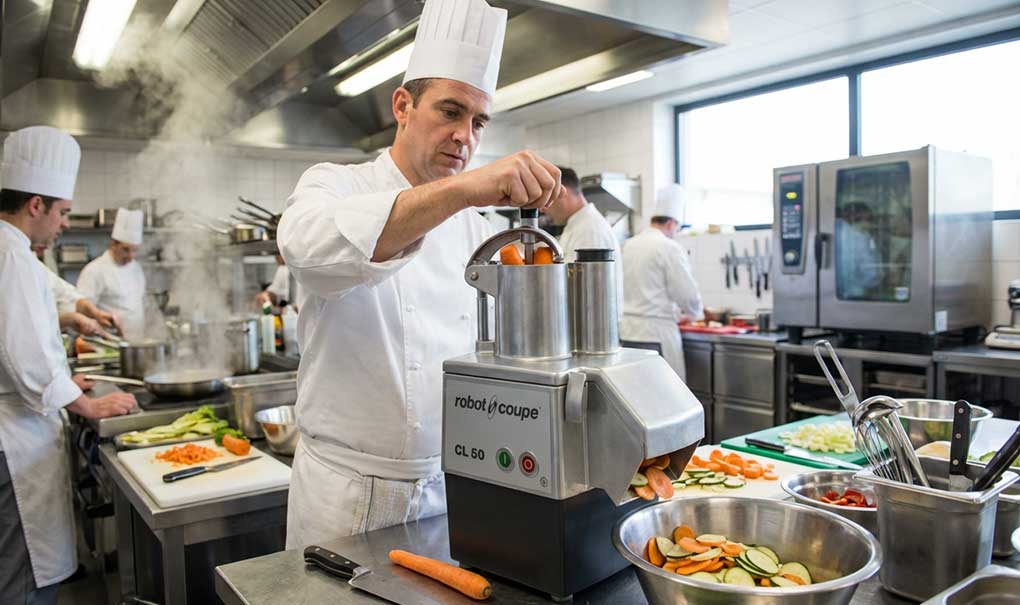
Robot Coupe CL50
Designed for heavy-duty slicing and grating without interruption. Supports uninterrupted preparation of vegetables, cheese and bulk ingredients — the right choice for high-volume kitchens and catering operations.
Setup and Placement
Position your processor on a stable, level stainless steel bench with adequate airflow around the motor housing. Avoid placing it near heat-producing equipment such as combi ovens or commercial cooktops — excess ambient heat reduces efficiency and shortens motor life. Ensure electrical outlets meet Australian standards and avoid extension leads in high-moisture environments.
Common Mistakes to Avoid
Watch Out For
- Using a domestic processor — domestic units are not built for extended runtime or heavy commercial loads. Overheating and motor failure are common when used in hospitality environments.
- Underestimating volume requirements — choosing a processor that is too small forces repeated batching and creates efficiency losses during peak periods.
- Ignoring safety compliance — always confirm RCM certification and safety interlocks to protect staff and ensure insurance and regulatory compliance.
- Prioritising price over quality — low-cost units often lack durability and long-term manufacturer support. Downtime in a commercial kitchen is expensive; reliable equipment pays for itself.
ROI and Total Cost of Ownership
The true cost of a commercial food processor is purchase price plus labour savings, maintenance and downtime risk — not the sticker price alone. A high-quality unit can save hours of prep time each week. Over a two-to-three year horizon, that labour efficiency consistently outweighs the higher upfront investment of a commercial-grade machine over a budget alternative.
Frequently Asked Questions
What size commercial food processor do I need?
Size your processor to your daily prep volume, not your bench space. Smaller cafés typically require a 2–3 litre bowl. High-volume kitchens processing 10 kg or more of ingredients per day benefit from larger bowl models or continuous-feed systems. When in doubt, size up — an undersized processor creates bottlenecks during peak service.
Are induction motors better for commercial use?
Yes, for most commercial applications. Induction motors are quieter, longer lasting and better suited to extended heavy-duty use. Universal motors are adequate for low-volume or intermittent tasks, but will wear faster under the demands of a busy commercial kitchen.
Is RCM certification required in Australia?
Yes. All commercial electrical equipment sold in Australia must meet RCM (Regulatory Compliance Mark) standards. Purchasing non-compliant equipment can void your insurance and expose your business to liability. Always verify certification before buying.
How long should a commercial food processor last?
With proper maintenance and correct usage, a commercial-grade unit from a reputable brand such as Robot Coupe can last many years in a busy hospitality environment. Cheaper units may fail within 12–18 months under commercial loads. The lifespan difference between quality tiers is significant.
What is the difference between a bowl processor and a continuous feed processor?
A bowl processor collects processed food in a fixed bowl and must be emptied between batches — ideal for sauces, dips and controlled prep. A continuous-feed processor ejects processed food as it works, allowing uninterrupted operation for high-volume slicing and grating tasks.
Snowmaster supplies commercial food processors from industry-leading brands including Robot Coupe. Our team can help you match the right model to your prep volume, kitchen layout and budget.
Browse Commercial Food Processors →
Also browse: Robot Coupe Range · Commercial Meat Slicers · Food Preparation Equipment · Contact Us