

Best Commercial Blast Chillers Australia: 2026 Expert Buyer’s Guide
- What it does: Rapidly cools cooked food from 70°C to 3°C in under 90 minutes — preventing bacterial growth and preserving quality.
- Legal requirement: Australian Food Standards Code requires cooling from 60°C to 21°C within 2 hours, then to 5°C within 6 hours total. A blast chiller achieves this comfortably.
- Not a freezer: A blast chiller and a commercial freezer serve different purposes — you cannot substitute one for the other.
- Key decision factors: GN tray capacity, probe vs timer controls, refrigerant type, and workflow position in your kitchen.
- ROI: Most commercial kitchens recover their investment within 12–24 months through waste reduction, labour savings and extended shelf life.
Why Blast Chillers Are Essential in 2026
Food safety compliance, labour efficiency and waste reduction are reshaping commercial kitchens across Australia. A commercial blast chiller is no longer optional equipment for serious hospitality operations — it is a critical component in any professional cook-chill system.
A blast chiller rapidly cools cooked food from 70°C to 3°C in under 90 minutes. This rapid temperature reduction moves food safely through the danger zone, preventing bacterial growth while preserving texture, flavour and nutritional integrity.
Modern kitchens integrate blast chillers alongside combi ovens, commercial convection ovens and commercial stoves to create efficient batch-cooking workflows. Once chilled, food is stored in commercial upright fridges or commercial freezers until regeneration or service.
What Is a Commercial Blast Chiller?
A commercial blast chiller is a high-performance refrigeration unit engineered to extract heat from freshly cooked food at speed. Unlike standard refrigeration — which is designed for storage — a blast chiller is designed specifically for rapid temperature reduction.
The typical cook-chill process works as follows:
- Food is cooked in a combi oven or on a commercial stove
- Food is transferred into GN pans
- The blast chiller reduces core temperature from 70°C to 3°C within 90 minutes
- Food is stored safely in commercial refrigeration until service or regeneration
Many units also offer blast freezing functionality, rapidly bringing food down to -18°C before transferring to commercial freezer storage.
Blast Chiller vs Commercial Freezer
A blast chiller is not simply a powerful freezer. Each serves a completely different purpose in a commercial kitchen.
| Feature | Blast Chiller | Commercial Freezer |
|---|---|---|
| Primary purpose | Rapid cooling of hot cooked food | Long-term storage of chilled or frozen food |
| Starting temperature | Accepts food at 70°C+ | Designed for food already at safe temperatures |
| Cooling speed | 70°C to 3°C in under 90 minutes | Not rated for rapid heat extraction |
| Effect of hot food | Engineered to handle it safely | Raises cabinet temp, strains compressor, risks other stored products |
| Compliance role | Meets Food Standards Code cooling requirements | Meets storage temperature requirements only |
Who Needs a Blast Chiller?
Restaurants and High-Volume Cafés
Venues preparing sauces, soups, proteins and desserts in batches benefit significantly from blast chilling. It improves consistency during peak periods and reduces food waste.
Catering and Event Companies
Caterers use blast chillers to prepare food days in advance while maintaining quality. They integrate seamlessly with food warming carts for controlled regeneration on-site.
Aged Care and Healthcare
Strict HACCP compliance standards make blast chillers essential in aged care and healthcare kitchens. These facilities often combine blast chilling with holding cabinets and controlled reheating systems.
Production and Central Kitchens
Central kitchens supplying multiple sites rely on blast chillers to maintain consistent cooling cycles, extended shelf life and uniform quality across all locations.
How to Choose the Right Blast Chiller
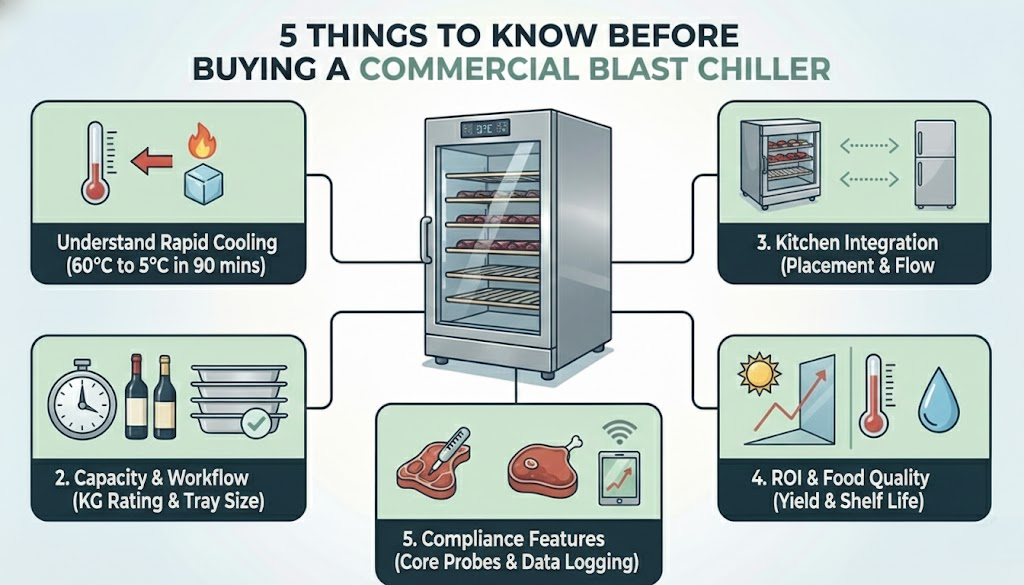
1. Capacity and Tray Configuration
Blast chillers are measured by GN tray capacity. Common configurations are 3, 5, 10 and 20 trays. When sizing your unit, consider daily production volume, number of batches per service, and expected growth over the next two to three years. Under-sizing creates workflow bottlenecks; over-sizing increases energy costs unnecessarily.
2. Probe vs Timer Controls
Timer-controlled units operate on fixed cooling cycles. Probe-controlled units measure core temperature directly and automatically stop when the target is reached. For compliance-driven operations — including aged care, healthcare and HACCP-certified kitchens — probe-controlled blast chillers provide superior accuracy and audit documentation support.
3. Refrigerant Type
In 2026, many Australian kitchens prefer environmentally responsible refrigerants such as R290. These systems improve energy efficiency while reducing environmental impact — an increasingly important consideration for both compliance and sustainability reporting.
4. Construction Quality
Look for stainless steel interiors, high-density insulation, durable hinges and self-closing doors. These features extend machine lifespan and improve operational efficiency over years of continuous use.
5. Workflow Integration
Your blast chiller should sit between your cooking line and cold storage. Position it near stainless steel benches for safe tray handling, and away from heat sources such as commercial deep fryers or commercial hot plates that would increase ambient temperature around the unit.
Australian Food Safety Compliance
Blast chillers are not specifically mandated by name under Australian law, but they are the most reliable way for high-volume kitchens to consistently meet these cooling time requirements. For aged care, healthcare and institutional operators, they are effectively essential for audit compliance.
Installation Requirements
Pre-Installation Checklist
- Electrical supply — confirm voltage and amperage requirements for your chosen model
- Ventilation clearance — adequate space around the unit is required for condenser airflow
- Drainage access — required on most models for defrost water and condensate
- Floor load capacity — larger roll-in units are heavy; confirm your floor can bear the load
- Proximity to heat sources — position away from fryers, ovens and hot plates to protect efficiency
- Licensed installation — always engage a licensed electrician and refrigeration technician prior to installation
Pricing and Return on Investment
Commercial blast chiller pricing varies by capacity, control type and brand. As a general guide:
- 3–5 tray models: Entry-level commercial pricing — suited to smaller restaurants and cafés
- 10 tray units: Mid-range pricing — suited to busy restaurants, caterers and aged care
- 20+ tray roll-in systems: Premium production pricing — suited to central kitchens and large institutions
When comparing price, evaluate total cost of ownership — including energy use, maintenance frequency and the labour savings generated by efficient batch-cooking workflows. For most commercial kitchens, return on investment is achieved within 12 to 24 months through reduced food waste, improved batch production efficiency, extended shelf life and reduced labour pressure during peak service.
Frequently Asked Questions
What is the main purpose of a commercial blast chiller?
A commercial blast chiller rapidly cools cooked food from 60°C to below 5°C in a controlled time frame to prevent bacterial growth. Unlike a standard fridge, it is designed for rapid heat extraction to meet Australian food safety cooling requirements under Standard 3.2.2.
What are the legal cooling requirements in Australia?
Under Food Standards Code Standard 3.2.2 Clause 10, food must cool from 60°C to 21°C within 2 hours, then to 5°C within a total of 6 hours. A blast chiller typically achieves this in under 90 minutes. Note that the 2-hour/4-hour rule is a separate requirement that applies to food held outside temperature control during display or service.
Why is cooling to 3°C in 90 minutes considered best practice?
Although the Food Safety Code allows up to 6 hours total cooling time, HACCP best practice is to cool to 3°C within 90 minutes. This minimises time spent in the bacterial danger zone and provides a strong safety buffer during compliance audits.
Can I use a commercial freezer instead of a blast chiller?
No. A commercial freezer is designed for storage, not rapid cooling. Placing hot food into a freezer raises cabinet temperature, strains the compressor and risks compromising other stored products. A blast chiller is engineered specifically for rapid cooling cycles.
Are blast chillers required by law in Australia?
Blast chillers are not specifically mandated by name, but businesses must comply with cooling time requirements under the Food Standards Code. For high-volume kitchens, a blast chiller is the most reliable way to consistently meet these legal standards.
What size blast chiller does my business need?
The correct size depends on kilograms of food cooled per cycle, not just tray count. Overloading a unit can extend cooling time beyond legal limits. Kitchens batch-cooking more than 10–15 kg at once should consider at least a 5-tray unit. Contact our team for a capacity assessment based on your specific production volumes.
Snowmaster supplies commercial blast chillers to Australian hospitality, healthcare and catering businesses. Our team can help you select the right capacity, control type and configuration for your kitchen workflow.
Browse Commercial Blast Chillers →
Also browse: Combi Ovens · Commercial Fridges · Commercial Freezers · Contact Us