

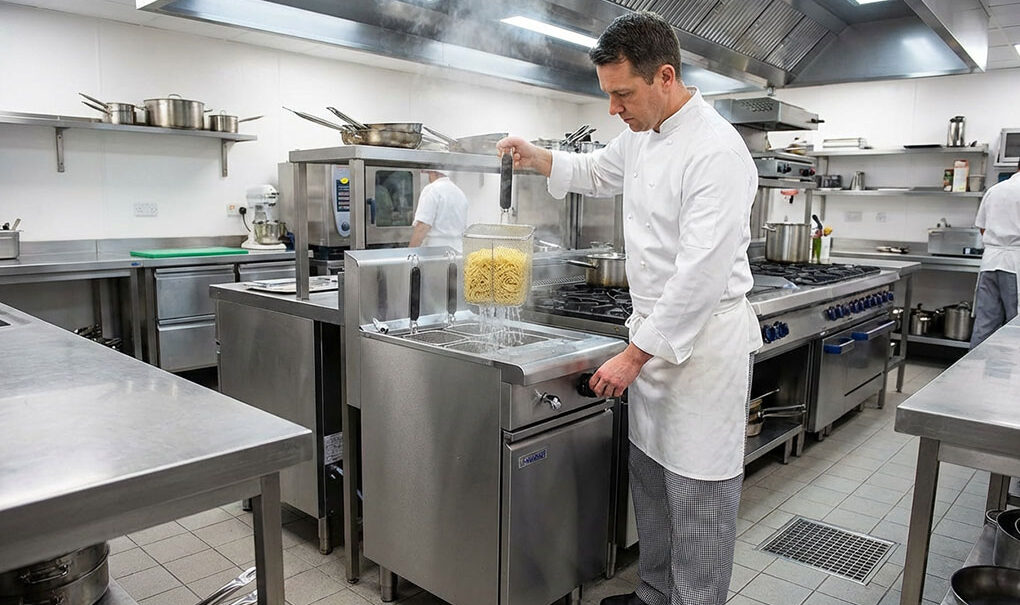
Commercial Noodle Cookers Australia: 2026 Buyer’s Guide
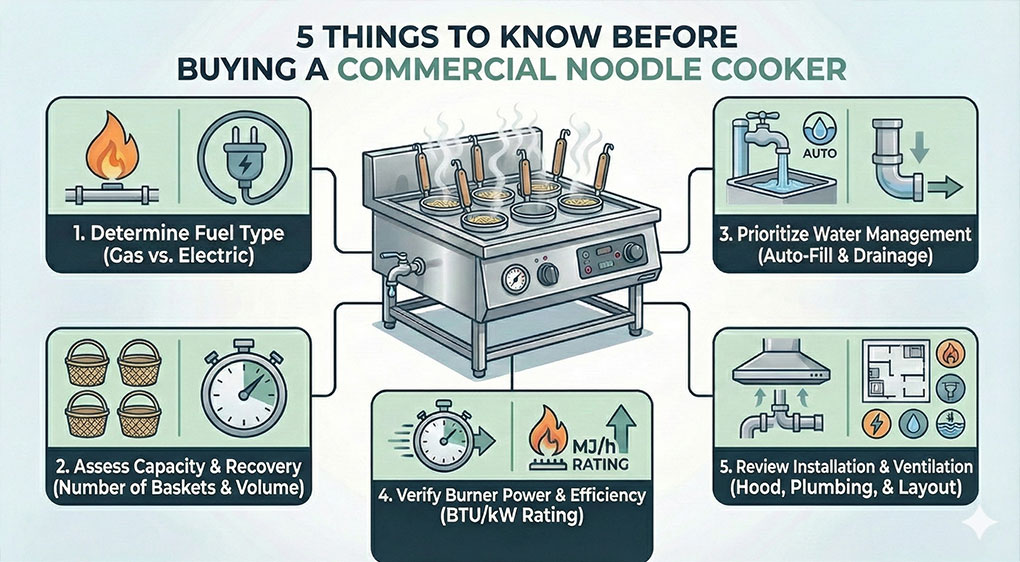
- Gas vs electric: Gas heats faster with better recovery times for high-turnover service; electric offers more precise temperature control for delicate noodles.
- Size by peak volume: Always size to your busiest service period, not your average — a cooker that can’t keep up during a rush causes slow service and inconsistent results.
- Water management: Look for a built-in overflow system to skim starch and a front drain valve for safe water changes during service.
- Placement: Position within your main cooking line next to the sauce station — and confirm exhaust, water supply and floor drain are all accessible before installing.
- Versatile: A noodle cooker can also blanch vegetables, boil eggs, cook dumplings and handle sous vide if the model has precise temperature control.
Choosing a Commercial Noodle Cooker
A commercial noodle cooker is one of the most hardworking pieces of equipment in a pasta bar, ramen shop or Italian restaurant. The right unit ensures every dish is cooked consistently, even during the busiest service periods — and the wrong one creates bottlenecks that back up the entire pass.
This guide covers power source, capacity, water management, workflow integration and common buying mistakes. All models referenced are available through Snowmaster’s pasta and noodle cooker range.
Is a Commercial Noodle Cooker Right for Your Business?
High-Volume Italian Restaurant
A freestanding gas pasta cooker with four to six individual baskets and a large water tank is essential for cooking multiple pasta types simultaneously during a dinner rush — without cross-contamination or delays. Often positioned alongside commercial stoves and ovens on the main cooking line.
Quick-Service Noodle Bar
Ramen and pho shops need speed and consistency above all else. A countertop electric noodle cooker with precise temperature control and automatic basket lifts ensures noodles are never overcooked and every order leaves the pass at the same quality.
Food Truck or Market Stall
When space is limited and mobility matters, a compact benchtop electric noodle cooker runs on a standard power outlet and delivers professional cooking results in a small footprint — ideal benchtop equipment for any mobile food service operation.
Multi-Purpose Kitchen
A noodle cooker with precise temperature control doubles as a blanching station for vegetables, an egg boiler, a dumpling cooker and even a sous vide bath. If your kitchen needs maximum flexibility from a single unit, confirm the model’s temperature range before purchasing.
Gas vs Electric
Gas
- Heats up faster and recovers temperature quickly between batches
- Better suited to high-turnover service with continuous basket use
- Requires gas connection and licensed gas fitter for installation
- Lower running costs than electric in most Australian states
- Best for: High-volume Italian restaurants, busy noodle bars, continuous service kitchens
Electric
- More precise temperature control — better for delicate noodles
- Can double as a sous vide or blanching station
- Simpler installation — no gas connection required
- Check whether single-phase or three-phase power is required before purchasing
- Best for: Noodle bars, food trucks, multi-purpose kitchens, smaller operations
Key Features to Consider
Capacity and Basket Configuration
Match the cooker’s size to your peak service volume. A small café may manage well with a 20-litre two-basket model. A large restaurant will need a 40-litre six-basket unit to maintain output during a busy service. Consider how many different noodle or pasta types need to cook simultaneously — each basket should be independently operable.
Water Management and Drainage
A built-in overflow system continuously skims starch from the water surface, keeping it cleaner for longer and improving pasta quality throughout service. A front-facing drain valve is essential for quick, safe water changes during service without disrupting the cooking line.
Build Quality
Specify 304-grade stainless steel construction — it is durable, corrosion-resistant and straightforward to clean. Rounded interior corners make daily cleaning faster and prevent starch and food debris from accumulating in hard-to-reach areas.
Workflow Integration and Installation
Position your noodle cooker within the main cooking line, directly next to your sauce station on commercial hot plates or commercial wok burners. This minimises chef movement and speeds up plating.
Pre-Installation Checklist
- Commercial exhaust hood — a noodle cooker produces significant steam; confirm your canopy is correctly sized and positioned directly above
- Water supply — plumbed cold water connection required; confirm supply is accessible at the installation point
- Floor drain — required for water changes and overflow; confirm drain location relative to the unit’s drain valve
- Power or gas supply — confirm single-phase vs three-phase for electric models; confirm gas pressure and line capacity for gas models
- Bench position — plan position on stainless steel benches relative to sauce station and pass before finalising placement
- Licensed installation — gas models require a licensed gas fitter; three-phase electric models require a licensed electrician
Common Buying Mistakes
Avoid These
- Sizing to average volume — always size to your peak service demand; a cooker that can’t keep up during a rush creates slow service and inconsistent food quality
- Hard-to-clean drainage — avoid models with complicated drainage or sharp internal corners; a simple front drain valve and rounded tank make daily cleanup significantly easier
- Mismatched power supply — purchasing a three-phase electric model for a single-phase kitchen requires costly electrical upgrades; confirm your supply capacity with a qualified electrician before purchasing
- No starch management — models without an overflow system require more frequent full water changes; starch buildup affects pasta quality and increases cleaning time
Frequently Asked Questions
How often should I change the water in a commercial pasta cooker?
Change the water every 2–4 hours during continuous service. If the water becomes visibly cloudy with starch before that point, change it immediately — starchy water affects cooking quality and produces inconsistent results.
Can I use a noodle cooker for anything besides pasta?
Yes. A noodle cooker can blanch vegetables, boil eggs, cook dumplings and handle sous vide cooking on models with precise temperature control. It is one of the more versatile pieces of equipment on a cooking line.
Is a pasta cooker the same as a commercial deep fryer?
No — they serve completely different purposes. A pasta cooker is engineered to boil water and manage starch efficiently. A commercial deep fryer is built to heat oil to much higher temperatures for frying and is not a substitute for either function.
What size noodle cooker do I need?
Base your decision on peak service volume, not average. A small café typically suits a 20-litre two-basket model. A busy restaurant will need a 40-litre six-basket unit. Consider how many pasta or noodle types you need to cook simultaneously when choosing basket count.
Does a commercial noodle cooker need a rangehood?
Yes. A noodle cooker produces substantial steam during operation and must be installed under a commercial exhaust hood with sufficient capture velocity. A standard kitchen canopy may be undersized if the noodle cooker is added to an existing cooking line — confirm with a mechanical services contractor.
Snowmaster stocks commercial noodle cookers and pasta cookers for Australian restaurants, noodle bars and food trucks. Our team can help you match the right capacity, power source and configuration to your kitchen and service volume.
Browse Commercial Noodle Cookers →
Also browse: Commercial Wok Burners · Commercial Stoves · Commercial Hot Plates · All Cooking Equipment · Contact Us