


Key Factors to Consider When Buying a Pizza Oven in 2026
The most important factors to consider when buying a pizza oven are the oven type, production capacity, fuel source, and ventilation requirements, which must align with your menu, space, and budget.
Introduction
Choosing the right commercial pizza oven is a critical decision for any food business. Whether you are launching a pizzeria, expanding a cafe menu, or upgrading a pub kitchen, the oven is the heart of your pizza operation. The correct choice delivers consistent, delicious results and an efficient workflow. The wrong one can lead to service bottlenecks and frustration. This guide details the essential factors to consider, from oven type and size to power needs and kitchen integration. Understanding these points will help you select a machine that perfectly suits your menu, space, and production goals. Explore our full range of commercial pizza ovens to see the latest models.
Choosing the Right Pizza Oven for Your Business Model
The ideal pizza oven depends entirely on your business. Different scenarios demand different ovens to maximise quality and efficiency.
High-Volume Pizzerias
A busy takeaway shop needing hundreds of pizzas per hour requires a conveyor oven. Its moving belt guarantees a consistent bake with minimal staff training. This ensures speed and uniformity during peak dinner service, often paired with high-capacity conveyor dishwashers to manage the workflow.
Artisan Restaurants and Cafes
If your focus is on gourmet pizzas with a perfect crust, a deck oven is your best choice. A restaurant adding authentic Neapolitan-style pizzas to its menu will benefit from the intense, direct heat of a stone deck. This provides the classic char and texture that other ovens cannot replicate.
Food Trucks and Mobile Caterers
When space and power are limited, a compact countertop pizza oven is the perfect solution. A food truck needs a portable, fast-heating unit that can run on LPG or a standard power outlet. This allows for quick setup and service in any location, often supplemented by efficient under-bench fridges.
Bars, Pubs, and Clubs
For venues adding pizza as a high-margin food option, a commercial high-speed oven is ideal. These units use combined microwave and convection technology to cook fresh pizzas in minutes. They are perfect for a fast-paced bar where customers want quick, tasty food.
Expert Tips for Buying a Pizza Oven
Making the right investment requires careful planning. Here are our top tips for choosing the perfect commercial pizza oven.
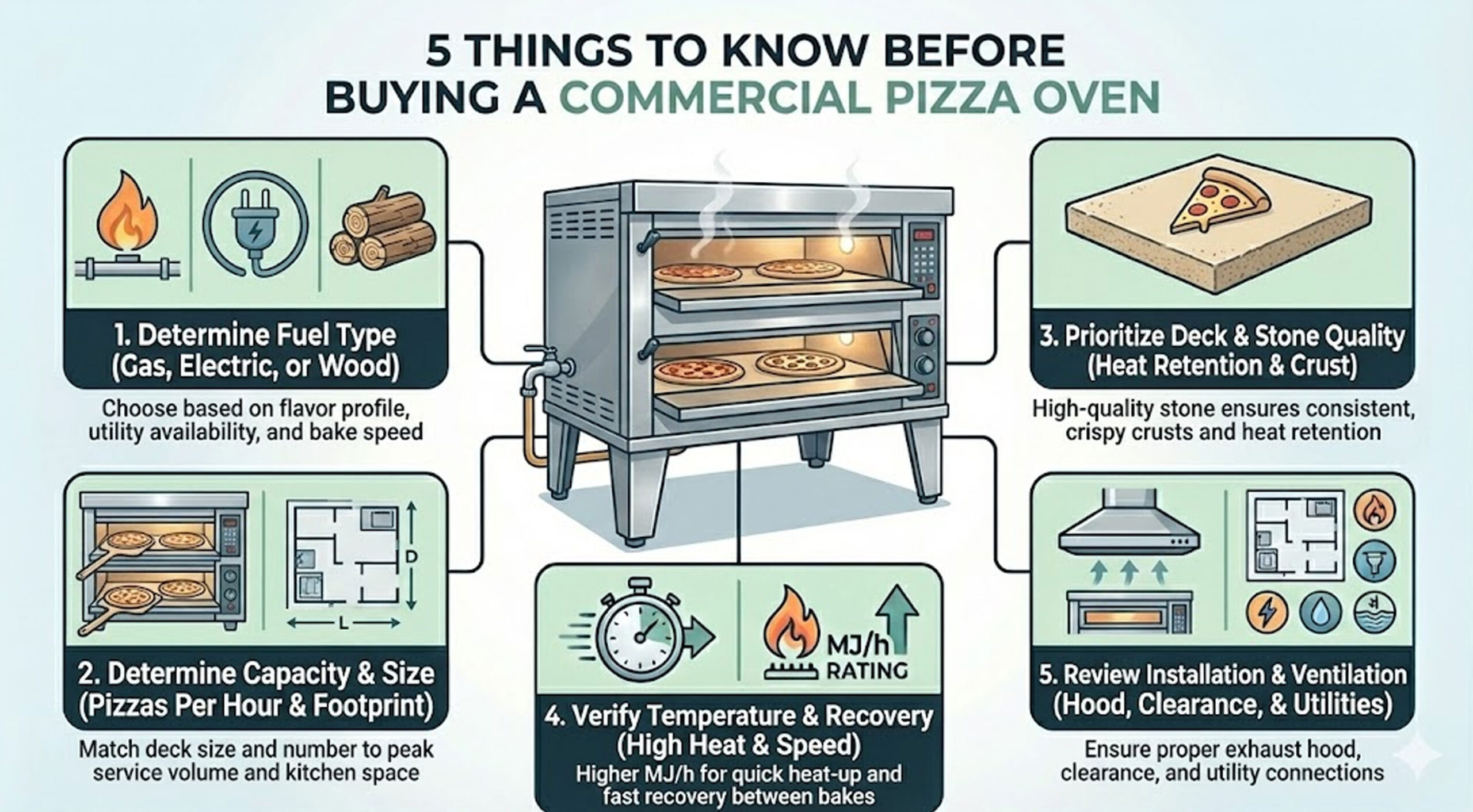
1. Match the Fuel Type to Your Kitchen
Before looking at models, check your kitchen’s services. Do you have 3-phase power for a large electric oven? Is your gas line robust enough for a powerful gas deck oven? Consulting an electrician and a gasfitter first can prevent you from buying an oven you cannot install.
2. Calculate Your Peak Production Needs
Estimate how many pizzas you need to cook during your busiest hour. If you expect to sell 60 pizzas on a Friday night, a small single-deck oven will not keep up. You will need a multi-deck model or a small conveyor oven to avoid long waits and lost sales. Your dough production, likely using spiral mixers, should also align with this output.
3. Consider Your Pizza Style
The oven shapes the final product. A stone deck oven is essential for a classic, crispy New York-style slice. For deep-dish pizzas that need longer, even baking, a convection or conveyor oven provides more consistent results.
4. Factor in Ventilation Costs
Every commercial pizza oven requires mechanical ventilation. A gas oven must be installed under a specific exhaust hood that complies with Australian safety standards. Budget for the cost of purchasing and installing this canopy from the start.
5. Check the Recovery Time
Ask about the oven’s recovery time-how quickly it returns to cooking temperature after the door is opened. In a busy service, slow recovery means inconsistent cooking and longer ticket times. Ovens with good insulation and powerful elements are worth the investment.
Pizza Oven Setup for a Safe and Efficient Kitchen
Proper placement of your pizza oven is critical for a safe and efficient workflow. Position the oven as the centrepiece of your production line. It should be close to your pizza prep fridges and dough station, equipped with pizza dough rollers, to minimise staff movement.
Ventilation is non-negotiable. Your oven must be installed under a certified commercial exhaust hood that meets all local council and Australian safety regulations. Ensure adequate clearance around the unit as specified by the manufacturer. This space is vital for preventing overheating, allowing for cleaning, and giving technicians access for maintenance. Finally, you need a heat-proof stainless steel bench next to the oven where staff can safely place hot trays.
Common Mistakes to Avoid When Buying a Pizza Oven
A new pizza oven is a major part of your cooking equipment investment. Here are the top mistakes to avoid.
- Underestimating Space and Access: A frequent error is buying an oven that will not physically fit. Measure your doorways, hallways, and the final installation space before purchasing. A large deck oven is useless if you cannot get it into the kitchen.
- Ignoring Your Power or Gas Supply: Many owners choose an oven without checking their building’s utilities. Buying a powerful 3-phase electric oven for a kitchen wired only for single-phase power will result in thousands of dollars in unexpected electrical work.
- Buying Based on Price Alone: A cheap, unbranded oven may cost more in the long run. Poor insulation leads to higher energy bills, slow recovery times create service bottlenecks, and frequent breakdowns mean lost revenue. Investing in a reputable brand with local support is always smarter.
- Choosing the Wrong Oven for Your Menu: Do not force an oven to make a style of pizza it was not designed for. Your oven should enhance your recipe, not compromise it. Using a conveyor oven for a delicate artisan pizza will likely result in a dry product.
Frequently Asked Questions
What’s the main difference between a deck oven and a conveyor oven?
A deck oven cooks pizza directly on a hot surface, typically stone or ceramic, which is ideal for creating a crispy, artisan-style crust. A conveyor oven uses forced hot air to cook pizzas as they move along a belt, perfect for high-volume output and consistency.
Do I need a gas or electric pizza oven?
This depends on your kitchen’s utilities and cooking preference. Gas ovens often provide a more intense, radiant heat that can produce a distinct char. Electric ovens are known for precise temperature control and even baking, making them very reliable.
How much ventilation does a commercial pizza oven need?
All commercial pizza ovens require a mechanical exhaust hood installed to Australian standards (AS 1668). This is a critical safety requirement to properly remove heat, smoke, and grease-laden vapours from the kitchen.
What is oven recovery time and why is it important?
Recovery time is how quickly an oven reheats to its set temperature after the door has been opened. A fast recovery time is vital in a busy kitchen to maintain consistent cooking temperatures and keep up with orders during peak service.
Conclusion
Selecting the right commercial pizza oven is a foundational step towards success. By carefully considering the factors of oven type, production volume, fuel source, and kitchen layout, you can make an informed decision. A well-chosen oven will not only produce exceptional pizza but also streamline your operations and boost profitability. Remember to account for installation, ventilation, and workflow to create a truly efficient pizza station, complete with planetary mixers for dough and hot food displays for service. Ready to find the perfect fit? Browse our extensive collection of commercial pizza ovens at Snowmaster today and equip your business for success.