

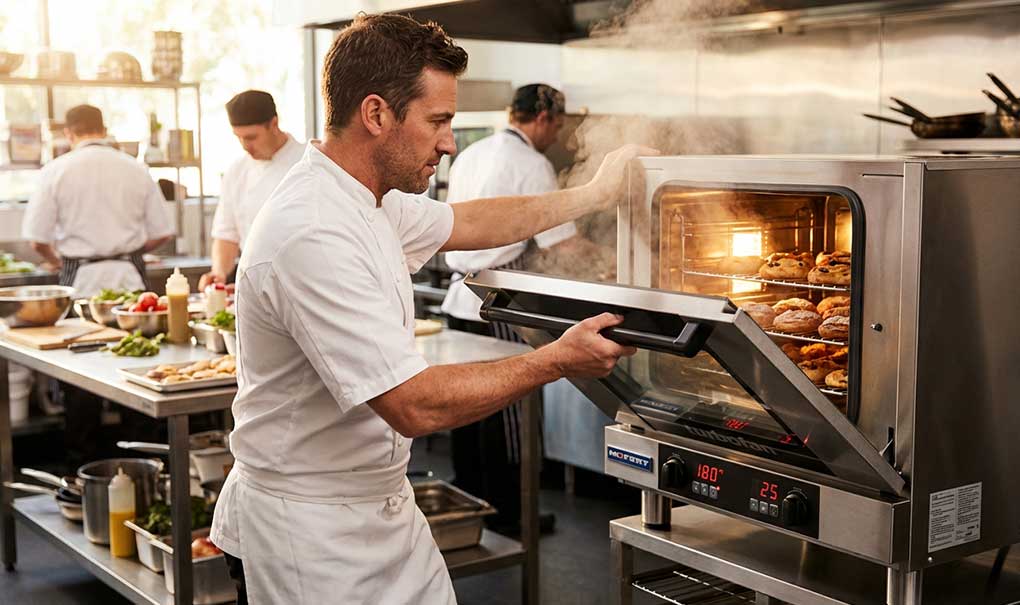
Key Factors to Consider Before Buying a Convection Oven in 2026
- Fan-forced cooking: A convection oven circulates hot air for faster, more even cooking than a conventional oven — typically 25% faster at 10–15°C lower temperature.
- Gas vs electric: Electric offers precise temperature control for delicate baking; gas heats faster and suits high-volume roasting with lower running costs.
- Size first: Measure your space before browsing — account for ventilation clearance on all sides, not just footprint.
- Power check: Many commercial models require three-phase power — confirm your electrical capacity before purchasing.
- Not a combi oven: A convection oven circulates dry heat only; a combi oven adds steam. If your menu requires steaming or regeneration, compare with a combi oven first.
Choosing a Commercial Convection Oven
A commercial convection oven uses a fan to circulate hot air, producing faster and more even cooking than a conventional oven. For cafés, bakeries and restaurants that require consistent results across high volumes, it is one of the most versatile pieces of cooking equipment available.
This guide covers the key decisions: gas vs electric, size and capacity, controls, installation requirements and common buying mistakes. All models referenced are available through Snowmaster’s commercial convection oven range.
When Is a Convection Oven the Right Choice?
Busy Café
A countertop convection oven suits cafés serving baked goods like muffins and croissants. It delivers a consistent golden-brown finish and reheats items quickly during the lunch rush, complementing pie warmers and display equipment.
High-Volume Bakery
Bakeries depend on consistency and volume. A floor-standing convection oven with multiple racks bakes dozens of items simultaneously. Circulating air eliminates hotspots across every tray — the ideal partner for planetary mixers and dough sheeters.
Restaurant Kitchen
In a diverse menu kitchen, a convection oven handles roasting large cuts of meat, browning vegetables, baking potatoes and preparing desserts. Its versatility makes it a true workhorse alongside commercial deep fryers and grills.
Not Sure? Compare With a Combi Oven
A convection oven circulates dry heat only. If your menu requires steaming, regeneration or combination cooking, a combi oven offers significantly greater versatility. For most high-volume baking and roasting operations, a convection oven is the right choice.
Gas vs Electric
Electric
- Precise, consistent temperature control
- Better for delicate baking — pastries, cakes, bread
- No gas connection required
- Higher running costs than gas in most Australian states
- Many models require three-phase power — confirm electrical capacity before purchasing
- Best for: Bakeries, patisseries, cafés focused on baked goods
Gas
- Heats up faster than electric
- Lower running costs for high-volume continuous use
- Requires gas connection and licensed gas fitter for installation
- Slightly less precise temperature control than electric
- Well suited to roasting and high-volume cooking applications
- Best for: Restaurants, high-volume roasting, operations with existing gas infrastructure
Key Features to Consider
Size and Capacity
Measure your available space before browsing — account for ventilation clearance on all sides, not just the unit footprint. Consider internal capacity and tray count relative to your peak production needs. Snowmaster stocks full-size floor-standing models and compact benchtop options to suit any kitchen layout.
Manual vs Digital Controls
Manual dial controls are straightforward and durable — well suited to kitchens where simplicity and reliability are priorities. Digital controls offer precision and programmability, allowing you to save recipes with specific times and temperatures for absolute consistency regardless of who is operating the oven.
Ease of Cleaning
Look for coved corners, removable rack guides and porcelain enamel interiors. These features significantly reduce cleaning time and prevent grease buildup that affects performance and creates a fire hazard over time. A clean oven also complements an efficient warewashing workflow alongside your commercial dishwashers.
Installation Requirements
Pre-Installation Checklist
- Ventilation and extraction — a commercial extraction hood is mandatory; confirm it is correctly sized for the oven’s heat and steam output
- Electrical supply — confirm voltage and phase requirements; many commercial models require three-phase power
- Gas supply — gas models require a licensed gas fitter for connection; confirm supply pressure and line capacity
- Clearance space — follow manufacturer clearance specifications on all sides to prevent overheating
- Workflow position — position near stainless steel benches and preparation tables to streamline kitchen flow
- Licensed installation — always engage a licensed electrician or gas fitter; required for compliance with Australian standards
Common Buying Mistakes
Avoid These
- No ventilation plan — failing to install an adequate extraction hood results in a hot, steamy kitchen, potential health code violations and damage to nearby refrigeration equipment
- Wrong size — an undersized oven slows service; an oversized oven wastes space and energy; analyse your peak production volume before deciding
- Not checking power supply — many commercial convection ovens require three-phase power; confirm your electrical capacity before purchasing to avoid expensive upgrades
- Hard-to-clean design — sharp corners and fixed rack guides make cleaning difficult, leading to grease buildup, poor performance and fire risk over time
- Using a domestic oven commercially — domestic appliances are not built for continuous heavy-duty use and do not meet Australian commercial health and safety standards
Frequently Asked Questions
What is the difference between a convection oven and a combi oven?
A convection oven circulates dry hot air only. A combi oven combines convection with steam, allowing it to steam, roast, bake and regenerate food. If your menu requires steaming or combination cooking, a combi oven offers significantly greater versatility.
How much faster does a convection oven cook?
As a general guide, a convection oven cooks approximately 25% faster than a conventional oven. You may also need to reduce the set temperature by 10–15°C to prevent overcooking, particularly for delicate baked goods.
Do I need special cookware for a convection oven?
No — most standard commercial-grade cookware works well. Pans with lower sides allow circulating air to reach food more effectively, which promotes better browning and more even cooking across the tray.
Can I use a domestic convection oven in my café?
No. Domestic appliances are not designed for continuous commercial use and do not meet Australian commercial health and safety standards. A purpose-built commercial convection oven is required for any food service operation.
Does a commercial convection oven need three-phase power?
Many commercial electric convection ovens require three-phase power. Always confirm your kitchen’s electrical capacity with a licensed electrician before purchasing. Gas models avoid this requirement but need a licensed gas fitter for installation.
Snowmaster stocks commercial convection ovens for Australian cafés, bakeries and restaurants. Our team can help you match the right size, fuel type and configuration to your kitchen and menu.
Browse Commercial Convection Ovens →
Also browse: Combi Ovens · Commercial Stoves · Commercial Deep Fryers · All Cooking Equipment · Contact Us