

Commercial Donut Fryers Buying Guide 2026: The Perfect Donut
- Type: Manual batch fryers for small to medium volume and variety; automated conveyor fryers for high-volume wholesale and dedicated donut shops producing 50+ dozen per hour.
- Heating: Gas for faster oil recovery and lower running costs in high-volume operations; electric for benchtop models, mobile catering and sites where gas installation isn’t practical.
- Recovery time is the key spec: Fast oil recovery after a cold batch is added prevents grease absorption — this matters more than oil tank size alone.
- Oil filtration: Integrated filtration extends oil life by up to 50% — a non-negotiable feature for any high-volume donut operation.
- Safe frying temperature: 175°C–195°C. Below this range produces greasy donuts; above it burns the exterior before the interior is cooked.
- Compliance: Gas fryers require AGA certification and licensed installation; all units must operate under a certified commercial exhaust hood.
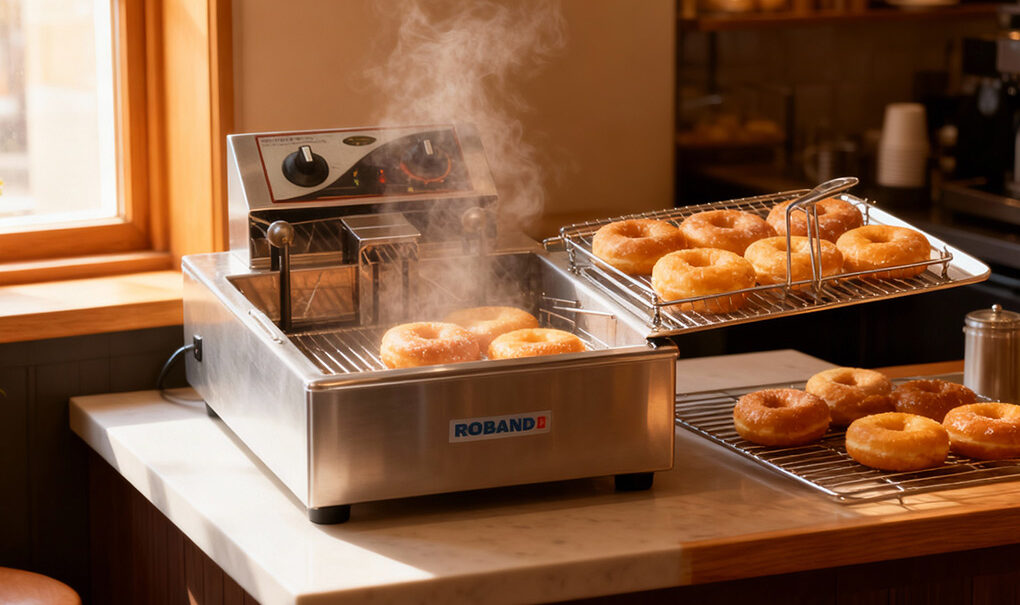
For any business where donuts, churros or funnel cakes are a key menu item, the fryer is your primary revenue generator. A commercial donut fryer is specialised equipment — it must deliver rapid oil recovery, precise temperature control and effective filtration in ways that general-purpose frying equipment cannot. Poor recovery, degraded oil or the wrong setup will quietly ruin product consistency and margins.
This guide covers the essential specifications for buying a commercial donut fryer in Australia — machine types, heating systems, capacity, oil management, safety requirements, brands and costs.
Manual vs Automated Donut Fryers
The choice between manual and automated systems determines your daily production volume and labour requirements.
Manual Batch Fryer
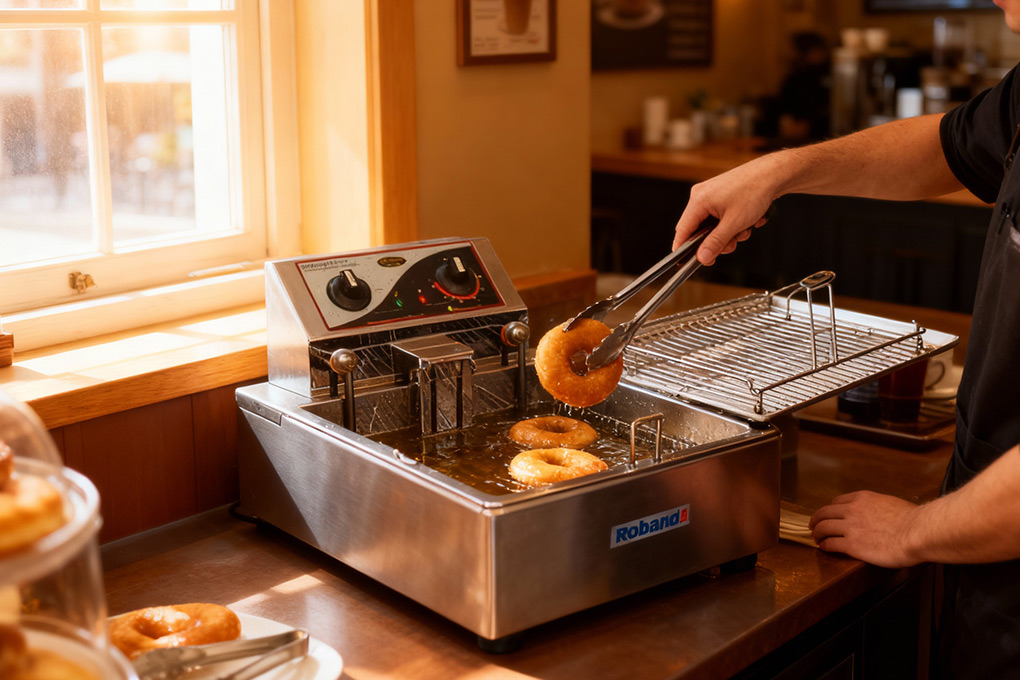
- Operator places donuts into the oil, flips manually with sticks or screens, and removes when done
- Highly versatile — can fry different products in small batches
- Lower upfront cost and compact footprint
- Requires consistent operator attention and timing throughout service
- Capacity limited by labour and available bench or floor space
- Best for: Cafés, bakeries, food trucks and low-to-medium volume kitchens where product variety is high
Automated Conveyor Fryer
- Continuous conveyor deposits dough, flips product mid-cycle and discharges finished donuts onto a cooling rack
- Maximum consistency and minimal labour — hundreds or thousands of pieces per hour
- High purchase price ($20,000–$50,000+) and larger footprint
- Limited flexibility for different product types or small batches
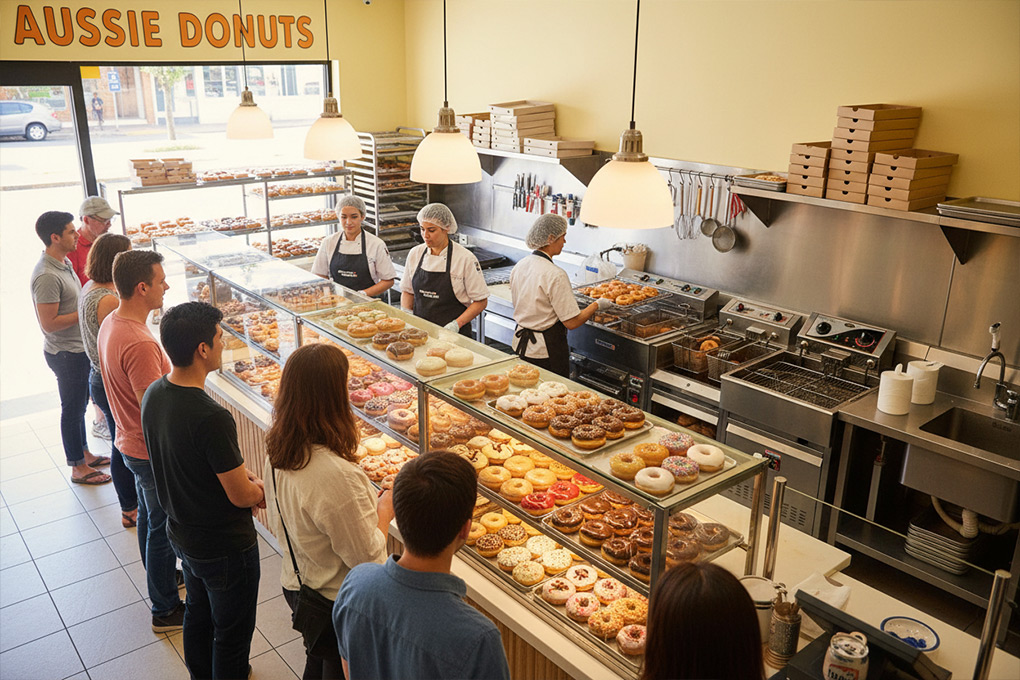
- Best for: Wholesale bakeries, dedicated donut shops and high-volume specialty stores producing 50+ dozen per hour
Which fryer suits your operation?
| Operation Type | Recommended Configuration |
|---|---|
| Café or bakery | Compact gas or electric floor fryer — strong recovery, good volume through peak periods |
| Food truck or mobile operator | Benchtop electric or smaller gas unit — compact footprint, easy transport, simpler installation |
| Small growing donut shop | Manual batch fryer with strong recovery and integrated filtration — scale to conveyor when demand is predictable |
| Wholesale or central production | Automated conveyor fryer — producing for multiple sites, supermarkets or large daily orders |
Gas vs Electric
The heat source directly determines oil recovery time — the time it takes for oil to return to set temperature after cold dough is added. Slow recovery means the next batch enters oil that’s below cooking temperature, absorbs excess oil and comes out greasy.
| Gas | Electric | |
|---|---|---|
| Recovery time | Faster — higher heat input returns oil to set temperature quicker after cold batches | Slower than equivalent gas, but stable once back at set temperature |
| Running cost | Lower in most Australian states — better for high-volume continuous frying | Higher per hour than gas for equivalent output |
| Installation | Requires licensed gas fitting and commercial exhaust ventilation | Simpler — many benchtop units plug in directly depending on phase and amperage |
| Best for | High-volume operations, floor-standing units, continuous peak-hour frying | Benchtop models, mobile catering, medium-volume operations, sites without gas infrastructure |
Capacity, Recovery and Oil Management
Do not confuse a large oil volume with high production capacity. The key metric is heat input (kW or BTU) working together with tank size — a large tank with an undersized heating element still recovers slowly, producing greasy, inconsistent product.
Oil capacity by operation size
- Benchtop / small café: 5L–15L — ideal for short runs or donuts as a feature item. The Roband FD10 at 8.5L is a popular choice for minimal counter space.
- Standard floor model: 20L–35L — suited to bakeries and donut shops with steady daily demand and regular peak periods.
Key specs to confirm before purchasing
Ask Your Supplier For
- Heat input — kW or BTU rating of the burner or elements
- Oil capacity — total litres and recommended fill line
- Recovery data — batch times and recovery speed to set temperature under load
- Footprint — external dimensions including clearance requirements under your hood
- Filtration — integrated pump filtration or manual drain only
Oil filtration and the cool zone
Oil quality directly affects donut taste, consistency and product cost. For any high-use operation, integrated filtration is not optional.
- Integrated filtration: Allows operators to filter oil quickly and safely at temperature — often within minutes — dramatically extending oil life and reducing replacement cost. A well-maintained filtration routine can extend oil life by up to 50%.
- Cool zone: A cooler area beneath the heating elements where crumbs collect without burning. Reduces carbon buildup — the primary cause of oil darkening and breakdown. A well-designed cool zone combined with daily filtration can save thousands of dollars per year in replacement oil.
Recovery Time is the Spec That Matters Most
Most buyers focus on oil volume when comparing donut fryers. The spec that actually determines product quality is recovery time — how fast the oil returns to set temperature after a cold batch of dough is added. A fryer with slow recovery produces the second and third batches in oil that’s below cooking temperature, causing excess oil absorption and greasy product. When comparing models, ask the supplier for recovery time data under load. A gas fryer with 35L capacity and fast recovery will outperform an electric fryer with 40L and slow recovery every service period.
Safety and Construction Features
Commercial frying is one of the highest-risk cooking processes in any kitchen. These features are non-negotiable.
Safety Features — Required
- Auto shut-off: Automatically cuts gas or power if oil temperature exceeds the safe limit (typically 200°C), preventing flash fires
- Over-temperature protection: A secondary thermostat that stops heating if the primary control fails
- Cool-touch exterior and handles: Reduces burn risk for operators during busy service
- Front drain valve and safety pipe: Wide, accessible drain makes oil changes safer and cleaner — confirm this is fitted before purchasing
Construction
304-grade stainless steel construction is the standard for commercial donut fryers — durable, resistant to hot oil, steam and commercial cleaning chemicals. Look for seamless welded tanks rather than folded and sealed construction — seamless tanks are easier to clean and don’t develop leaks at joins over time.
Compliance and Installation
- Power phase: Confirm your site’s power supply before ordering high-powered electric units — many floor-standing models require three-phase power
- Hood coverage: Confirm your existing canopy covers the fryer’s output — an undersized hood is a compliance issue and a comfort issue for staff
- Gas certification: Confirm AGA certification on any imported gas model before purchase
Complementary Equipment
A high-volume donut operation requires a small ecosystem of equipment around the fryer to maintain consistent output.
Mixers and Sheeters
A spiral mixer or planetary mixer handles high-volume dough production. A dough sheeter or dough roller produces consistent thickness for even frying. Inconsistent dough thickness produces inconsistent cook times and colour.
Provers and Holding Cabinets
Provers and holding cabinets control dough temperature and humidity before frying — improving rise, structure and final texture. Well-proofed dough absorbs less oil during frying, producing a lighter, better textured product.
Display and Warming
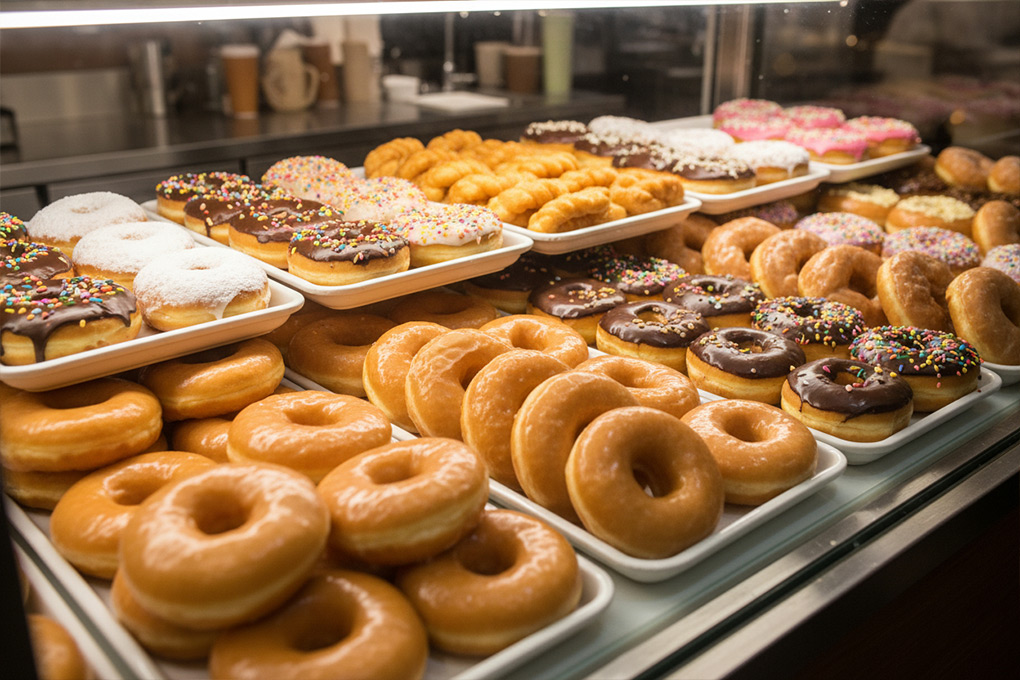
Finished donuts held at the wrong temperature deteriorate quickly. A heated display case — similar to a pie warmer — keeps donuts warm and ready for sale without overcooking them. Chip warmers work similarly for other fried products sold alongside donuts.
Vacuum Sealers
Vacuum sealers extend the shelf life of bulk ingredients and pre-portioned dough, reducing waste in high-volume production operations where batching in advance is part of the workflow.
Brand Guide
| Brand | Position | Strengths | Best For |
|---|---|---|---|
| Frymaster | Premium | Frymaster delivers high-efficiency gas and electric fryers with advanced integrated filtration — a benchmark for recovery speed and oil management in high-volume operations | Busy donut shops, QSR environments and multi-site operators prioritising energy savings and oil longevity |
| Pitco | Premium | Pitco supplies durable, powerful fryers with generous cool zones and straightforward controls — a reputation for solid construction and long operational life | Bakeries and donut shops frying throughout the day that need a robust, long-life fryer |
| Blue Seal / Waldorf | Mid-Range | Blue Seal and Waldorf provide modular frying solutions that integrate with full commercial cooking suites — consistent build quality and strong Australian support | Mixed-menu kitchens wanting a fryer that matches their existing cooking line in footprint and configuration |
| Roband | Mid-Range | Roband delivers compact, reliable benchtop electric models — the FD10 (8.5L) is a popular choice for small spaces and ease of cleaning | Cafés, mobile setups and small-batch operations wanting fresh donuts without a large floor fryer footprint |
Costs and ROI
| Type | Capacity / Fuel | Price Range (AUD excl. GST) |
|---|---|---|
| Benchtop / small batch | Electric, 8L–15L | $950–$2,000 |
| Standard floor model | Gas, 25L–40L | $3,000–$7,000 |
| High-efficiency with filtration | Gas or electric, 25L+, built-in pump | $7,000–$15,000 |
| Automated conveyor | Electric or gas, specialty | $20,000–$50,000+ |
When comparing models at similar price points, prioritise recovery performance and filtration over minor differences in oil volume. A quality fryer with integrated filtration typically pays for its premium through reduced oil replacement cost and lower energy consumption within the first year of high-volume use.
Pre-Purchase Checklist
Before You Buy
- Gas or electric — confirmed against your site’s infrastructure and recovery requirements?
- Does the unit include integrated oil filtration?
- Does the heat input and recovery rate match your peak hourly production demand?
- Does it include automatic shut-off and cool-touch surfaces?
- Is the tank seamless and the construction 304-grade stainless steel?
- Is the unit rated for use under a commercial exhaust hood?
- Have you confirmed power phase (single or three-phase) for electric models?
- Have you budgeted for complementary equipment — mixer, prover and display holding?
Frequently Asked Questions
What is oil recovery time and why does it matter?
Oil recovery time is how long the oil takes to return to the set cooking temperature after cold dough is added. When cold dough hits hot oil, the oil temperature drops — how quickly it recovers determines whether the next batch fries correctly. Slow recovery means the second and third batches enter oil that’s below cooking temperature, absorbing excess oil and producing greasy, inferior product. Recovery speed is a function of heat input (kW or BTU) relative to oil volume — always ask for recovery data when comparing models.
What is the safe temperature range for frying donuts?
175°C–195°C (350°F–385°F) is the optimal range. Below 175°C, the dough absorbs excess oil before the exterior sets — producing greasy, heavy product. Above 195°C, the exterior browns and sets before the interior is fully cooked. Most operations work within 180°C–185°C as a practical target, adjusting by dough type and size.
How often should I filter the oil in a commercial donut fryer?
At minimum once per day for high-volume operations — ideally once during service and once at close on long shifts. Filtering removes carbonised crumbs and impurities that accelerate oil degradation and transfer off-flavours to the product. Combined with a cool zone design, a consistent daily filtration routine can extend oil life by up to 50%, directly reducing one of the largest ongoing operating costs in donut production.
Are automated conveyor fryers worth the cost?
Yes — at the right volume. Automated conveyor fryers justify their $20,000–$50,000+ price point when production consistently exceeds 50 dozen donuts per hour. At that volume, the labour savings, product consistency and throughput advantages outweigh the capital cost. For operations producing less than this — or where product variety is important — a high-quality manual batch fryer with integrated filtration delivers better value and more flexibility.
What complementary equipment does a donut operation need?
At minimum: a planetary mixer or spiral mixer for dough production, a prover and holding cabinet for dough temperature and humidity control before frying, and a heated display for finished product. A dough sheeter significantly improves consistency at medium to high volumes. Consistent dough prep directly improves frying consistency — variations in dough thickness and proofing produce variations in finished product colour, texture and oil absorption.
Also browse: Commercial Deep Fryers · Spiral Mixers · Provers and Holding Cabinets · Commercial Waffle Makers · Contact Us