

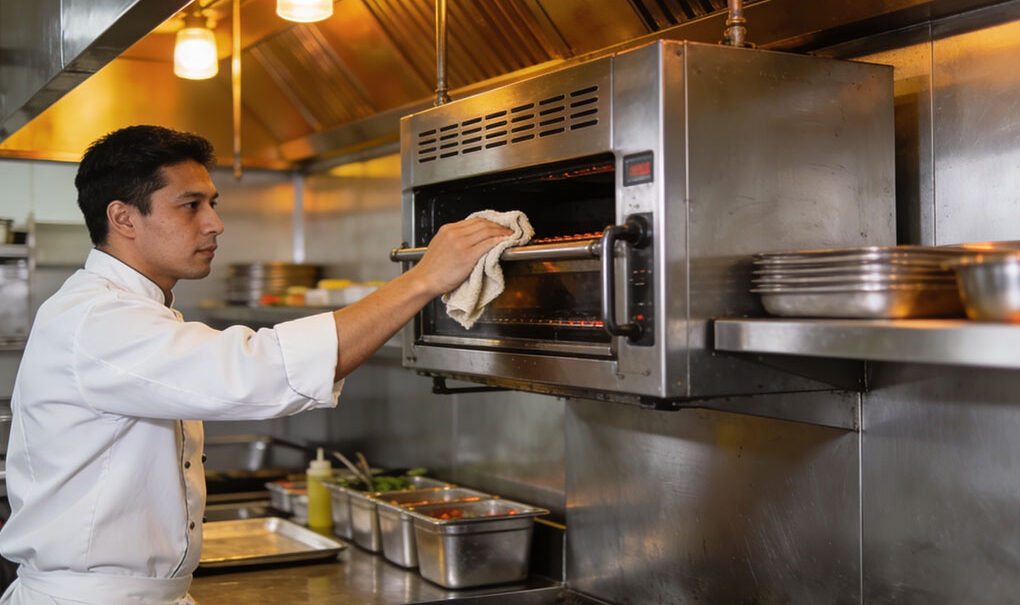
Restaurant Kitchen Equipment Maintenance: The Complete Guide for Australian Kitchens
- Most neglected task: Condenser coil cleaning on refrigeration — the leading cause of early fridge and freezer failure in Australian commercial kitchens.
- Highest fire risk: Deep fryers and canopy extraction — over 20% of commercial kitchen fires are linked to poorly maintained fryers and grease-laden ducts.
- Compliance requirement: FSANZ Standard 3.2.2 requires cold food held at 5°C or below — a fridge that fails because of neglected maintenance is a compliance failure, not just an equipment problem.
- Daily discipline: Most equipment failures are preceded by warning signs — temperature drift, unusual noise, reduced output — that daily checks catch before they become breakdowns.
- Budget rule: Set aside 2–3% of equipment replacement value annually for maintenance — preventive servicing costs a fraction of emergency repair or replacement.
Restaurant kitchen equipment maintenance is one of the highest-return activities in a commercial kitchen. Every piece of equipment that fails mid-service creates a problem that costs more than the maintenance that could have prevented it — in repairs, lost revenue, food waste and staff stress.
This guide covers the maintenance schedules, warning signs and key tasks for every major category of restaurant kitchen equipment in Australia — refrigeration, cooking equipment, dishwashers, canopy extraction and more.
Why Restaurant Kitchen Equipment Maintenance Matters
Prevent Expensive Repairs
Preventive maintenance costs a fraction of emergency repair. A blocked condenser coil that causes a compressor failure costs $800–2,000+ to repair. Monthly coil cleaning costs nothing but fifteen minutes. The same principle applies to every piece of equipment in the kitchen.
Reduce Fire Risk
Grease buildup in deep fryers, canopy ducts and extraction fans is the leading cause of commercial kitchen fires in Australia. Regular cleaning of these systems is not just good practice — it’s a legal requirement under Australian building and fire codes.
Meet Food Safety Standards
FSANZ Standard 3.2.2 requires potentially hazardous food to be held at 5°C or below. Equipment that fails to maintain safe temperatures due to poor maintenance creates a compliance liability — not just an operational inconvenience.
Extend Equipment Life
Commercial kitchen equipment is a significant capital investment. A quality commercial fridge or combi oven should last 10–15 years with proper maintenance. Without it, the same unit may last 4–6 years — representing a major difference in total cost of ownership.
Refrigeration Maintenance
Refrigeration runs 24 hours a day, seven days a week — more than any other equipment in the kitchen. It also has the most direct connection to food safety compliance. Maintenance failures here carry the highest risk.
Daily
- Check and log internal temperature on all fridges and freezers — confirm holding at 5°C or below for fridges, -15°C or below for freezers
- Inspect door seals for full closure — a door left slightly ajar overnight can result in a full stock loss by morning
- Wipe down door handles and exterior surfaces — handle contamination is a cross-contamination risk at every access point
Weekly
- Clean interior shelves and walls — remove all stock, wipe down with a food-safe cleaner, allow to dry before restocking
- Inspect door gaskets for cracking, tearing or mould buildup — replace immediately if damaged; a replacement gasket costs less than $50
- Clear the front ventilation grille on underbench units — floor-level condensers accumulate grease and dust rapidly
Monthly
- Clean condenser coils with a soft brush or vacuum — the single most important refrigeration maintenance task
- Pull underbench units from the bench run and clean behind and beneath — grease accumulation here is a hygiene and fire risk
- Check evaporator coils for ice buildup — excessive ice indicates a door seal fault or defrost system issue
- Verify thermostat accuracy with an independent probe thermometer
The Condenser Coil Problem That Costs Thousands
The most common cause of early commercial fridge failure in Australian kitchens is not component fault — it’s blocked condenser coils. In a busy kitchen, floor-level condensers on underbench units can be fully coated in grease and dust within three months of no cleaning. A blocked condenser forces the compressor to run at maximum load continuously, consuming 20–30% more energy than it should and failing well before its rated lifespan. In a bakery or high-flour environment, coils coat even faster. Monthly cleaning with a soft brush takes ten minutes. Replacing a compressor costs $800–2,000+. This is the highest-return maintenance task in commercial refrigeration — and the most neglected.
Cooking Equipment Maintenance
Deep Fryers
Commercial deep fryers require the most rigorous cleaning schedule of any cooking equipment — and carry the highest fire risk when neglected. Over 20% of commercial kitchen fires are linked to improperly cleaned fryers.
Deep Fryer Maintenance Schedule
- Daily: Skim food debris from oil surface during and between services; check oil colour and smell; wipe down exterior surfaces and controls
- Weekly: Full boil-out — drain oil, fill with water and cleaning solution, bring to temperature, drain and rinse thoroughly; this removes carbonised grease from tank walls and elements that daily skimming misses
- Monthly: Inspect heating elements (electric) for carbon buildup; check gas burners and ignition (gas) for irregular flame pattern; verify thermostat calibration with an independent probe; service the oil filtration system if fitted
- Annually: Professional service inspection — element condition, thermostat calibration, drain valve integrity, gas certification check for gas models
Combi Ovens and Convection Ovens
Combi ovens and commercial convection ovens require daily cleaning to prevent grease and food residue from carbonising on interior surfaces — carbonised residue affects cooking performance, creates smoke during service and is significantly harder to remove the longer it’s left.
- Daily: Wipe down the interior cavity, door glass and door seals while still warm — residue is far harder to remove once it carbonises overnight
- Weekly: Deep clean the interior with a commercial oven cleaner — confirm the product is safe for your interior finish; clean the fan blades and fan housing; descale the steam generator on combi ovens (limescale is the most common cause of steam system failure)
- Monthly: Check heating element condition (electric models); verify thermostat calibration with an independent probe; inspect door hinges and self-closing mechanism for wear
- Annually: Professional service — electrical safety check, gas burner inspection (gas models), calibration verification
Commercial Stoves and Cooktops
Commercial stoves and cooktops accumulate grease, food debris and carbon in burner ports and around igniters — reducing heat output and creating ignition problems over time.
- Daily: Wipe down cooking surfaces, burner caps and surrounding bench area after service
- Weekly: Remove burner caps and rings; clean burner ports with a fine wire or compressed air to clear blocked holes; inspect igniters for carbon buildup
- Monthly: Inspect gas connections and flexible hoses for wear (gas models); check that all burners ignite promptly and burn with a consistent blue flame — yellow or orange flame indicates a blocked port or gas supply issue
- Annually: Licensed gas technician inspection and certification for all gas appliances
Char Grills
Commercial char grills accumulate grease and carbonised food in the drip tray, on burners and under the grill bars — the combination of high heat and grease accumulation creates a significant fire risk if cleaning is not maintained.
- Daily: Remove and empty drip trays; scrape grill bars clean while hot using a grill brush; wipe down exterior surfaces
- Weekly: Remove grill bars and clean separately; clean burner ports and lava rocks or ceramic briquettes; check burner flame pattern
- Monthly: Full deep clean including underneath the unit; gas connection inspection
Dishwasher Maintenance
A commercial dishwasher that isn’t maintained washes poorly, fails early and can put your kitchen out of food safety compliance. The most common causes of poor wash results — blocked spray arms and neglected filters — are both preventable with a consistent daily routine.
After Every Service
- Drain and flush the wash tank completely
- Remove and clean all filters and strainer baskets — blocked filters reduce wash pressure and temperature
- Wipe down door seals and interior surfaces
- Leave the door open overnight to air-dry and prevent odour buildup
Weekly
- Remove and inspect all spray arms — clear blocked nozzles with a fine wire or compressed air; a partially blocked spray arm is the most common cause of poor wash results
- Verify wash temperature (60–65°C) and rinse temperature (82°C minimum) with a calibrated probe thermometer
- Check detergent and rinse aid dosing levels
- Inspect door gaskets for wear or damage
Most Common Dishwasher Failures — All Preventable
- Scale on heating elements — the leading cause of element failure in hard water areas; descale monthly or fit an inline water softener; a heavily scaled element draws more power and fails faster
- Blocked spray arms — even one or two blocked nozzles per arm noticeably degrades wash quality; inspect weekly without exception
- Running with dirty filters — forces the pump to work harder, reduces wash pressure and accelerates pump wear; the single most preventable cause of early pump failure
- Rinse temperature below 82°C — items won’t sanitise correctly and will exit wet; check element condition and thermostat calibration immediately if temperature drops
Canopy Extraction and Ventilation
Canopy extraction maintenance is a legal requirement in Australian commercial kitchens — not just a housekeeping task. Grease-laden ducts and extraction fans are a primary cause of commercial kitchen fires.
- Weekly: Clean or replace canopy grease filters — most commercial canopies use baffle filters that should be removed and cleaned in the dishwasher or by hand weekly; some high-volume operations need this more frequently
- Six-monthly: Professional duct cleaning by a licensed contractor — grease accumulates in ductwork beyond the filters and must be removed by specialist equipment; this is a compliance requirement under AS 1668
- Annually: Full extraction fan inspection and service — including motor condition, blade balance and electrical safety
- Six-monthly: Fire suppression system (wet chemical) service by a licensed technician — required under Australian Standards AS 1851 for kitchens with automatic suppression systems
Master Maintenance Checklist
| Equipment | Daily | Weekly | Monthly | Annually |
|---|---|---|---|---|
| Fridges and freezers | Temp log, seal check | Interior clean, gasket inspect | Condenser coils, thermostat check | Professional service |
| Deep fryers | Skim oil, wipe exterior | Full boil-out | Element/burner inspect, thermostat | Professional service |
| Combi and convection ovens | Wipe interior while warm | Deep clean, descale steam | Element check, calibration | Professional service |
| Stoves and cooktops | Wipe surfaces | Clean burner ports | Gas connection check | Licensed gas inspection |
| Commercial dishwashers | Drain, clean filters | Spray arms, temp verify | Descale elements | Professional service |
| Canopy and extraction | — | Clean grease filters | — | Fan service, duct clean ×2 |
| Fire suppression | Visual check | — | — | Licensed service ×2 |
Maintenance Budgeting
A simple rule for budgeting equipment maintenance: set aside 2–3% of the total replacement value of your kitchen equipment annually. For a kitchen with $100,000 of equipment, that’s $2,000–3,000 per year — a fraction of the cost of a single emergency compressor replacement or an out-of-service combi oven during a busy trading week.
Maintenance Budget Checklist
- Record the purchase price and warranty expiry of every major piece of equipment
- Schedule professional service visits annually for all equipment — book in advance rather than reactively
- Keep warranty documentation accessible — many warranties require evidence of professional servicing to remain valid
- Factor replacement timelines into capital planning — equipment approaching end of rated lifespan should be budgeted for replacement, not just maintenance
- For gas equipment, budget for annual licensed technician inspection — required for compliance, not optional
Warning Signs to Act On Immediately
Don’t Ignore These
- Fridge or freezer not holding temperature — check the ambient rating, condenser coils and door seals in that order; if none of these resolve it, call a technician before the next service
- Unusual noise from refrigeration — a fan working overtime, loose drain pan or compressor under strain; each has a different cause but all require investigation before they become failures
- Fryer oil degrading faster than usual — indicates carbonised debris in the tank or a cool zone fault; address immediately before the next service
- Oven not reaching or holding set temperature — element fault, thermostat drift or calibration issue; a thermostat drifting 20°C out of calibration is both a quality and a food safety problem
- Dishwasher exit items still wet or poorly rinsed — rinse temperature below 82°C, blocked spray arms or incorrect detergent dosing; any of these can put your kitchen out of food safety compliance
- Yellow or orange flame on gas burners — indicates blocked burner ports or a gas supply issue; do not continue using the appliance until inspected by a licensed gas technician
- Any smell of gas — shut off the gas supply, evacuate the kitchen and call a licensed gas technician immediately
Frequently Asked Questions
How often should restaurant kitchen equipment be serviced?
Most major commercial kitchen equipment should receive a professional service inspection at least annually — more frequently for high-use items like combi ovens and commercial dishwashers in busy operations. Gas appliances require annual inspection by a licensed gas technician as a compliance requirement. Refrigeration condensers need monthly cleaning as part of the operator’s routine. Daily and weekly maintenance tasks are the operator’s responsibility and are the most impactful in preventing failures.
What is the most important maintenance task in a commercial kitchen?
Condenser coil cleaning on refrigeration equipment — it’s the most neglected task and the most damaging to skip. Blocked condenser coils force the compressor to run at maximum load continuously, consuming significantly more energy and failing well before the unit’s rated lifespan. Monthly cleaning takes ten minutes and directly prevents the most common and most expensive equipment failure in commercial kitchens. After that, daily oil skimming and weekly boil-outs on deep fryers are the highest-priority tasks for fire safety.
How often should commercial kitchen canopy ducts be cleaned?
At minimum every six months by a licensed duct cleaning contractor — more frequently for kitchens with high-grease cooking like deep fryers and char grills. AS 1668 governs commercial kitchen ventilation requirements in Australia; your cleaning contractor can advise on the frequency required for your specific kitchen configuration. This is a legal compliance requirement, not optional maintenance — grease-laden ducts are a primary cause of commercial kitchen fires.
How do I know when commercial kitchen equipment needs replacing rather than repairing?
The general rule: if the repair cost exceeds 50% of the equipment’s current replacement value, replacement is usually the better investment. Also factor in age — equipment past its rated lifespan (typically 10–15 years for quality commercial units) will require increasingly frequent repairs that cumulatively exceed replacement cost. Energy consumption is also a factor — older equipment often runs significantly less efficiently than modern equivalents, and the energy saving from replacement can contribute meaningfully to the payback period.
What should be on a restaurant kitchen equipment maintenance checklist?
At minimum: daily temperature logging for all refrigeration, daily fryer oil checks, daily wipe-down of cooking surfaces; weekly deep clean of dishwasher filters and spray arms, weekly condenser grille clearing on underbench fridges, weekly canopy filter cleaning; monthly condenser coil cleaning on all refrigeration, monthly fryer boil-out, monthly oven calibration check. Annual professional service visits for all major equipment and licensed gas inspection for all gas appliances.
Also browse: Commercial Fridges · Commercial Freezers · Commercial Dishwashers · Deep Fryers · Contact Us