

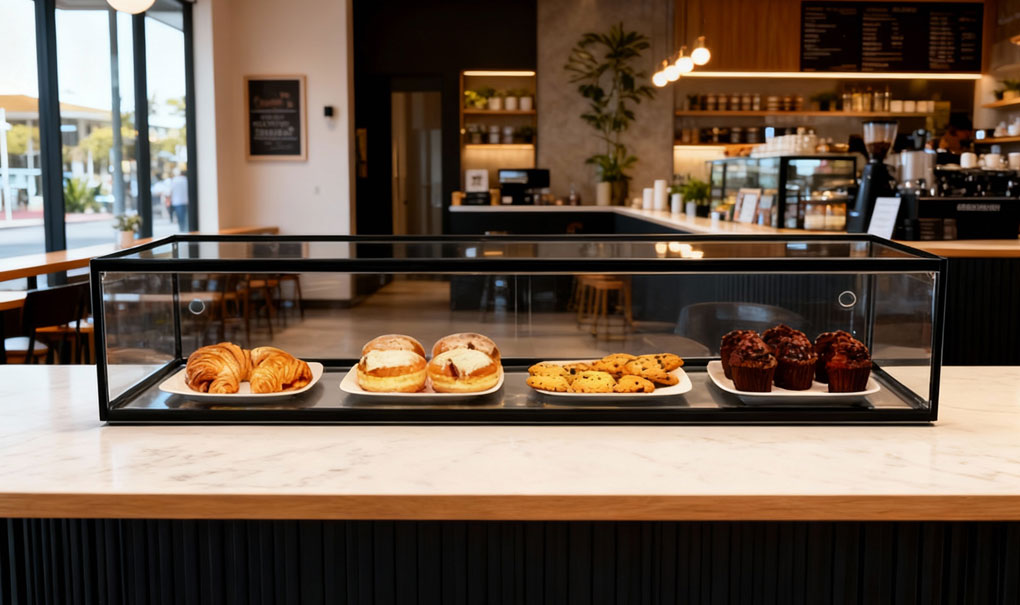
Ambient Display Cabinets: 2026 Buying Guide for Australian Cafés & Bakeries
- What they are: Non-refrigerated benchtop display cases for dry baked goods — muffins, croissants, slices, bread, cookies and pastries that don’t require active cooling.
- Not suitable for: Fresh cream, custard, dairy fillings or any product requiring refrigeration — use a cake display fridge for those.
- Configuration: Single tier for simple grab-and-go product; two-tier for greater capacity; curved glass for premium patisserie presentation.
- Price range: $322–$643 + GST across the full Sayl range at Snowmaster.
- Only brand stocked: Sayl — 7 benchtop models in single and two-tier configurations, straight and curved glass.
- Key decision: Straight glass for modern minimal aesthetics; curved glass for classic café and patisserie presentation.
An ambient display cabinet is one of the simplest and most effective tools for increasing counter sales in a café, bakery or patisserie. Placing your baked goods behind clean glass with good LED lighting — rather than in a basket or under a cloche — consistently increases impulse purchases. The product is visible, protected from handling and dust, and presented professionally at the point of decision.
Snowmaster stocks ambient display cabinets exclusively from Sayl, available in single and two-tier configurations, straight and curved glass, across seven models ranging from 555mm to 1190mm wide. This guide covers how to choose the right model, what these units will and won’t do, and how to maintain them.
What Ambient Display Cabinets Are — and Are Not
Ambient display cabinets operate at room temperature. They have no refrigeration and no heating element. Their only active component is LED lighting. This makes them straightforward to install — plug into a standard power outlet and place on your counter — but it also defines exactly what they can and cannot display safely.
Suitable Products
- Muffins, croissants, danishes
- Bread loaves and rolls
- Cookies, biscuits, slices
- Donuts, scones, scrolls
- Dry tarts and pastry shells
- Packaged confectionery
- Any baked good that does not require refrigeration
Not Suitable — Use a Fridge Display
- Fresh cream cakes or slices
- Custard-filled pastries
- Products with dairy-based fillings
- Cheesecakes or mousse-based desserts
- Anything requiring below 5°C under Australian food safety law
- → See cake display fridges for refrigerated product
The Sayl Range at Snowmaster
All ambient display cabinets at Snowmaster are Sayl models — seven configurations covering the key variables of tier count, glass style and width.
| Model | Tiers | Glass | Width | Price + GST | Best For |
|---|---|---|---|---|---|
| Sayl ADS0025 | 1 | Straight | 555mm | $322 | Small counter, single product type |
| Sayl ADS0020 | 1 | Straight | Compact | $370 | Coffee station grab-and-go |
| Sayl ADS0010 | 2 | Straight | Standard | $482 | Two product categories, compact space |
| Sayl ADS0036 | 2 | Straight | Standard | $482 | Wider two-tier straight glass display |
| Sayl ADS1200 | 1 | Straight | 1200mm | $482 | Long counter, high-volume single tier |
| Sayl ADSC0840 | 1 | Curved | 840mm | $563 | Patisserie, premium presentation |
| Sayl ADSC1190 | 1 | Curved | 1190mm | $643 | Wider curved glass, larger product range |
Straight Glass vs Curved Glass
Straight Glass
- Clean, modern aesthetic — suits contemporary café and bakery fitouts
- Easier to clean — flat panels with no curved edges
- Better for taller products — muffins, bread rolls, stacked slices
- Available in single and two-tier configurations
- More models and width options across the range
- Best for: Modern cafés, coffee stations, minimal aesthetics
Curved Glass
- Softer, classic patisserie aesthetic — draws the eye and enhances presentation
- The curved front creates a subtle effect that makes products look fuller
- Better for flat or low-profile items — tarts, slices, croissants
- Available in 840mm and 1190mm widths
- Slightly higher price than equivalent straight glass models
- Best for: Patisseries, dessert counters, premium front-of-house presentation
Single Tier vs Two Tier
| Single Tier | Two Tier | |
|---|---|---|
| Display capacity | One product line or category | Two separate product lines or categories |
| Counter footprint | Same width, lower profile | Same width, taller — check clearance under overhead shelving |
| Best for | Coffee stations, single-product focus, tight counters | Bakeries displaying multiple product types simultaneously |
| Cleaning | Simpler — one shelf level to remove and wash | Both tiers require daily wipe-down and weekly removal |
Placement
Placement Mistakes to Avoid
- Next to the espresso machine — steam and heat dries out pastries rapidly and damages LED components over time
- In direct sunlight — UV exposure fades product colours and accelerates staleness; position away from windows
- Near a toaster or grill — radiant heat from adjacent cooking equipment will warm the display interior
- Where customers can’t see it — the display only drives sales if it’s in the customer’s sightline at the point of decision
- On an unstable surface — glass display cases should sit on a flat, stable counter; vibration from adjacent equipment stresses glass joints over time
Maintenance
Daily
- Wipe all glass surfaces with a soft non-abrasive cloth and food-safe glass cleaner
- Remove crumbs and debris from the base tray
- Wipe down stainless-steel trim and access doors
Weekly
- Remove trays and shelves and wash with warm soapy water — all Sayl components are fully removable
- Wipe LED panels with a dry microfibre cloth to prevent dust buildup reducing light output
- Check sliding door runners and hinges move freely
Monthly
- Inspect glass panels for chips or cracks around edges and corners
- Check LED strips are functioning evenly — replace dull or flickering strips promptly
- Confirm the unit is sitting level on the counter
Frequently Asked Questions
Do ambient display cabinets need a power connection?
Yes, but only for the LED lighting. Ambient display cabinets have no refrigeration or heating element — they draw minimal power purely to run the LED strips. A standard 10-amp outlet is sufficient for all Sayl models.
Can I display cream cakes or custard-filled pastries in an ambient display?
No. Products containing fresh cream, custard or dairy fillings must be held at 5°C or below under Australian Food Standards Code 3.2.2. These products require a refrigerated display — see Snowmaster’s cake display fridges .
What is the difference between straight and curved glass?
Straight glass suits modern minimal café aesthetics and is easier to clean. Curved glass gives a classic patisserie look and creates a subtle visual effect that makes products appear fuller. Both use tempered safety glass — the choice is primarily aesthetic.
Single tier or two tier — which do I need?
Single tier suits coffee stations and operations displaying one product type. Two tier doubles the display capacity in the same counter footprint — useful when you want to separate product categories, such as savoury scrolls on one tier and sweet pastries on the other. Check overhead clearance before ordering a two-tier unit.
How long do ambient display cabinets last?
With daily cleaning and monthly inspection, a Sayl ambient display will typically last 5–8 years in a busy café or bakery environment. The LED lighting is the component most likely to require replacement after several years of continuous daily use.
Are all parts removable for cleaning?
Yes — all trays, shelves and internal components in the Sayl range are fully removable. Staff can remove and wash components during a service break without tools.
Snowmaster stocks the full Sayl ambient display range — straight and curved glass, single and two-tier, from $322 + GST. Australia-wide delivery available.
Browse Ambient Display Cabinets →
Also browse: Cake Display Fridges · Hot Food Displays · Cold Food Displays · All Benchtop Equipment · Contact Us