

10 Commercial Kitchen Equipment Buying Mistakes to Avoid (2026)
Quick Summary
- Size for peak demand, not average — undersized equipment creates daily bottlenecks that cost more in labour and service pace than the price difference between models.
- Confirm power and gas supply first — discovering your premises can’t support the equipment after it arrives is an expensive problem with no quick fix.
- Buy commercial grade, not domestic — domestic appliances fail quickly under commercial use and often void your insurance and compliance obligations.
- Plan bench and ventilation infrastructure alongside equipment — equipment without adequate landing space and exhaust creates safety and workflow issues from day one.
- Check warranty and local service support — a brand with no Australian service network is a liability the moment something goes wrong.
Buying commercial kitchen equipment is one of the largest capital decisions a hospitality business makes. The mistakes that cost the most aren’t always obvious at the time — they often show up months later as daily operational friction, unexpected repair bills, or equipment that simply doesn’t fit how your kitchen actually works.
Here are the ten most common kitchen equipment buying mistakes — and how to avoid them.
Buying for average demand instead of peak demand
The most consequential sizing mistake is buying equipment based on your typical service volume rather than your busiest period. A dishwasher, fryer, or oven running at maximum capacity during a rush has no buffer — quality drops, service slows, and staff are under pressure.
The right approach: calculate what you need at your busiest service, then add 20%. The price difference between sizes is almost always smaller than the operational cost of running undersized equipment every single day. If you’re between two models, size up.
Not confirming power and gas supply before purchasing
Commercial cooking equipment and dishwashers often require three-phase 415V power or a dedicated high-capacity gas line — neither of which is guaranteed in an existing premises. Discovering this after the equipment arrives means delays, extra costs for electrical or gas infrastructure upgrades, and potentially a machine sitting idle while trades are organised.
Before purchasing any commercial oven, dishwasher, wok burner, or large cooking appliance: confirm your power supply with a licensed electrician and your gas supply with a licensed gas fitter. This is a 30-minute conversation that prevents a very expensive problem.
Buying domestic appliances for a commercial kitchen
Domestic appliances are designed for occasional home use — they’re not built for the heat, frequency, or volume of a commercial kitchen. A domestic fridge opened 50 times per service will fail far sooner than its rated life. A domestic mixer running bread dough for a full baking shift will burn out its motor within months.
Beyond equipment life, using domestic appliances in a commercial kitchen can void your business insurance and put you in breach of FSANZ food safety standards, which require food contact equipment to be commercial grade and suitable for the application. The upfront saving is not worth the compliance and reliability risk. Browse commercial fridges, commercial mixers, and cooking equipment designed for the job.
Choosing machine type based on price rather than volume
Every equipment category has a range from entry-level to high-capacity — and the right choice isn’t always the cheapest option, but it also isn’t always the most expensive. The right choice is the one matched to your actual volume requirements.
The clearest example is dishwashers: an under-bench dishwasher costs significantly less than a pass-through, but for a kitchen washing 80+ covers per service, the under-bench machine creates a daily bottleneck that costs more in labour than the price difference. Match the machine type to your volume first, then compare models within that category.
Not planning bench and ventilation infrastructure alongside equipment
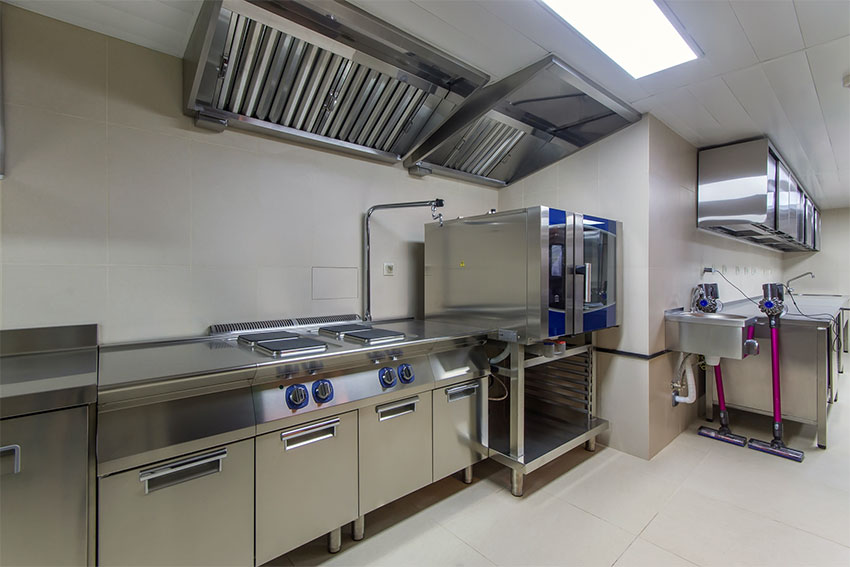
A combi oven with no adjacent landing bench creates an unsafe food handling situation. A pass-through dishwasher surrounded by inadequate inlet and outlet benches bottlenecks the machine from day one. A char grill or wok burner without an adequately sized exhaust canopy above it is a health and safety issue and will fail a council inspection.
Equipment doesn’t operate in isolation. Plan your stainless steel bench infrastructure, ventilation, and drainage at the same time as selecting equipment — not as an afterthought once the machines are on order.
Ignoring total cost of ownership
The purchase price is only part of the cost picture. A cheaper machine that consumes more energy, requires more frequent servicing, or fails sooner than a quality alternative will cost more over its operating life. Before comparing prices between models, compare the relevant running costs: energy consumption (kW rating), water consumption (for dishwashers), chemical costs, and expected service intervals.
For high-use equipment like commercial dishwashers, combi ovens, and refrigeration, a quality brand with a longer service life will almost always deliver a lower total cost of ownership over 5–10 years than the cheapest available option at purchase.
Buying specialist equipment before confirming your menu
A commercial pizza oven, wok burner suite, or dim sum steamer is a significant investment in a specific cuisine direction. Buying specialist equipment before your menu is confirmed — or for a menu item that turns out to be a minor seller — ties up capital in equipment that sits underutilised.
The rule: specialist equipment earns its place only when your menu is built around it. A commercial pizza oven is essential for a pizzeria; it’s a waste of floor space and capital for a venue that sells pizza as a side item. Confirm your menu direction first, then specify the equipment that serves it.
Not checking warranty terms and local service availability
A comprehensive warranty protects your investment — but only if the brand has a service network that can honour it. An international brand with no Australian service agents is effectively unwarranted in practice: when something fails, you’re waiting on parts from overseas with no local technician available.
Before purchasing, confirm: what does the warranty cover and for how long, who carries out warranty repairs, and is there a local service agent or authorised repairer in your area? Snowmaster stocks brands with established Australian service support — including Washtech, Eswood, Unox, Luus, Goldstein, and FED — for this reason.
Skipping inspection on arrival
Commercial kitchen equipment is bulky, heavy, and expensive to return once installed. Inspect every piece of equipment thoroughly on arrival — before installation — and document any damage with photographs. Damage that is discovered after installation is significantly harder to claim under warranty or transport insurance.
Check: physical condition of the unit, all doors and seals, control panels and displays, included accessories and racks, and that the model and specifications match your order. Any discrepancy should be reported to your supplier immediately before the installation team leaves the premises.
Not planning lead times into your opening or upgrade schedule
Commercial kitchen equipment — particularly large or specialist items — can have lead times of several weeks from order to delivery. Planning a kitchen fitout or equipment upgrade without accounting for this means delays that push back your opening date or leave you operating with incomplete equipment.
Order equipment as early as possible once your kitchen plan is confirmed. For custom or imported items, ask your supplier for realistic lead time estimates at the time of quoting, not after placing the order. Build a buffer into your project schedule — equipment delays are common, and they compound when multiple items are involved.
Frequently Asked Questions
How do I know which commercial kitchen equipment I actually need?
Start with your menu and your projected covers — these two factors determine almost everything else. Map out every cooking technique your menu requires, then identify the equipment needed to execute each one at your expected volume. Add cold storage sized to your batch cooking frequency and stockroom requirements, a dishwasher matched to your peak cover count, and bench infrastructure to support each piece of equipment. If you’re unsure, Snowmaster’s team can help you work through the specification for your specific operation — call 02 9799 9911.
Is it worth buying used commercial kitchen equipment?
Used equipment can offer good value for low-risk items like stainless steel benches, sinks, and shelving. For high-use items — ovens, dishwashers, refrigeration, and fryers — the risks are higher: unknown service history, no warranty, potential for imminent failure, and parts availability concerns for older models. If buying used, have a qualified technician inspect the item before purchase and confirm parts are still available for the specific model.
What should I look for in a commercial kitchen equipment supplier?
Look for a supplier that stocks commercial-grade products from brands with Australian service networks, provides accurate specification advice rather than just selling what’s in stock, offers transparent warranty terms, and has been operating long enough to have a track record. Snowmaster has supplied Australian commercial kitchens since 1945 across restaurants, hotels, aged care facilities, schools, and catering businesses.
How important is energy efficiency in commercial kitchen equipment?
Increasingly important — particularly for high-use equipment running multiple services per day. Commercial dishwashers, refrigeration, and ovens consume significant electricity and water across a year of operation. The energy difference between an efficient model and an inefficient one at the same price point can represent thousands of dollars annually in operating cost. Compare kW ratings and water consumption figures when evaluating models, not just purchase price.
Snowmaster has supplied commercial kitchen equipment to Australian restaurants, cafés, hotels, aged care facilities, and catering businesses since 1945. Our team can help you specify the right equipment for your operation — whether you’re fitting out a new kitchen or upgrading existing equipment.
Also browse: Commercial Fridges · Dishwashers · Stainless Steel Benches · Cooking Equipment · Contact Us