

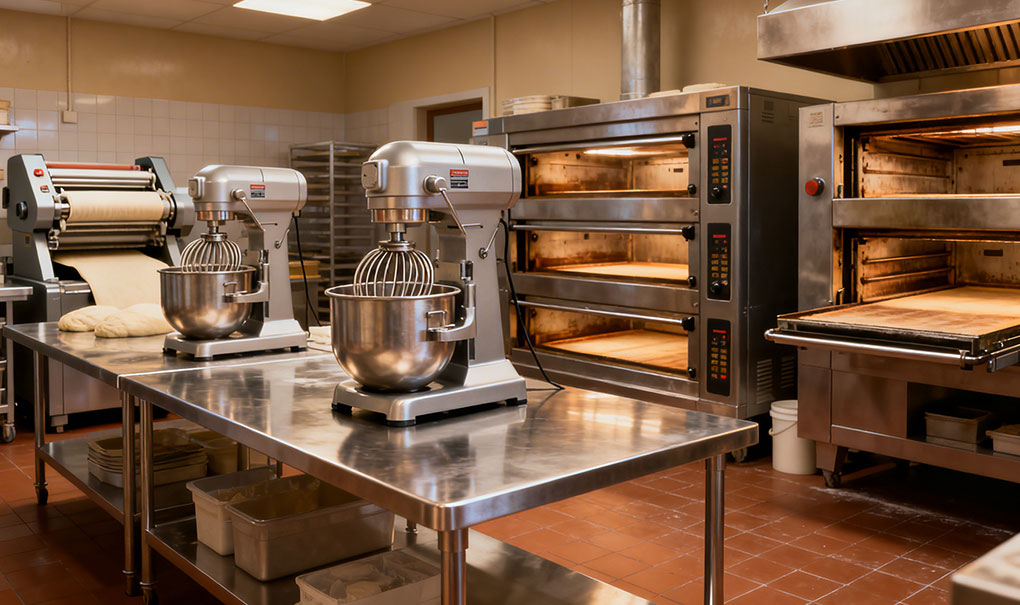
10 Pieces of Equipment Every Commercial Bakery Needs
- Mixer first: A planetary mixer handles cakes, pastries, icing and light doughs; a spiral mixer is purpose-built for bread and enriched doughs. Most bakeries need both — or a spiral mixer plus a planetary for finishing work.
- Dough sheeter: Essential for any bakery producing croissants, puff pastry, Danish or laminated doughs at volume. Manual rolling is inconsistent and physically unsustainable at commercial scale.
- Prover: Consistent, temperature-controlled proofing is what separates reliable bread production from guesswork. A deck oven without a prover is an incomplete bakery setup.
- Deck oven vs convection oven: Deck ovens produce superior crust development for bread; convection ovens suit pastries, cakes and high-volume even baking. Most commercial bakeries use both.
- Refrigeration: Dough retarder-prover combinations allow overnight cold fermentation — a significant quality and workflow advantage for artisan bakeries.
A commercial bakery kitchen has different equipment priorities from a restaurant or café kitchen. The focus is on dough, fermentation, lamination and precise oven control — processes that require specific equipment to execute consistently at volume. This guide covers the ten pieces of equipment that form the backbone of a productive commercial bakery, with notes on specification and the Snowmaster range for each category.
1. Spiral Mixer
A spiral mixer is the primary mixing equipment for any bakery producing bread, pizza dough, focaccia or enriched doughs at volume. The spiral hook develops gluten efficiently without overheating the dough — critical for fermentation quality and crumb structure. Planetary mixers are not an adequate substitute for bread dough at commercial scale; the bowl-and-hook geometry of a spiral mixer is specifically designed for high-hydration, high-volume dough work.
Specify spiral mixer capacity by dough weight per batch. A 20kg spiral mixer suits a small artisan bakery producing 50–100 loaves per day; larger production bakeries typically require 40kg or 60kg capacity. Read our planetary vs spiral mixer comparison guide for full specification guidance.
2. Planetary Mixer
A planetary mixer handles everything a spiral mixer does not — cake batters, pastry cream, icing, meringue, whipped cream, shortcrust pastry and lighter doughs. The interchangeable attachments (flat beater, whisk, dough hook) make it the most versatile mixing equipment in a bakery kitchen.
Most commercial bakeries require both a spiral and a planetary mixer. If budget constraints require choosing one first, the spiral mixer is the priority for bread-focused operations; the planetary is the priority for pastry and cake-focused operations. Bowl capacities range from 10 litres for small pastry operations to 60+ litres for high-volume production kitchens.
3. Deck Oven or Convection Oven
Oven selection is the most consequential equipment decision in a bakery fit-out. The two principal types serve different purposes and most serious bakeries use both.
Deck Oven
- Stone or steel deck provides direct base heat — produces superior crust development and oven spring for sourdough, baguettes and hearth breads
- Steam injection for crust development on lean doughs
- Multiple independent deck chambers allow different temperatures simultaneously
- Slower to load and unload than a convection oven
- Best for: Artisan bread, sourdough, baguettes, pizza, hearth-baked products
Convection Oven
- Fan-forced heat produces even baking across all tray positions
- Faster than deck ovens for pastries, cakes and biscuits
- Higher throughput — multiple trays baked simultaneously with consistent results
- Less suitable for lean breads requiring bottom-heat crust development
- Best for: Croissants, Danish pastry, cakes, slices, biscuits, muffins, high-volume even baking
Browse Snowmaster’s commercial convection ovens — or read our commercial convection oven buying guide for full specification guidance.
4. Prover and Holding Cabinet
A commercial prover provides a controlled temperature and humidity environment for dough fermentation before baking. Consistent proofing produces consistent results — without a prover, fermentation time varies with ambient kitchen temperature, which changes across seasons and throughout the day.
For artisan bakeries, a retarder-prover combination unit allows cold overnight fermentation (retarding) followed by a controlled warm proof before the morning bake. This workflow produces superior flavour development and allows a small team to bake fresh bread without a pre-dawn start.
5. Dough Sheeter
A dough sheeter rolls dough to a consistent, precise thickness in a single pass — a process that takes significant time and physical effort by hand, and is impossible to execute consistently across high volumes without one. For any bakery producing croissants, puff pastry, Danish, kouign-amann or laminated doughs, a dough sheeter is not optional equipment — it is the difference between a viable production line and an exhausting, inconsistent manual process.
Bench-mounted sheeters suit smaller bakeries with limited floor space; floor-standing models with longer conveyor belts suit higher-volume production. Specify belt width to match your standard dough sheet size.
6. Pizza Dough Roller
For bakeries producing pizza bases, flatbreads or other round-form doughs, a pizza dough roller produces consistent thickness and diameter far faster than hand-stretching. A dough roller is a single-purpose tool that pays for itself quickly in labour savings for any bakery producing pizza bases at volume.
7. Commercial Food Processor
A commercial food processor handles bulk chopping, slicing, grating and mixing tasks that would otherwise consume significant prep time. In a bakery context, food processors are used for nut pastes, fruit preparation, crumbing, vegetable fillings for savoury pastries and rough pastry mixing where a planetary mixer’s precision is not required.
8. Commercial Vacuum Sealer
A commercial vacuum sealer extends the shelf life of finished bakery products, pre-portioned dough and prepared fillings by removing oxygen from the packaging. For bakeries selling wholesale or operating a retail counter alongside a production kitchen, vacuum sealing reduces waste and allows batch production ahead of demand peaks.
Chamber vacuum sealers are the standard for commercial bakeries — they seal liquids and soft fillings without spillage, which external suction models cannot reliably do. Read our commercial vacuum sealer buying guide for specification guidance.
9. Refrigeration
Bakery refrigeration requirements differ from restaurant refrigeration in two important ways: dough retarding and butter temperature management. Laminated doughs (croissants, puff pastry) require cold butter that holds its shape during folding — ambient kitchen temperature butter will melt into the dough layers rather than remaining distinct.
| Equipment | Bakery Application |
|---|---|
| Upright fridge | Ingredient storage — dairy, eggs, fillings, finished products for display |
| Underbench fridge | Immediate-access cold storage at the lamination bench — keeps butter and dough at working temperature |
| Blast chiller | Rapid chilling of baked products before packaging; rapid cooling of custards, pastry cream and other fillings |
| Chest freezer | Bulk frozen storage for par-baked products, frozen dough portions and long-term ingredient stock |
10. Stainless Steel Benches
Bakery benches require more surface area than restaurant kitchen benches — dough work, lamination and shaping all require generous flat space. Specify stainless steel benches with a minimum 900mm depth for lamination work; standard 600mm depth benches are insufficient for rolling and folding large dough sheets.
A marble or granite inset bench surface is preferred by some pastry teams for lamination — the natural cold surface helps keep butter firm during the folding process. Standard stainless steel works adequately in a climate-controlled kitchen.
Common Bakery Equipment Mistakes
Avoid These
- Using a planetary mixer for high-volume bread dough — planetary mixers overheat dough and strain the motor under the load of stiff bread dough at commercial volume; a spiral mixer is required
- No prover — baking on ambient fermentation produces inconsistent results across seasons and is not a viable production system for a serious bakery
- Undersizing the oven — oven capacity is the primary throughput constraint in any bakery; always size to your projected peak production volume, not your current volume
- No dough sheeter for laminated products — hand-laminating croissants and puff pastry at commercial volume is not sustainable and produces inconsistent results
- Insufficient bench space — dough work requires more surface area than most kitchen planners allocate; plan for at least 3–4 linear metres of bench space for a production bakery
Frequently Asked Questions
Do I need both a planetary and a spiral mixer?
For most commercial bakeries, yes. A spiral mixer is purpose-built for bread and high-hydration doughs; a planetary mixer handles pastry, cake batters, icing and lighter doughs. The two tools are complementary — using a planetary mixer for bread dough at commercial scale will strain the motor and produce inferior gluten development. Read our planetary vs spiral mixer comparison for full guidance.
What size mixer do I need for a commercial bakery?
Size your mixer to your largest single batch. For spiral mixers, capacity is measured in dough weight — a 20kg spiral mixer suits smaller artisan bakeries; 40–60kg models suit higher-volume production. For planetary mixers, capacity is measured in bowl volume — a 20-litre bowl suits most café and small bakery applications; 40-litre and 60-litre bowls suit high-volume production kitchens.
Is a deck oven or convection oven better for a bakery?
Both — they serve different products. Deck ovens produce superior crust and oven spring for lean breads (sourdough, baguettes) through direct base heat and steam. Convection ovens suit pastries, cakes and biscuits with their fan-forced even heat and higher throughput. A production bakery making both bread and pastry needs both types.
Do I need a dough sheeter for croissants?
Yes, for any commercial volume. Hand-laminating croissant dough is physically demanding and produces inconsistent butter layer thickness, which directly affects the final texture and appearance. A dough sheeter produces precise, consistent lamination at a fraction of the time and effort. It is essential equipment for any bakery producing laminated pastry at commercial scale.
What is a retarder-prover?
A retarder-prover is a refrigeration unit that controls both temperature and humidity to manage dough fermentation. In retard mode, it slows fermentation to allow overnight cold proofing. In prover mode, it creates a warm, humid environment to accelerate the final proof before baking. The combination allows a bakery to shape dough the night before, retard it overnight, and bake fresh product in the morning without staff starting at 3am.
Snowmaster stocks commercial bakery equipment including spiral mixers, planetary mixers, dough sheeters, provers, convection ovens and blast chillers — all available Australia-wide. Our team can help you specify the right equipment for your bakery from day one.
Browse: Spiral Mixers · Planetary Mixers · Dough Sheeters · Provers · Convection Ovens