

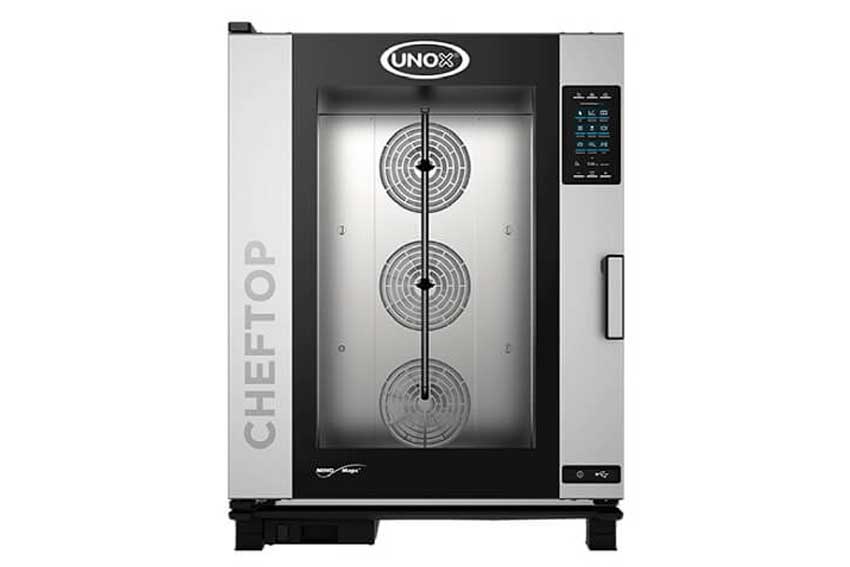
Unox Combi Ovens and Convection Ovens: ChefTop, BakerTop & Bakerlux Guide (2026)
Quick Summary
- Combi vs convection: A combi oven cooks with dry heat, steam, or both — the most versatile oven in any commercial kitchen. A convection oven uses fan-forced dry heat only — simpler, lower cost, ideal for baking-focused operations.
- Unox range at Snowmaster: 47 models — 35 combi ovens and 12 convection ovens across the ChefTop, BakerTop, Bakerlux, and LineMiss series.
- ChefTop series: Unox’s full-service kitchen combi range — electric and gas, ONE and PLUS tiers, 6 to 20 tray capacity.
- BakerTop series: Optimised for bakery production — combi functionality tuned for bread, pastry, and dough-based products.
- Convection ovens: Bakerlux LED and LineMiss series for high-volume baking and pastry production without steam capability.
- Power: Most Unox combi ovens require three-phase power — confirm your electrical supply before purchasing.
Unox is the benchmark combi oven brand in Australian commercial kitchens. With 47 models across combi and convection categories — from a 3-tray benchtop convection oven at $1,694 to a 20-tray ChefTop PLUS combi at $25,000+ — the range covers every scale of professional cooking operation. This guide explains the difference between combi and convection, breaks down the Unox series available at Snowmaster, and helps you identify which model suits your kitchen.
Browse the full Unox range at Snowmaster — 35 combi ovens and 12 convection ovens.
Combi Ovens vs Convection Ovens: The Key Difference
Combi Oven
- Three cooking modes: convection (dry heat), steam, and combination of both
- Steam mode for fish, vegetables, rice, and delicate proteins
- Convection mode for roasting, baking, and crisping
- Combination mode for maximum yield on proteins — high heat with moisture control reduces shrinkage
- Food regeneration — reheats blast-chilled food to service temperature without drying out
- Programmable multi-step cooking programs for consistent, unattended results
- Replaces a standalone steamer and convection oven in a single footprint
- Best for: Full-service restaurants, hotels, aged care, production kitchens — any operation cooking a variety of proteins, vegetables, and baked goods
Convection Oven
- Fan-forced dry heat only — no steam capability
- Circulates hot air for even, consistent cooking across all tray positions
- Reduces cooking time by up to 30% versus a static oven
- Manual or digital humidity injection on select models (not full steam)
- Simpler operation — no steam system to maintain
- Lower purchase price than an equivalent combi oven
- Best for: Bakeries, cafés, and pastry operations focused on dry-heat baking — bread, pastries, pies, and baked goods where steam isn’t required
Unox ChefTop Series: Combi Ovens for Full-Service Kitchens
The ChefTop range is Unox’s combi oven line designed for full-service restaurant, hotel, and institutional kitchens. It’s available in two tiers — ONE and PLUS — and in both electric and gas configurations.
ChefTop ONE Series
- Unox’s entry-level professional combi range — full combi functionality with intuitive controls
- Manual and programmable cooking modes
- Available in electric, 6 and 20 tray configurations
- Lower price point than PLUS — suited to operations that need reliable combi performance without advanced automation
- Example models: Unox ChefTop ONE 20 Tray Electric from $22,769 + GST
ChefTop PLUS Series
- Unox’s premium combi range with advanced automation and connectivity
- CHEFTOP MIND.Maps PLUS technology — touchscreen interface with recipe storage, cooking programs, and remote monitoring
- Available in electric and gas, 12 and 20 tray configurations
- Remote energy monitoring and management via connected device
- Independent multi-zone cooking — multiple programs running simultaneously in the same oven
- Example models: Unox ChefTop PLUS 20 Tray Electric from $25,133 + GST; ChefTop PLUS 20 Tray Gas also available
Unox BakerTop Series: Combi Ovens for Bakery Production
The BakerTop series applies Unox’s combi oven technology specifically to bakery and pastry production. Where ChefTop ovens are optimised for cooking proteins and multi-purpose food production, BakerTop ovens are tuned for bread, pastry, and dough-based products — with humidity and airspeed profiles calibrated for baking performance.
BakerTop Key Features
- Humidity management optimised for bread baking — precise steam injection for crust development and crumb texture
- Airspeed control — adjustable fan speed for delicate pastry work that requires gentle air movement
- Programmable recipes for consistent production across shifts
- Available in electric, multiple tray configurations from small to full production scale
- Example model: Unox BakerTop ONE 16 Tray Electric from $22,769 + GST
Unox Convection Ovens: Bakerlux and LineMiss Series
Unox’s convection oven range covers everything from compact benchtop models for small cafés to high-capacity multi-tray units for production bakeries.
| Series | Trays | Key Feature | Entry Price |
|---|---|---|---|
| LineMiss | 4 | Manual humidity injection — adds steam manually for crust development on bread and pastry; simple analogue controls | $1,694 + GST |
| LineMicro | 4 | Compact convection with digital controls; suited to small cafés and supplementary oven positions | $2,703 + GST |
| Bakerlux LED 3 Tray | 3 | LED display, electronic humidity control, high-speed heating — designed for consistent bakery and pastry production | $2,310 + GST |
| Bakerlux LED 4 Tray | 4 | Same Bakerlux platform with additional tray capacity — suited to higher-volume bakery and café production | $2,503 + GST |
How to Choose the Right Unox Model
Decision Guide
- Primarily baked goods, no proteins or steaming required → Unox convection oven (Bakerlux or LineMiss series)
- Mixed menu — proteins, vegetables, and baked goods → Unox ChefTop combi oven
- Bakery or pastry production at scale → Unox BakerTop combi oven
- Cook-chill workflow with a blast chiller → Unox ChefTop combi oven with programmable regeneration mode
- High volume requiring multi-step automated programs → ChefTop PLUS (MIND.Maps technology)
- Gas preferred over electric → ChefTop PLUS gas models available in 12 and 20 tray configurations
- Limited bench or floor space → Start with a 3 or 4 tray convection model; stackable configurations available in some combi series
Installation Requirements
Before Installing a Unox Oven
- Three-phase power (415V) — most Unox combi ovens require three-phase power; confirm with a licensed electrician before ordering; entry-level convection models (LineMiss, some Bakerlux) may run on single-phase
- Gas connection — gas ChefTop models require a natural gas or LPG connection installed by a licensed gas fitter under AS/NZS 5601
- Water connection — combi ovens require a plumbed water connection for steam generation and automatic cleaning; confirm cold water supply at the installation point
- Drain connection — combi ovens produce condensate and require a drain connection; plan floor waste position before finalising oven placement
- Exhaust ventilation — all combi ovens produce steam and require an exhaust canopy or direct duct connection above; confirm ventilation requirements with your mechanical services contractor
- Landing bench space — allow at least 600mm of adjacent stainless steel bench space on each side for safe loading and unloading of hot trays
Cleaning and Maintenance
Daily
- Run the oven’s automatic cleaning cycle at the end of each service — all Unox combi ovens include an integrated auto-clean system
- Remove and rinse tray supports and oven door seal after cleaning cycle completes
- Check water inlet filter for blockage — particularly important in hard water areas
Weekly / Periodic
- Descale the water system according to the frequency recommended by Unox for your local water hardness — scale buildup in the steam generator reduces performance and causes premature component failure
- Inspect door gaskets for wear or damage — a damaged seal allows heat and steam to escape, affecting cooking performance and energy consumption
- Calibrate temperature probes periodically using a reference thermometer to confirm accuracy
- In hard water areas (most of Australia outside major coastal cities), fit a water softener or inline filter — this single step significantly extends steam generator life
Frequently Asked Questions
What is the difference between Unox ChefTop and BakerTop ovens?
ChefTop ovens are designed for full-service kitchen applications — proteins, vegetables, multi-course cooking, and food regeneration. BakerTop ovens apply the same combi platform with humidity and airspeed profiles specifically calibrated for bread, pastry, and dough production. If your primary output is baked goods, BakerTop’s calibration delivers better results. For a mixed menu, ChefTop is the more versatile choice.
What is the difference between ChefTop ONE and ChefTop PLUS?
ChefTop ONE is Unox’s entry-level professional combi range with full combi functionality and programmable cooking modes at a lower price point. ChefTop PLUS adds MIND.Maps PLUS touchscreen technology, advanced automation, remote monitoring and energy management, and independent multi-zone cooking capability. For most restaurant and hotel kitchens, ONE delivers excellent performance. PLUS is the choice for high-volume operations requiring maximum automation and connectivity.
Do Unox combi ovens require a water connection?
Yes. All Unox combi ovens require a plumbed cold water connection for steam generation and for the integrated auto-clean system. They also require a drain connection for condensate. This is a standard part of any combi oven installation — plan for both water supply and drainage at the installation point before ordering.
Can Unox combi ovens replace a separate steamer?
Yes — a combi oven’s steam mode delivers the same core functionality as a standalone commercial steamer, with the added benefit of combination cooking and convection modes in the same unit. For most kitchens currently running a separate steamer and convection oven, a single combi oven replaces both appliances and saves floor space. The only exception is very high-volume steaming operations where dedicated steaming capacity is required simultaneously with other cooking modes.
Are Unox ovens suitable for a small café?
Yes — the Unox convection oven range starts with compact 3 and 4 tray benchtop models (Bakerlux LED from $2,310 + GST, LineMiss from $1,694 + GST) that suit small cafés and bakeries well. These run on single-phase power, require no water connection, and fit standard commercial bench heights. For cafés needing steam capability, the smaller ChefTop combi models offer full combi functionality in a compact format.
Snowmaster stocks 47 Unox oven models — 35 combi ovens and 12 convection ovens across ChefTop, BakerTop, Bakerlux, and LineMiss series. Entry convection ovens from $1,694 + GST. Finance available. Delivery across Australia with Unox’s 24/7 customer support.
Also browse: All Combi Ovens · All Convection Ovens · Blast Chillers · All Cooking Equipment · Contact Us