

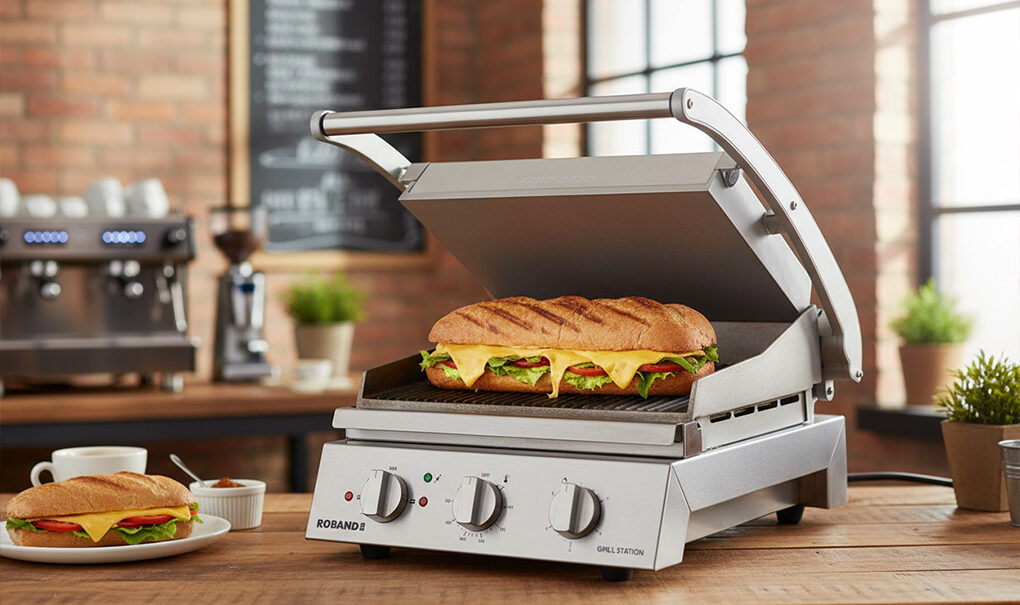
Café Sandwich Press Guide: Flat vs Ribbed Plates
Quick Summary
- Plate type: Choosing between flat plates for high-speed throughput or ribbed plates for premium panini presentation
- Capacity: How to calculate your peak hourly demand to select the right 6-slice, 8-slice, or double configuration.
- Plate material: Heavy-duty cast iron for heat retention vs non-stick coatings for rapid cleanup.
- Brands: Understanding the operational differences between high-volume grill stations and competitive panini presses.
- Power: Why all models in the Snowmaster range operate on standard single-phase electrical outlets.
- Compliance: Meeting FSANZ hygiene standards using removable grease traps and food-grade contact surfaces.
A sandwich press is one of the hardest-working benchtop appliances in any café, takeaway, or restaurant kitchen. It’s on from open to close, handles constant use, and the quality of its output is visible to every customer. Getting the right one — the right plate type, the right capacity, the right brand — makes a genuine difference to service speed, food quality, and daily cleanup.
This guide covers the full range of sandwich presses available at Snowmaster, helping you cut through the options and find the right model for your operation. To find the right fit for your counter space, view our online collection of commercial sandwich presses. ready for fast shipping.
Flat vs Ribbed Plates: The Decision That Matters Most
The plate configuration is the most consequential spec decision when buying a sandwich press. It determines the finish on every item you produce, how long cleanup takes between orders, and how flexible your menu can be.
Flat Plate (9 Models)
- Smooth cooking surface — full contact with the bread for even toasting
- Fastest, most consistent results on standard toasted sandwiches and wraps
- Easiest to clean — no grooves to scrape, wipes down quickly between orders
- Most versatile surface for mixed-menu operations
- No grill marks — presentation is uniform rather than restaurant-style
- Best for: High-volume cafés, takeaway shops, canteens, any operation focused on speed and throughput
Ribbed Plate (8 Models)
- Raised ridges create distinctive grill marks — premium panini presentation
- Better suited to thicker breads: focaccia, ciabatta, sourdough
- More cleaning time required — grooves accumulate grease and food debris
- Slightly lower direct surface contact — results depend on bread thickness
- Available in ribbed top / flat bottom configuration for the classic panini look with an easier-clean base
- Best for: Café menus focused on gourmet panini, specialty breads, and presentation
Capacity: How Many Slices Do You Actually Need?
| Capacity | Covers / Hour | Typical Operation | Selection Rule |
|---|---|---|---|
| Single / Small | Up to ~40/hr | Low-volume café, supplementary press, food truck | Ideal as a secondary unit. |
| 6-Slice | 40–80/hr | Mid-size café, pub bistro, school canteen | Steady mid tier unit |
| 8-Slice | 80–120/hr | High-volume café, large restaurant, busy takeaway | Continuous heavy production |
| Double Press | 100–150+/hr | Very high volume, multiple product lines simultaneously | Independant temp control |
Plate Material: Cast Iron vs Non-Stick
Cast Iron Plates
- Excellent heat retention — recovers temperature quickly between sandwiches
- More durable over time — less susceptible to surface damage from metal utensils
- Heavier — takes slightly longer to reach operating temperature at startup
- Requires seasoning and specific cleaning care — no abrasive pads or soaking
- Best for: High-volume operations where fast heat recovery between orders is critical
Non-Stick Coating
- Food releases cleanly — significantly faster and easier cleanup
- Less cooking oil or spray required during service
- Coating can be damaged by metal utensils or abrasive cleaning — use only plastic/silicone implements
- Replace when coating shows wear — a damaged non-stick surface is a food safety risk
- Best for: Operations prioritising fast turnaround between orders and minimal cleaning time
Brand Guide: Roband vs Anvil
| Brand Style | Technical Focus | Configuration Options | Best For |
|---|---|---|---|
| Premium | High output, rapid heat recovery , robust support | 6/8-slice, flat/ribbed/non-stick. | Heavy-duty, fast-paced kitchens. |
| Mid Range | Durable cast iron, heavy lids, competitive price. | Single/Double split-plate | Targeted, gourmet panini lines. |
Key Features Checklist
What to Look For
- Adjustable thermostat — precise temperature control (50°C–300°C range) prevents burning on delicate breads and allows higher heat for thicker sandwiches
- Removable grease trap — essential for fast cleanup between service periods; a fixed grease tray is a hygiene and compliance risk in a busy operation
- Adjustable top plate height — allows the press to accommodate different bread thicknesses without crushing thinner items
- Independent top and bottom temperature control — available on higher-end models; allows different temperatures on each plate for better results on filled sandwiches
- Power indicator light — confirms the unit is at temperature and ready to use, reducing guesswork during service
- Non-slip feet — keeps the unit stable on wet or greasy benchtop surfaces during heavy use
Compliance and Food Safety
All sandwich presses sold in Australia must meet FSANZ food safety standards. In practice this means:
Compliance Checklist
- Food-grade materials — cooking surfaces and any components that contact food must be food-grade rated; confirm this with the product specification before purchasing
- Non-damaged surfaces — a scratched or worn non-stick coating is a food safety risk; replace plates or the unit when surface integrity is compromised
- Cleanable design — FSANZ Code 3.2.3 requires food contact equipment to be constructed so it can be effectively cleaned and sanitised; removable plates and accessible grease traps are not optional in a compliant kitchen
- Temperature accuracy — maintaining consistent cooking temperatures is a HACCP requirement; calibrate and check thermostat accuracy periodically
- Electrical safety — all Snowmaster models are single-phase and compliant with Australian electrical standards (AS/NZS 3820); ensure the unit is connected to a correctly earthed outlet
Maintenance
A sandwich press used across two or three services daily accumulates grease and carbonised food rapidly. Consistent cleaning is both a food safety requirement and the single biggest factor in how long the unit lasts.
After Every Service
- While still warm (not hot), wipe cooking surfaces with a damp cloth to remove food debris — this is significantly easier than cleaning a cold press
- Empty and wipe the grease trap
- Wipe down the exterior housing
Weekly
- Remove plates (where removable) and clean thoroughly with warm water and mild detergent
- For cast iron plates: dry immediately and apply a light coat of food-grade oil to prevent rust
- For non-stick plates: use only soft cloths — never abrasive pads or steel wool
- Check hinges and spring mechanism for smooth operation
- Verify temperature accuracy with a probe thermometer at your standard operating temperature
What to Avoid
- Metal utensils on non-stick surfaces — scratches the coating; use only plastic or silicone implements on non-stick plates
- Submerging in water or soaking — damages heating elements and electrical components; wipe clean only
- Abrasive cleaning pads — damage both cast iron seasoning and non-stick coatings
- Cleaning while still hot — thermal shock can warp cast iron plates; allow to cool to warm before cleaning
- Ignoring a worn non-stick coating — flaking non-stick coating is a food contamination risk; replace plates or the unit when coating shows visible wear
Common Mistakes
Avoid These
- Undersizing for peak demand — a press running at maximum capacity all service has no buffer; buy for your peak hour output, not your average
- Choosing ribbed plates without considering cleaning time — grooved plates require significantly more cleaning time per service; if staff are already stretched, flat plates are the practical choice
- Buying on price alone — a cheap press with poor heat retention produces inconsistent results and fails faster; the cost of replacement and lost service time quickly exceeds the initial saving
- Ignoring plate replaceability — confirm replacement plates are available for any model you’re considering; a press with unavailable replacement parts has a short commercial life
- Not checking benchtop space — double presses and 8-slice Grill Stations have a significant footprint; measure your available bench space before ordering, including clearance around the unit for heat dissipation
Frequently Asked Questions
What is the difference between a flat plate and ribbed plate sandwich press?
A flat plate press has a smooth cooking surface that makes full contact with the bread, producing consistent toasting and faster cleanup. A ribbed plate press has raised ridges that create grill marks on the food — ideal for panini and specialty breads where presentation matters. Flat plates are generally better for high-volume operations; ribbed plates suit cafés with a panini-focused menu.
How do I choose between Roband and Anvil?
Roband’s Grill Station range is the higher-output option — 6-slice and 8-slice configurations with non-stick or cast iron plates, suited to high-volume operations. Anvil’s panini press range offers solid cast iron performance at more competitive pricing, in single and double configurations. For most busy cafés, Roband is the benchmark. For smaller operations or panini-focused menus, Anvil provides reliable value.
What temperature should I use for toasting sandwiches?
A range of 180°C to 220°C suits most standard toasted sandwiches. Thinner, more delicate breads (wraps, flatbreads) benefit from lower temperatures around 160–180°C to avoid burning. Thicker breads and filled sandwiches may require 200–240°C to ensure the filling heats through before the bread over-toasts. Most presses reach operating temperature within 3–5 minutes.
Can I use a commercial sandwich press for items other than sandwiches?
Yes — sandwich presses are versatile. Flat plate models work well for quesadillas, wraps, flatbreads, and even light-duty protein searing. Ribbed plate models are popular for grilling vegetables and halloumi. The adjustable top plate on most models accommodates different food thicknesses. For very high volumes of toasted bread specifically, a conveyor toaster will deliver higher throughput than a sandwich press.
How often should I replace a commercial sandwich press?
A well-maintained sandwich press from a quality brand should last 5–8 years in regular commercial use. The most common reasons for early replacement are worn non-stick coating (a food safety issue when it begins flaking), damaged heating elements, or a broken thermostat. Regular cleaning and avoiding metal utensils on non-stick surfaces significantly extends service life.
Do commercial sandwich presses require special power connections?
No — all sandwich presses in Snowmaster’s range operate on standard single-phase power. They plug into a standard commercial 10A or 15A outlet. No three-phase connection or special electrical infrastructure is required.
Snowmaster stocks sandwich presses from Roband and Anvil — flat and ribbed plates, single and double configurations, cast iron and non-stick. 17 models available with delivery across Australia.
Browse Commercial Sandwich Presses →
Also browse: Commercial Toasters · Conveyor Toasters · Pie Warmers · All Benchtop Equipment · Contact Us