

Best Commercial Deep Fryers Australia: 2026 Buyer’s Guide
Last updated: January 2026
Choosing the right commercial deep fryer is critical for Australian hospitality businesses that rely on fast service, consistent food quality, and reliable kitchen performance. From fish and chip shops to pubs, cafes, and high-volume commercial kitchens, the fryer you choose directly impacts food quality, service speed, oil usage, and ongoing running costs.
In this 2026 buyer’s guide, we break down the best types of commercial deep fryers available in Australia, explain gas vs electric options, capacity sizing, and the features that matter most in real-world kitchen use. If you are ready to browse, you can view our full range of commercial deep fryers or explore other essential commercial cooking equipment for professional kitchens.
How to Choose the Best Commercial Deep Fryer in Australia
There is no one-size-fits-all fryer. The right model depends on your venue, menu, service volume, and whether you have access to gas or the correct electrical supply. Deep fryers are often used alongside other core kitchen appliances such as combi ovens, grills, and refrigeration, so layout and workflow should also be considered.
- Kitchen volume and service speed: High-volume venues need faster heat recovery and larger oil capacity.
- Gas vs electric availability: Your kitchen setup will determine which options are practical.
- Oil capacity and recovery time: Larger tanks can handle more product but take more space and oil.
- Energy efficiency and running costs: Better insulation and accurate thermostats can reduce energy and oil waste.
- Safety and compliance: Ensure the fryer is suitable for commercial use and meets Australian standards.
Commercial Deep Fryers in 2026: What’s Changed?
Deep fryers have improved significantly over the last few years. In 2026, buyers are prioritising efficiency, consistency, and ease of maintenance more than ever. This mirrors broader trends across commercial kitchens, including upgrades to commercial fridges and commercial freezers to reduce energy usage and improve food safety.
- Greater focus on energy efficiency: Better insulation and smarter heating controls reduce running costs.
- Improved temperature accuracy: More stable oil temperatures help improve food consistency and reduce oil breakdown.
- Better oil life features: Cold zone designs and improved filtration options can help oil last longer.
- Compact, high-output options: Smaller venues can still achieve strong output with the right model and recovery performance.
Types of Commercial Deep Fryers
Knowing your fuel source is a vital first step in determining which commercial deep fryer to select. The fuel source can be electricity or gas – either propane or natural gas.
Commercial electric deep fryers need specialised wattage, voltage, and amperage to function correctly. Speak with a qualified electrician about the power available in your venue before purchasing, particularly if the fryer will operate alongside other appliances such as commercial dishwashers.
Commercial Electric Deep Fryers
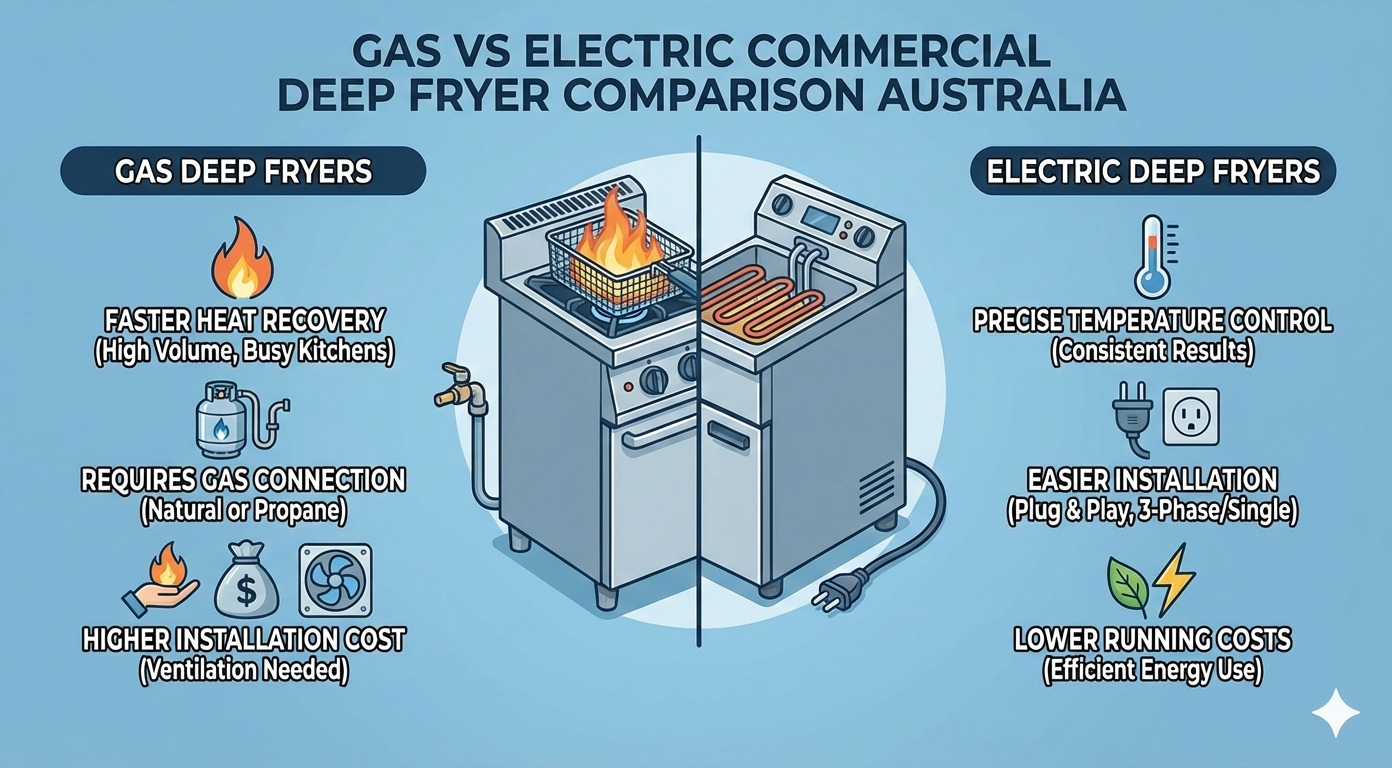
If there are no gas outlets in your kitchen, a commercial electric deep fryer is often the best option. Electric fryers typically offer precise temperature control and are straightforward to operate, but they may take longer to heat up compared to gas units.
An important detail is matching the fryer’s voltage to your electrical supply. If the supply does not match, an electrician may need to assess whether upgrades or rewiring are required.
Gas Deep Fryers
Commercial gas deep fryers are commonly available in propane or natural gas. You connect the appliance to a gas outlet, and most gas units heat quickly and recover temperature fast during busy service.
If your kitchen already has gas available, a gas fryer is often a strong investment for high-volume venues due to speed and long-run performance. Food quality can be excellent with either gas or electric – the main difference usually comes down to recovery time, installation, and operating costs.
Countertop Deep Fryers
Commercial countertop deep fryers are a popular choice for compact kitchens, smaller menus, and venues with limited space. They are generally more affordable and easier to relocate, clean, and maintain than larger floor models.
Freestanding Floor Deep Fryers
Freestanding floor deep fryers are ideal for restaurants and takeaways serving high volumes of deep-fried foods. These units are designed to run for long periods and often come in single, double, or multi-basket configurations.
Most floor models are available in gas or electric options, and the best choice depends on your kitchen layout, service volume, and installation requirements.
Power, Dimensions, and Capacity
Before you purchase, confirm your fryer will suit your workflow, fit your kitchen, and handle your daily demand. A large fryer allows you to cook more at once, but it takes up more space and requires more oil. If deep-fried items are only a small part of your menu, a smaller capacity model may make more sense.
Have measurements on hand before ordering. Confirm the fryer will fit into your kitchen, allow safe movement around it, and suit your bench or floor layout, especially when positioned near refrigeration or prep areas.
A practical way to validate sizing is to visit venues similar to yours and note the tank volume and basket configuration they use. Then factor in your menu – the amount, type, and weight of food you cook will influence the capacity you need, as will the number of customers you serve per service period.
Key Features and Buying Considerations
When buying a professional deep fryer, understanding the practical features of each model is just as important as choosing the right size or fuel type. For some hospitality businesses, the fryer is the primary cooking appliance, so performance, efficiency, and ease of use should be carefully considered.
Bench Top vs Freestanding Fryers
Commercial deep fryers generally fall into two main categories: bench top fryers and freestanding floor fryers. As a general rule, freestanding fryers offer higher output and faster recovery times, but they take up more kitchen space. Bench top fryers are more compact and are often ideal for cafes, smaller menus, or venues with limited space.
There are also specialised fryer types, such as doughnut fryers, designed for very specific applications. These are best suited to businesses with narrow, dedicated frying requirements.
Power and Oil Capacity
Power output and oil capacity directly affect how quickly a fryer heats up and how well it maintains temperature during busy service. Higher-powered fryers generally recover temperature faster, allowing more food to be cooked in less time.
If your fryer is only used for occasional or small batches, a smaller capacity model may be more efficient long-term. While larger tanks allow bulk frying, they also require more oil, take up more space, and can increase running costs.
Gas or Electric Power
Commercial deep fryers typically operate on gas or electricity. Higher-powered electric models often require a permanent hardwired connection, while gas fryers need access to a suitable gas supply.
Performance differences between gas and electric fryers are usually minimal, so the choice often comes down to kitchen infrastructure, installation requirements, and operator preference.
Single Tank vs Twin Tank Fryers
Most commercial fryers are available in single or twin tank configurations. Twin tank fryers allow you to fry different food types at separate temperatures without cross-contamination. They can also be more efficient, as you can operate only the tanks you need.
Single tank fryers, on the other hand, often allow larger baskets or higher batch volumes, making them suitable for bulk frying during peak periods.
Basket Configuration
Fryers with multiple baskets allow several items to be cooked at the same time, usually in smaller quantities. Large single-tank fryers offer flexibility, as they can be used with either single or multiple baskets depending on menu requirements.
Manual vs Programmable Controls
Some commercial fryers feature programmable controls that notify staff when cooking is complete, and higher-end models may even automatically lift baskets once frying is finished. While programmable fryers typically cost more upfront, they can reduce training time, minimise food wastage, and improve consistency.
Running Costs and Oil Management
Cooking oil is one of the most significant ongoing costs when operating a deep fryer. As oil degrades, food quality and flavour decline, so regular oil changes are essential.
Many modern fryers are designed to extend oil life through features such as cool zones, which prevent food sediment from burning, or built-in filtration systems commonly found in freestanding models. Oil life can also be improved by manually removing food debris using skimmers and lifters.
Tip: Used cooking oil can usually be recycled, and some providers may even offer collection services. Used oil should never be poured down drains, as it can cause serious blockages.
Cleaning and Maintenance
Cleaning is one of the most time-consuming kitchen tasks, so fryer design plays an important role in daily maintenance. Many commercial fryers include front-mounted drain valves, allowing oil to be safely drained once cooled using a suitable container.
If a fryer does not have a drain valve, the oil tank and heating elements can often be removed completely for easier cleaning. Most stainless steel fryer baskets can be cleaned in a commercial dishwasher or industrial pot washer, helping reduce manual cleaning time.
Best Commercial Deep Fryers for Different Venues
Cafes
For many cafes, a compact electric fryer or countertop fryer is often enough, especially if fried items are a smaller part of the menu. Look for easy cleaning, stable temperature control, and a footprint that suits limited kitchen space.
Fish and Chip Shops
High-volume takeaways typically benefit from larger capacity floor fryers, often gas models for faster recovery. Twin pan setups are useful when frying seafood and chips separately to maintain flavour and consistency.
Pubs and Restaurants
Most pubs and restaurants need a balance of capacity and flexibility. Twin pan fryers allow you to run different menu items during peak periods without cross-flavour transfer. Prioritise recovery time and oil life features.
Food Courts and QSR
Busy venues with constant throughput should focus on heavy-duty fryers designed for continuous use, strong recovery performance, and simple cleaning routines to minimise downtime.
Maintenance, Servicing, and Warranty
Commercial deep fryers require regular cleaning and maintenance to keep them running safely and efficiently. Talk to the vendor about servicing requirements, recommended schedules, and what is covered under warranty.
Watch for oil build-up and confirm knobs, panels, and safety cut-offs remain in good working order. A simple staff checklist can help catch issues early and reduce downtime.
A warranty is essential. Many new commercial fryers include a 12-month warranty on parts, often excluding labour. Always confirm warranty terms and the availability of replacement parts, as these can affect long-term costs.
For accidental damage and theft, consider business insurance that covers commercial kitchen equipment. You can find guidance through Australian Government business resources: Business insurance information.
Purchasing Commercial Deep Fryers
Choosing the right commercial deep fryer is pivotal for foodservice businesses. If you match the fryer type, capacity, and fuel source to your menu and service volume, you will get better food quality, smoother service, and more reliable performance.
Snowmaster supplies commercial kitchen equipment across Australia, including a wide selection of commercial deep fryers, as well as refrigeration, dishwashing, and cooking solutions for professional kitchens.
Contact us if you would like help selecting the right fryer for your kitchen, including installation considerations, capacity sizing, and model recommendations.