

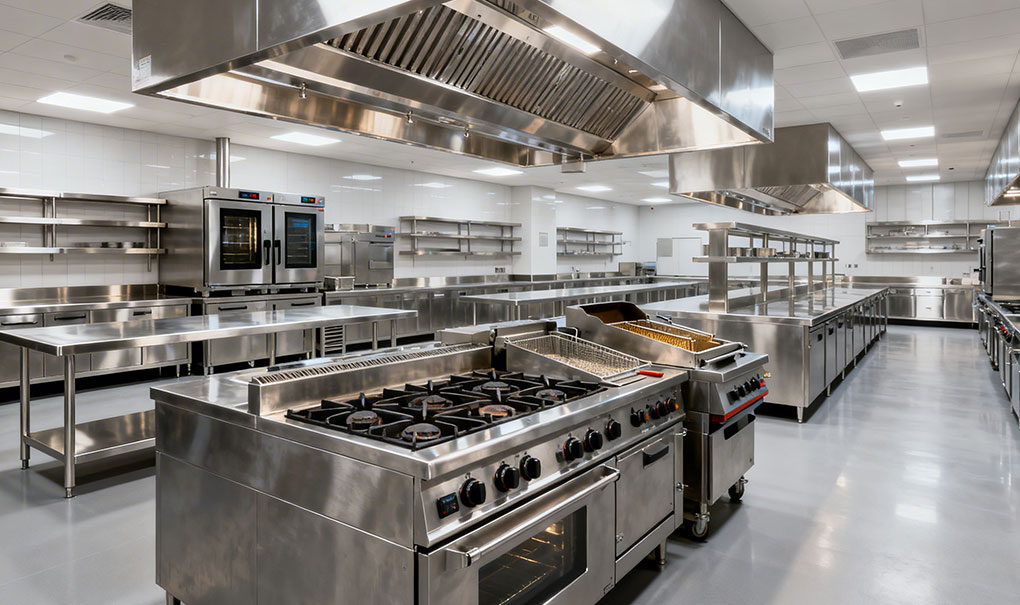
Hotel Kitchen Guide: Essential Equipment for Australian Hotels
- Breakfast service is the priority: Hotel kitchens live and die by breakfast — the equipment that supports hot holding, bulk refrigeration and high-throughput dishwashing is where specification matters most.
- Hot holding compliance: Hot food must be held at 60°C or above under Standard 3.2.2. Bain maries, hot food displays and pie warmers are the primary equipment for this.
- Refrigeration scale: Hotel kitchens require bulk cold storage — upright fridges for service items, chest or upright freezers for frozen stock, and underbench fridges for mise en place at the cooking line.
- Dishwashing throughput: Hotels need a dishwasher specified to cover count. A 200-cover breakfast service requires a pass-through or conveyor machine — an underbench model will not keep up.
- Combi oven: The single most versatile piece of equipment in a hotel kitchen — roasting, steaming, baking and reheating in one unit, with consistent results across large batch quantities.
A hotel kitchen operates differently from a restaurant kitchen. The pressure point is not dinner service — it is breakfast. A 150-room hotel serving a full buffet breakfast must deliver hundreds of covers in a two-hour window, hold food safely across a continuous service period, and then turn the kitchen around for the next service. The equipment specification that supports this is specific. This guide covers every category, with product links to Snowmaster’s full commercial range.
Cooking Equipment
Combi Oven
The combi oven is the most important piece of cooking equipment in a hotel kitchen. It combines convection heat and steam in a single unit, allowing the same equipment to roast proteins, steam vegetables, bake pastries, reheat batch-cooked food and hold at temperature. For a hotel kitchen that must produce a wide menu across a single breakfast service, a combi oven replaces multiple single-purpose appliances and delivers consistent results regardless of batch size.
For high-volume hotel kitchens, specify a combi oven with an automatic cleaning program and a 10-tray or 20-tray capacity. Hotels with a dedicated pastry program should consider a second smaller unit for baking.
Commercial Stove and Cooktop
A commercial stove or commercial cooktop is required for egg stations, sauce work and à la minute cooking during breakfast service. Specify a minimum 6-burner model for hotel kitchens serving 100+ covers. For hotels with a live cooking station (omelette bar, egg Benedict station), add a separate commercial hot plate or char grill at the service station.
Commercial Deep Fryer
Hotels serving cooked breakfast require a commercial deep fryer for hash browns, fried eggs and any fried breakfast items. A twin-tank freestanding model allows simultaneous frying of different items at different temperatures. Specify a gas model for high-volume operations — gas recovers temperature faster between batches than electric.
Hot Holding and Display Equipment
Hot holding is where most hotel breakfast compliance failures occur. Under Standard 3.2.2 of the Australia New Zealand Food Standards Code, hot food must be held at 60°C or above during service. All hot holding equipment must be capable of maintaining this temperature across the full duration of a buffet service — not just at the start.
Bain Marie
The standard for wet-heat hot holding of soups, sauces, scrambled eggs, baked beans and wet breakfast items. A commercial bain marie holds food in water-heated pans, maintaining even temperature without drying out the food. Specify a countertop model for smaller operations; a floor-standing 4–6 pan unit for buffet services of 100+ covers.
Hot Food Display
Heated display cabinets are used for grilled items, sausages, bacon, hash browns and any plated hot items that need to be visible to guests during service. Snowmaster stocks hot food displays from Roband, Anvil and FED — countertop models from 678mm wide to full 1200mm display units with curved or straight glass fronts.
Pie Warmer
Pie warmers and chip warmers maintain the temperature of pastries, baked items and other hot snacks without a bain marie. Useful for hotel grab-and-go breakfast stations where guests self-serve pastries and savoury items.
Hot Water Urn
A commercial hot water urn is essential for tea service at scale. Specify an urn with a minimum 20L capacity for buffet breakfast operations — a 10L unit will require constant refilling during a busy service window.
Refrigeration
Hotel kitchens require refrigeration at multiple scales — bulk cold storage for ingredient stock, line refrigeration for service prep, and display refrigeration for buffet cold items.
| Equipment | Purpose | Specification Guide |
|---|---|---|
| Upright Fridge | Bulk cold storage for ingredients and prepped items | Minimum 2 × solid-door upright fridges for a 100+ cover breakfast service; glass-door for service items accessed frequently |
| Underbench Fridge | Line refrigeration — keeps prepped ingredients cold at the cooking station | 1–2 units under the main cooking line; specify models with drawers for protein storage |
| Chest Freezer | Bulk frozen storage for breakfast proteins, pastries and ice cream | 600L+ for hotels with 100+ rooms; dual units for large properties |
| Upright Freezer | Accessible frozen storage for daily use items | Supplement chest freezers where daily access is required without digging |
| Cake Display Fridge | Cold display for pastries, fruit platters and cold buffet items | Curved-glass models suit buffet presentation; ensure temperature is maintained at 5°C or below under load |
| Blast Chiller | Rapid cooling of batch-cooked food before cold storage | Required for kitchens batch-cooking ahead of service — mandatory for Standard 3.2.2 cooling time compliance |
Warewashing
Dishwashing throughput is one of the most commonly underspecified areas in hotel kitchen fit-outs. A breakfast service of 200 covers will generate 600–800 items of crockery, glassware and cutlery within a two-hour window. An underbench dishwasher rated for 40 racks per hour will not keep up — the result is service running out of crockery mid-breakfast.
| Cover Count | Recommended Dishwasher Type |
|---|---|
| Up to 100 covers | Pass-through dishwasher — higher throughput than underbench, more manageable footprint than conveyor |
| 100–300 covers | Pass-through or entry-level conveyor dishwasher |
| 300+ covers | Conveyor dishwasher — continuous throughput, typically 150–300 racks per hour |
Browse Snowmaster’s full commercial dishwasher range — underbench, pass-through and conveyor models from Washtech, Eswood and Classeq, or read our commercial dishwasher buying guide for full specification guidance.
Food Preparation Equipment
Hotel kitchens preparing high-volume breakfasts require food preparation equipment scaled to batch quantity. Key items include:
- Commercial mixer — planetary mixer for pastry and baking production; spiral mixer for bread-based hotels
- Commercial food processor — for bulk vegetable preparation, fruit platter prep and sauce production
- Commercial meat slicer — for hotels offering cold cuts at breakfast or in-room dining
- Commercial blender — for smoothies, juices and protein shakes at health-focused hotel breakfast services
Benches and Storage
All bench and storage surfaces in a hotel kitchen must meet Standard 3.2.3 requirements — smooth, impervious, easy to clean and free from cracks or crevices that harbour bacteria. Stainless steel is the required material for all food-contact surfaces.
Specify stainless steel benches with splashbacks for all wall-adjacent prep stations, and open undershelf designs where possible for easy cleaning access. Mobile benches on castors allow flexible layout reconfiguration during service and thorough cleaning of the floor beneath.
Common Hotel Kitchen Specification Mistakes
Avoid These
- Underspecifying dishwasher throughput — size to breakfast cover count, not restaurant dinner service; breakfast generates more crockery turnover per hour than most dinner services
- Hot holding equipment that cannot reach 60°C under load — a bain marie that holds temperature when empty but drifts below 60°C when full during a busy breakfast service is a compliance failure waiting to happen
- No blast chiller — hotels batch-cooking ahead of service without a blast chiller are not meeting Standard 3.2.2 cooling time requirements
- Insufficient refrigeration capacity — hotel kitchens receiving large weekly deliveries need bulk cold storage capacity; underspecifying forces daily deliveries or unsafe ambient storage of overflow
- Single combi oven for a large property — a single 10-tray combi oven is a single point of failure for breakfast service; large hotels should specify at least two units
Frequently Asked Questions
What is the most important piece of equipment in a hotel kitchen?
For most hotel kitchens, the combi oven — it handles the widest range of cooking tasks in the smallest footprint, delivers consistent results across large batch quantities, and reduces the number of single-purpose appliances required. For kitchens without a combi oven, a commercial stove or cooktop paired with a convection oven is the minimum cooking line requirement.
What dishwasher do I need for a hotel breakfast service?
Match the dishwasher to your cover count. A breakfast service of up to 100 covers suits a pass-through dishwasher. 100–300 covers typically requires a pass-through or entry-level conveyor machine. Above 300 covers, specify a conveyor dishwasher with a throughput of at least 150 racks per hour. Underbench dishwashers are not appropriate as the primary dishwasher for hotel breakfast services.
How do I keep buffet breakfast food at a safe temperature?
All hot food must be held at 60°C or above under Standard 3.2.2. Use commercial bain maries for wet items (eggs, beans, sauces) and hot food display cabinets for grilled and fried items. Log temperatures at the start of service, mid-service and at close. Do not allow food to remain on display if the holding unit drops below 60°C — remove it and replace with a fresh batch.
Do I need a blast chiller in a hotel kitchen?
Yes, if you batch-cook ahead of service. Standard 3.2.2 requires hot food to be cooled from 60°C to 21°C within 2 hours, then to 5°C within a further 4 hours. A blast chiller is the reliable way to achieve this in a high-volume kitchen. Relying on a standard coolroom for rapid cooling of large batch quantities risks holding food in the temperature danger zone for too long.
Snowmaster has supplied commercial kitchen equipment to Australian hotels, restaurants, cafés and institutions since 1945. Our team can help you specify the right equipment for your hotel kitchen — from individual units to full fit-out packages.
Browse: Cooking Equipment · Fridges · Dishwashers · Hot Food Displays · Blast Chillers