

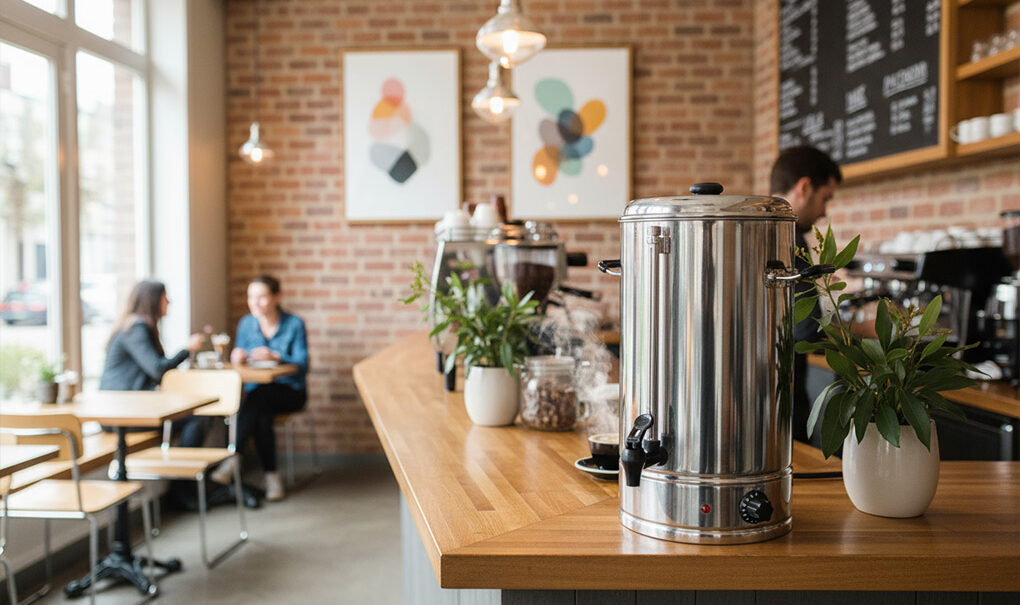
Hot Water Urn Buying Guide 2026: How to Choose the Right Urn for Your Catering Business
- Double-skinned is non-negotiable: Insulated models use up to 60% less energy than single-skinned units and are essential for staff safety in high-traffic areas.
- Size for peak demand: Calculate your busiest 60-minute window — not your average daily use.
- System type: Manual fill for portability and events; auto-fill (plumbed) for permanent high-volume sites.
- Compliance: Always confirm RCM certification. Auto-fill units require licensed plumbing installation to AS/NZS 3500.
- TCO, not sticker price: Energy consumption is the largest long-term cost — a premium insulated unit typically pays for itself within 12–24 months.
The commercial hot water urn is the silent engine of any high-volume hospitality, corporate or institutional kitchen — ensuring fast, consistent hot water for tea, coffee, soups and more without the inefficiency of repeated kettle cycles. It is an indispensable piece of commercial beverage equipment.
Choosing the right model is a decision that directly affects service speed, energy costs, staff safety and long-term reliability. This guide covers everything you need — technical specifications, capacity sizing, compliance requirements, brand comparisons and a pre-purchase checklist — to make a confident investment in 2026.
Featured Models
Ready to compare? The table below covers the core Snowmaster range of commercial hot water urns, from entry-level FED models to premium double-skinned Robatherm units.
| Brand | Model | Capacity | Key Feature |
|---|---|---|---|
| FED | FED WB10 | 10 L | Standard capacity, concealed element |
| FED | FED WB20 | 20 L | Medium capacity, concealed element |
| FED | FED WB30 | 30 L | Large capacity, concealed element |
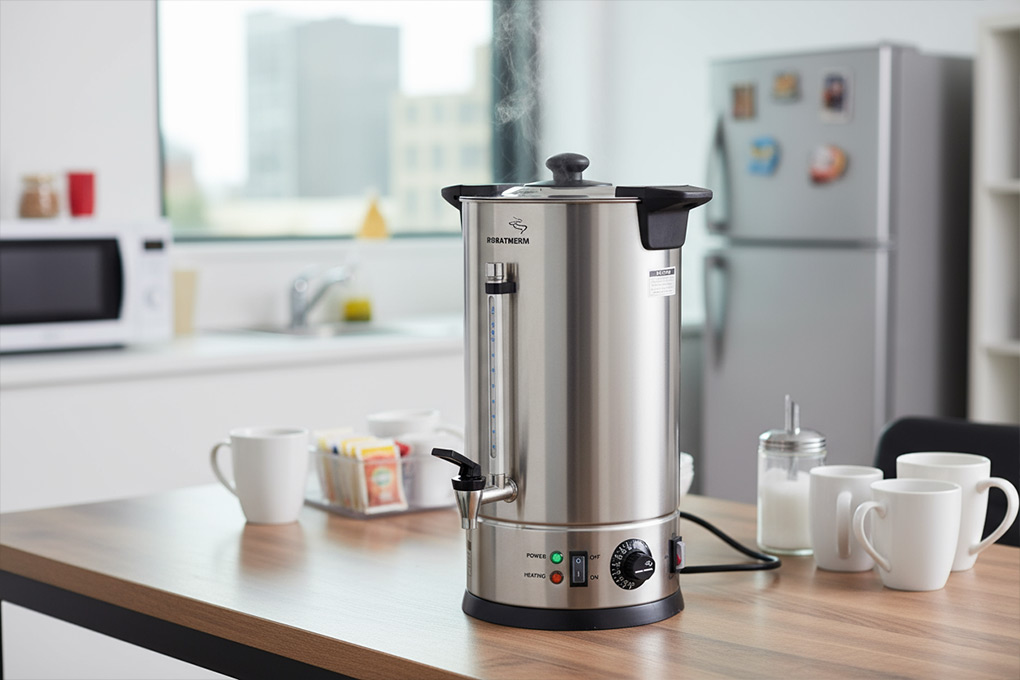
| Robatherm | Robatherm UDS10VP | 10 L | Double-skinned, pre-set 95°C control |
| Robatherm | Robatherm UDS20VP | 20 L | Double-skinned, pre-set 95°C control |
| Robatherm | Robatherm UDS30VP | 30 L | Double-skinned, pre-set 95°C control |
What Is a Commercial Hot Water Urn?
A commercial hot water urn is a heavy-duty, thermally efficient appliance designed for the continuous, high-volume production and storage of hot water. Its core distinction from a kettle is that it maintains a constant temperature rather than heating a small batch from cold and cooling down between uses.
For a commercial kitchen, this translates into three operational advantages:
- Consistency: Water held at a precise temperature (typically 92–96°C) delivers better beverage quality than water that has been sitting or re-boiled
- Speed: Eliminates staff downtime waiting through repeated kettle cycles during peak service
- Longevity: Commercial units are built with concealed elements and double-skinned stainless steel to withstand daily non-stop operation for five to ten years or more
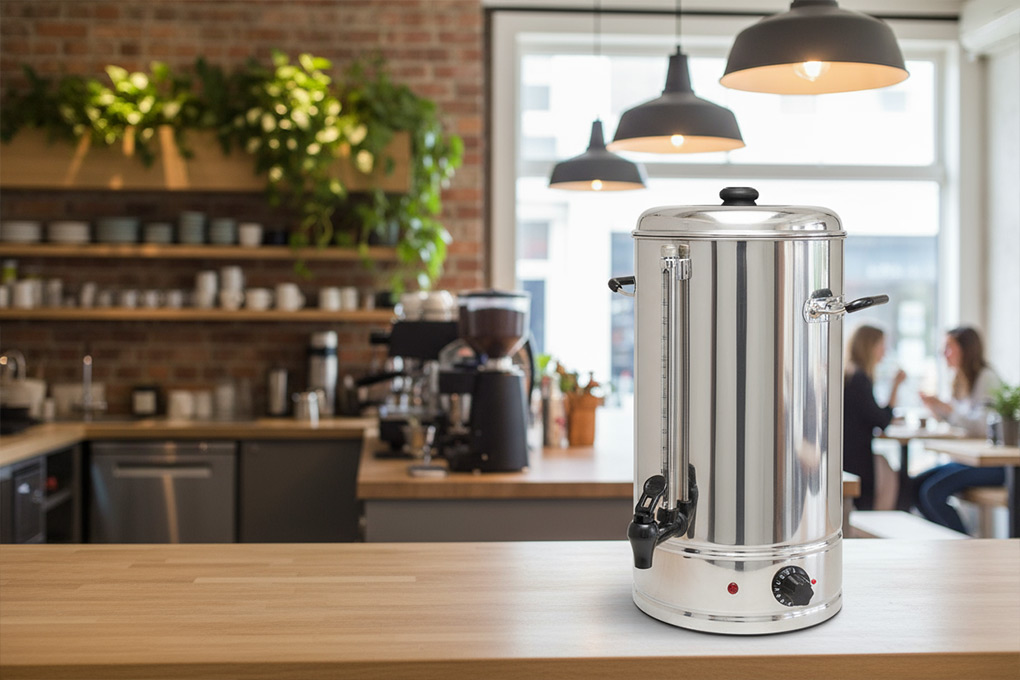
Manual Fill vs Auto-Fill: Choosing Your System
The first decision is your core system type. This determines installation complexity, mobility and long-term operational fit.
Manual Fill — Portable
- Filled via tap or jug; no plumbing required
- Portable — ideal for events, catering, temporary setups
- Low setup cost; no licensed plumber needed
- Requires staff to monitor and refill regularly
- Risk of service interruption if run dry
- Best for: Event hire, pop-up cafés, small office staff rooms
Auto-Fill — Plumbed In
- Connected to mains water; automatically regulates level
- Unlimited supply — never runs dry during service
- Often includes smart timers and eco-modes
- Higher upfront cost; requires licensed plumber
- Fixed location once installed
- Best for: Large cafés, hotel breakfast areas, staff canteens
Sizing for Peak Demand
The most common sizing mistake is buying for average daily use rather than peak demand. Size your urn for your busiest 60-minute window — if your unit can’t keep up during that period, it will fail you when it matters most.
| Business Type | Peak Demand Scenario | Recommended Capacity | Approx. Cups |
|---|---|---|---|
| Small Office / Function | Morning rush, 10–20 people | 5–10 litres | 20–40 |
| Medium Café / School Canteen | Lunch rush / light catering event | 10–20 litres | 40–80 |
| Large Hotel / Corporate Catering | Busy breakfast service, 100+ guests | 20–40 litres | 80–160 |
| Industrial / High-Volume | Continuous flow for multiple catering lines | 40 litres+ | 160+ |
Key Technical Features
Double-Skinned Insulation
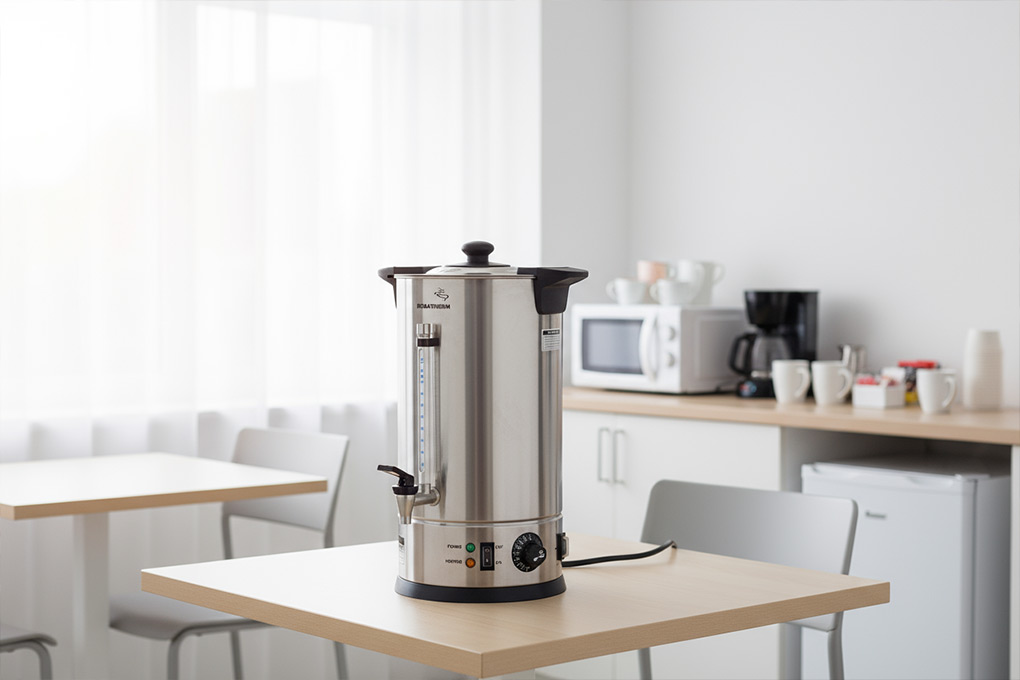
The insulating air gap between the inner and outer walls dramatically reduces standby energy draw — the largest component of long-term running cost. Double-skinned models use up to 60% less energy than single-skinned equivalents and keep the external surface cool to the touch (<50°C).
Concealed Heating Element
Positions the element under the tank base rather than in direct water contact. This dramatically reduces limescale accumulation on the element itself — the primary cause of element failure. Easier to descale, longer lasting, more efficient.
Variable Temperature Control
Allows precise temperature setting — 95°C for coffee and instant drinks, 80°C for delicate green teas. Pre-set models lock to an optimal serving temperature to prevent over-boiling, which can affect taste.
Hands-Free Taps
Push-button or sensor-activated taps reduce contact points in high-traffic environments — an increasingly expected standard in post-COVID hospitality settings. Paired with drip-free heavy-duty brass or stainless steel tap bodies.
Energy Costs and True Efficiency
Energy efficiency is the single largest factor in your Total Cost of Ownership. In Australia’s high-cost energy market, a cheap single-skinned urn can become the most expensive piece of equipment in your kitchen over a five-year period.
| Cost Component | Description | Impact on TCO |
|---|---|---|
| Purchase Price | Initial outlay for the unit | Low — approx. 15–25% of TCO over 5 years |
| Energy Consumption | Standby power draw while maintaining temperature | Highest — the dominant long-term cost |
| Maintenance and Descaling | Cleaning chemicals, labour, component replacement | Medium — variable based on water hardness |
| Downtime and Repair | Lost service and call-out fees during breakdown | Very High — unpredictable but operationally serious |
Australian Safety and Compliance
- Boil-dry protection: Automatic cut-out if the element runs without water — essential for safety and element longevity
- Cool-touch exterior: Double-skinned units must keep the external casing below 50°C under Australian standards
- Auto-fill plumbing (AS/NZS 3500): Plumbed units must be installed by a licensed plumber in compliance with the national plumbing standard
- Backflow prevention: Required by most local water authorities for any appliance connected to the mains water supply
Common Mistakes to Avoid
Watch Out For
- Choosing a single-skinned unit — cheaper to buy but expensive to run, a burn risk in busy environments, and simply outdated for permanent commercial use
- Ignoring water hardness — in hard water areas (common in SA, WA and regional Victoria), a concealed element and strict descaling regimen are essential to prevent premature failure
- Underestimating tap quality — a cheap plastic tap will leak or break quickly under commercial use; always specify heavy-duty brass or stainless steel, ideally drip-free
- Skipping local warranty support — ensure the supplier has Australian repair agents and a fast turnaround; downtime during service is a direct revenue loss
Maintenance and Descaling
An urn’s lifespan directly reflects its maintenance schedule. Limescale — calcium and magnesium carbonate deposited from hard water — is the primary threat, coating the element and tank walls, reducing heating efficiency and eventually causing element failure.
- Soft water areas: Descale monthly using a commercial-grade citric acid or food-approved descaler
- Hard water areas: Descale bi-weekly or weekly — never use harsh scourers or bleach
- Auto-fill units: Installing a commercial water filter (carbon block or hardness reduction) significantly reduces scale and protects internal components
- Daily: Rinse the unit with clean water at the end of service; wipe down the exterior, lid and drip tray with a food-safe cloth
Popular Australian Brands
| Brand | Reputation | Key Feature | Best For |
|---|---|---|---|
| Birko | Australian industry standard; wide capacity range | Cool-touch twist-lock lids; range spans portable urns to instant wall boilers | All-round commercial — offices to major catering |
| Robatherm | Precision engineering, energy-efficient design | Variable/pre-set temperature mode; double-skinned as standard | Premium cafés, hotels and high-spec kitchens |
| Apuro | Strong quality-to-price ratio | Up to 60% energy saving on double-skinned manual fill models | Small to medium operations, event hire, budget-conscious buyers |
| Buffalo | Large-capacity, high-wattage reliability | No-frills high-volume units, commonly 40L+ | Industrial kitchens, large canteens, institutional settings |
Pre-Purchase Checklist
Before You Buy
- Capacity confirmed — sized for your busiest 60-minute window, not average daily use
- System type selected — auto-fill with plumbing quote obtained, or manual fill for portability
- Double-skinned insulation — non-negotiable for permanent commercial use
- Cool-touch exterior — external casing below 50°C under load
- RCM certified — confirmed before purchase
- Concealed element — protects against limescale and extends lifespan
- Heavy-duty tap — brass or stainless steel, drip-free, ideally hands-free
- Local warranty support — minimum 12 months commercial warranty with Australian service agents
Frequently Asked Questions
How does a concealed element help with efficiency and longevity?
It prevents direct contact between the heating coil and the water, which is where limescale deposits most rapidly. A clean element heats faster, uses less power, and is far less likely to burn out — dramatically extending the unit’s working lifespan.
Is filtered water required for a commercial urn?
Not mandatory, but strongly recommended — especially for auto-fill units. Filtration improves water taste and significantly reduces mineral content, which is the primary cause of limescale buildup and subsequent element failure. In hard water areas, a filter is a worthwhile investment that protects the machine.
Should I choose a wall-mounted or countertop unit for a permanent café?
For a permanent café or restaurant, a wall-mounted auto-fill instant boiler is generally the better choice. It frees up bench space, provides continuous supply, is more hygienic (plumbed and sealed), and typically offers superior filtration options. The higher installation cost is recovered quickly in labour savings and service continuity.
What temperature should a commercial urn be set to?
Most commercial operators set urns between 92°C and 96°C. This maximises brewing temperature for instant drinks while avoiding the metallic taste that can result from continuous hard-boiling. For delicate teas, a lower setting of 75–80°C is recommended.
How often should a commercial urn be descaled?
Monthly in soft water areas; bi-weekly or weekly in hard water areas. Use a commercial-grade citric acid solution or food-approved descaler — never bleach or abrasive scourers. For auto-fill units, a water softening filter will reduce descaling frequency significantly.
Snowmaster supplies commercial hot water urns to Australian hospitality, corporate and institutional businesses. Our team can help you select the right capacity, system type and brand for your operation.
Browse Commercial Hot Water Urns →
Also browse: Beverage Equipment · Commercial Milkshake Makers · Food Preparation Equipment · Contact Us