

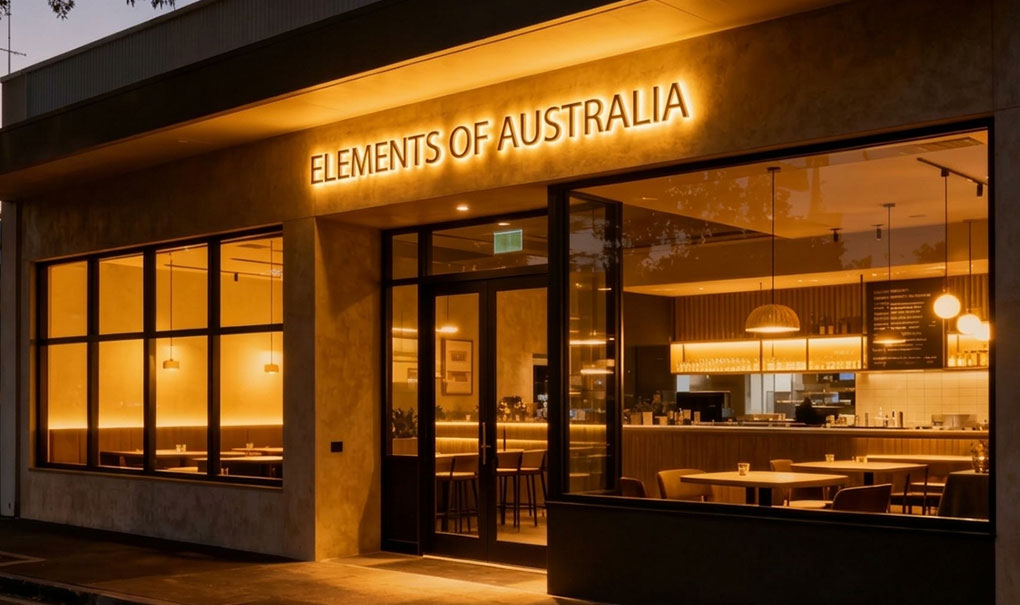
8 Tips for Choosing the Best Name for Your Restaurant
Your restaurant’s name is the first thing a potential customer encounters — before they see your menu, your fit-out or your food. It appears on Google, on delivery platforms, on signage and in word-of-mouth recommendations. A good name is memorable, easy to search and gives people a sense of what to expect. A bad one creates friction from day one. Here are eight practical tips for getting it right.
Keep It Short
Short names are easier to remember, easier to search and easier to say out loud when recommending to a friend. Look at Australia’s most acclaimed restaurants — Quay, Attica, Marque, Est. One word. Instantly memorable.
Long, descriptive names are a risk. They are hard to recall, hard to fit on signage and hard to work with on social media. If you cannot say your restaurant’s name comfortably in a sentence — “Let’s go to…” — it is probably too long.
Be Self-Explanatory
The best restaurant names tell you something about the food before you walk through the door. A name that signals cuisine type, cooking style or concept removes ambiguity and helps the right customers find you.
This can be direct — The Grill, Sushi Room — or more subtle. Names of cities or regions associated with a cuisine work well: Mumbai for Indian, Firenze for Italian, Saigon for Vietnamese. You do not have to spell out every detail, but give customers a clear signal about what they are walking into.
Use Humour if It Fits Your Concept
Playful names work well for casual dining concepts — and Australian diners respond well to wit. Wok This Way, The Middle Feast, Fleetwood Macchiato. Names like these are memorable, shareable on social media and generate goodwill before the customer arrives.
The rule is that the name must match the concept. A clever, punny name sets an expectation of casual, relaxed dining. If your food and service do not match that tone, the name creates the wrong impression. Only use humour if it genuinely reflects how your restaurant operates.
Use a Name
Named restaurants — whether using the owner’s name or a character — create an immediate sense of personal accountability. They suggest there is someone behind the food who stands for its quality. Michel’s, Bill’s, Rockpool. Customers develop a relationship with a person faster than with an abstract brand.
You do not have to use your own name. Create a character that fits your concept. The name just needs to feel like there is a person behind it — someone whose reputation is attached to what comes out of the kitchen.
Invent a Word
A made-up word has one significant advantage: no competition. Searching for an original restaurant name is increasingly difficult — there are thousands of restaurants across Australia, and common names are taken across every capital city.
An invented name is unique by definition, which helps significantly with Google search, social media handles and domain availability. Before committing, search the word across Google, Instagram and ASIC’s business name register to confirm it is genuinely available and not already associated with something else.
Use Your Address
If your location has a strong identity — a well-known street, a landmark building, a distinctive suburb — consider naming your restaurant after it. An address-based name gives customers an immediate location anchor and doubles as a memory prompt.
It works best when the address itself has character. King Street Kitchen, The Strand, 22 Bridge Road. Simple, location-specific and easy to remember. It also helps with local SEO — a restaurant named after its street is more likely to appear in suburb-based searches.
Make It Searchable
Before finalising any name, test how easy it is to find online. Type it into Google. Search for it on Instagram. Check if the domain is available. Confirm the name is not already registered through ASIC’s business name search.
Avoid names with unusual spellings, silent letters or characters that people are likely to misspell. If customers cannot find you because they cannot spell your name, you are losing business before they even walk through the door. Simplicity in spelling is not a creative compromise — it is a practical advantage.
Build a Concept Around It
Your restaurant’s name is the anchor point for everything else — menus, fonts, logo, uniforms, signage, social media presence and the physical fit-out. A strong name that does not connect to a coherent visual and experiential identity loses most of its value.
Once you have a name, build the concept outward from it consistently. Every touchpoint a customer encounters — from the Instagram profile to the menu card to the kitchen pass — should feel like it belongs to the same place. Consistency of identity is what turns a name into a brand.
Snowmaster has supplied commercial kitchen equipment to Australian restaurants, cafés and hospitality businesses since 1945. When you are ready to fit out your kitchen, our team can help you get the specification right from the start.
Browse: Cooking Equipment · Fridges · Dishwashers · Food Prep · Benches